Home
Class 12
PHYSICS
An equiconvex lens has its two surfaces ...

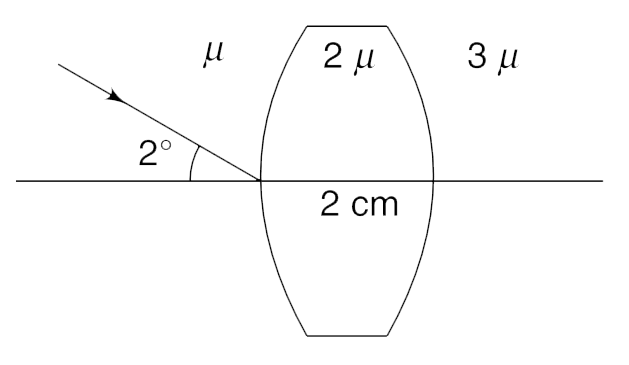
An equiconvex lens has its two surfaces of radius of curvature `R = 10 cm`. Thickness of the lens at its centre is 2 cm. A light ray is incident making an angle of `2°` with the optic axis of the lens. Find the angle that the emergent ray will make with the optic axis. The refractive index of all media is as marked in the Figure.

Text Solution

Verified by Experts

The correct Answer is:

`((8)/(15))^(@)`
Promotional Banner

Topper's Solved these Questions

  • GEOMETRICAL OPTICS

    ARIHANT|Exercise Level 3|9 Videos
  • GEOMETRICAL OPTICS

    ARIHANT|Exercise Level 3|9 Videos
  • ELECTROSTATICS

    ARIHANT|Exercise Level 3|59 Videos
  • MAGNETIC EFFECT OF CURRENT

    ARIHANT|Exercise Magnetic effect of Current|45 Videos

Similar Questions

Explore conceptually related problems

A ray of light is incident at 60^(@) on one face of a prism of angle 30^(@) and the emergent ray makes 30^(@) with the incident ray. The refractive index of the prism is

A ray of light is incident at 65^(@) on one face of a prism of angle of 30^(@) and the emergent ray makes 35^(@) with the incident ray. The refractive index of the prism is:

A light ray hits the pole of a thin biconvex lens as shown in fig. The angle made by the emergent ray with the optic axis will be approximately

The radius of curvature of convex surface of piano convex lens is 10 cm and its focal length is 30 cm, then the refractive index of the material of the lens is

An equiconvex lens of refractive index 1.5 has its two surfaces having radius of curvature of 30 cm. A point object has been placed on the principal axis at a distance of 60 cm from the lens. Find the distance of image from the lens formed by the rays which suffer refraction at first surface, reflection at second surface, again a reflection on the first surface and finally a refraction from the second surface.

Light ray is incident on a prism of angle A=60^(@) are refractive index mu=sqrt(2) . The angle of incidence which the emergent rays grazes the surface is given

Light ray is incident on a prism of angle A=60^(@) and refractive index mu=sqrt(2) .the angle of incidence at which the emergent ray grazes the surface is given by

ARIHANT-GEOMETRICAL OPTICS-Level 2
  1. A beam of light rays converges to a point O on x-axis as shown. The an...

    Text Solution

    |

  2. A spherical surface of radius R separates air from a medium of refract...

    Text Solution

    |

  3. A point object O is placed at a distance of 41 cm from a convex lens o...

    Text Solution

    |

  4. A man is Standing on the peak of a mountain and finds that evening sun...

    Text Solution

    |

  5. A light ray 1 after passing through a lens kept in air, goes along pat...

    Text Solution

    |

  6. An observer holds in front of himself a thin equi convex lens. R is th...

    Text Solution

    |

  7. An observer is standing at a point O, at a distance of 100 cm from a c...

    Text Solution

    |

  8. A small object (A) is placed on the principal axis of an equiconvex le...

    Text Solution

    |

  9. A virtual image is formed by a lens for a real object. Take |(v)/(f...

    Text Solution

    |

  10. An equiconvex lens of refractive index 1.5 has its two surfaces having...

    Text Solution

    |

  11. A thin plano convex lens A has material of refractive index mu(A) = 1....

    Text Solution

    |

  12. The refractive index of light in glass varies with its wavelength acco...

    Text Solution

    |

  13. An image B is formed of a real point object A by a lens whose optic ax...

    Text Solution

    |

  14. A horizontal parallel beam of light passes through a vertical convex l...

    Text Solution

    |

  15. A plane convex lens has aperture diameter of 8 mm and thickness of the...

    Text Solution

    |

  16. A convex lens of focal length 20 cm and another planocovex lens of foa...

    Text Solution

    |

  17. An equiconvex lens has its two surfaces of radius of curvature R = 10 ...

    Text Solution

    |

  18. Due to manufacturing defect, the plane surface of a thin plano-concave...

    Text Solution

    |

  19. Two lenses L(1) and L(2) are used to make a telescope. The larger lens...

    Text Solution

    |

  20. A convex lens of focal length 15 cm is split into two halves and the t...

    Text Solution

    |
