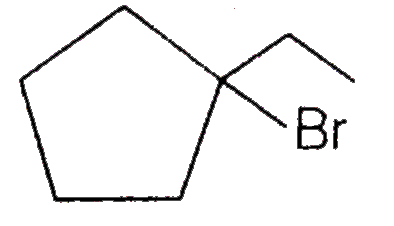
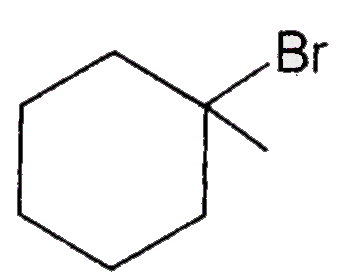
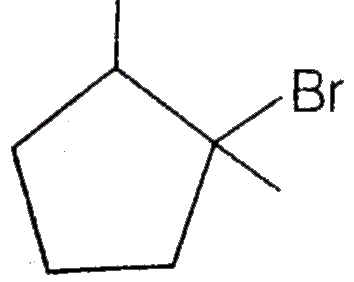
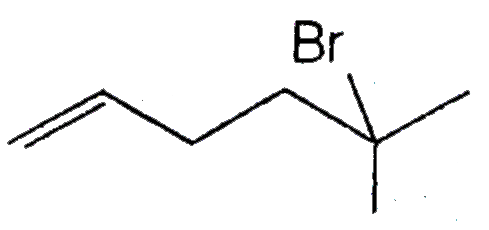
Compound `A(C_(7)H_(13)Br)` is a tertiary bromide. On treatement with sodium ethoxide in ethanol. A is treatement to a hydrocarbon B. Ozonolysis of B followed up by work up with `Zn-H_(2)O` gives 6-oxoheptanal as the only product The most likely structure of A is
A
B
C
D
Text Solution
AI Generated Solution
The correct Answer is:
To solve the problem step by step, we will analyze the information given and deduce the structure of compound A (C7H13Br) based on the reactions described.
### Step 1: Identify the structure of compound A
Given that compound A is a tertiary bromide with the formula C7H13Br, we know that it must have a carbon atom bonded to three other carbon atoms and one bromine atom. The general structure of a tertiary alkyl bromide can be represented as follows:
- A tertiary carbon (C) is bonded to three other carbon groups (R) and one bromine atom (Br).
### Step 2: Reaction with sodium ethoxide
When compound A is treated with sodium ethoxide (C2H5ONa) in ethanol, it undergoes a dehydrohalogenation reaction. This reaction typically results in the formation of an alkene (hydrocarbon B) by eliminating hydrogen bromide (HBr).
### Step 3: Determine the structure of hydrocarbon B
Since ozonolysis of hydrocarbon B leads to the formation of 6-oxoheptanal, we can deduce that hydrocarbon B must be a heptene (C7H14) with a double bond. The ozonolysis of an alkene typically cleaves the double bond and forms carbonyl compounds.
### Step 4: Ozonolysis of B
The ozonolysis of hydrocarbon B followed by workup with Zn-H2O gives 6-oxoheptanal. The structure of 6-oxoheptanal can be represented as:
- A seven-carbon chain (heptanal) with a carbonyl group (C=O) at the sixth position.
### Step 5: Constructing the structure of B
To generate 6-oxoheptanal from ozonolysis, hydrocarbon B must have a double bond between the 5th and 6th carbons. Therefore, the structure of B can be represented as follows:
- A double bond between C5 and C6 in a straight-chain heptene.
### Step 6: Finalizing the structure of A
To determine the structure of compound A, we need to consider how we can form hydrocarbon B (C7H14) from a tertiary bromide (C7H13Br). The most likely structure of A would be a tertiary bromide that can lead to the formation of the required alkene.
The structure of A can be represented as:
- A tertiary bromide with a bromine atom on the carbon that is bonded to three other carbons.
### Conclusion
The most likely structure of compound A (C7H13Br) is 2-bromo-2-methylhexane.
Topper's Solved these Questions
ALDEHYDES AND KETONES
IIT-JEE PREVIOUS YEAR (CHEMISTRY)|Exercise Integer Answere Type Questions|1 Videos
ALCOHOLS AND ETHERS
IIT-JEE PREVIOUS YEAR (CHEMISTRY)|Exercise Test|5 Videos
ALIPHATIC COMPOUNDS CONTAINING NITROGEN
IIT-JEE PREVIOUS YEAR (CHEMISTRY)|Exercise chpter test|1 Videos
Similar Questions
Explore conceptually related problems
An alkyl bromide A has molecular formula C_(8)H_(17)Br and four different structures can be drawn for it, all optically active. A on refluxing with ethanolic KOH solution yields only one elirnination product B(C_(8)H_(16)) which it still enantiomeric. B on treatment with H_(2)//Pt yields C(C_(8)H_(18)) which does not rotate the plane polarized light, B on ozonolysis followed by work-up with H_(2)O_(2) yields D(C_(7)H_(14)O) as one product which it still resolvable. Deduce structures of A to D.
CH_(3) CO_(2) C_(2) H_(5) on reaction with sodium ethoxide in ethanol gives A , which on heating in the presence of acid gives B compound B is
Refer to Question. When the compound (B) on ozonolysis is followed by oxidation with H_(2)O_(2) , the products are :
An organic compound with molecular formula C_6 H_(12) upon ozonolysis gives only acetone as the product. The compound is :
IIT-JEE PREVIOUS YEAR (CHEMISTRY)-ALDEHYDES AND KETONES-Integer Answere Type Questions