

Home
Class 11
PHYSICS
A metal ball of mass 1.0 kg is kept in a...

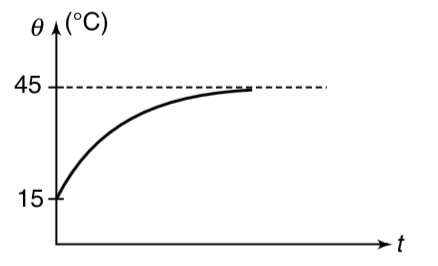
A metal ball of mass 1.0 kg is kept in a room at `15^(@)C`. It is heated using a heater. The heater supplies heat to the ball at a constant rate of 24 W. The temperature of the ball rises as shown in the graph. Assume that the rate of heat loss from the surface of the ball to the surrounding is proportional to the temperature difference between the ball and the surrounding. Calculate the rate of heat loss from the ball when it was at temperature of `20^(@)C`.

Promotional Banner

Similar Questions

Explore conceptually related problems

A metal ball of mass 2kg is heated means of a 40W heater in a room at 25^(@)C . The temperature of the ball beomes steady at 60^(@)C . Assume that the temperature of the ball rises uniformly from 25^(@)C to 39^(@)C "in" 2 minutes. Find the total loss of heat to the surrounding during this period.

A metal ball of mass 2kg is heated means of a 40W heater in a room at 25^(@)C . The temperature of the ball beomes steady at 60^(@)C . Assume that the temperature of the ball rises uniformly from 25^(@)C to 39^(@)C "in" 2 minutes. Find the total loss of heat to the surrounding during this period.

A block is kept in a room which is at 20^(@)C . To raise the temperature of the block, heat is given to it at a constant rate of 600 watt (using an electric heater). The temperature of the block rises with time as shown in the graph. The slope of the graph at time t = 0 is 3^(@)C s^(-1) . Once the temperature rises to 60^(@)C , the heater is switched off and another heater is switched on to maintain the temperature of the block at 60^(@)C . This new heater supplies heat at a constant rate of 100 watt. Assume that heat capacity of the block remains constant for the range of temperature involved. (a) Explain why the slope of the given graph is decreasing with time. (b) Calculate the heat capacity of the block. (c) If the 100 W heater is also switched off, what will be initial rate of cooling of the block? (d) Assuming that rate of heat loss by the block to the surrounding is proportional to difference in its temperature with surrounding, calculate the heat radiated per second by the block when it was at 30^(@)C .

A metal ball of mass 2kg is heated means of a 40W heater in a room at 25^(@)C . The temperature of the ball beomes steady at 60^(@)C . Find the rate of loss of heat to the surrounding when the ball is at 60^(@)C .

A metal ball of mass 2kg is heated means of a 40W heater in a room at 25^(@)C . The temperature of the ball beomes steady at 60^(@)C . Find the rate of loss of heat to the surrounding when the ball is at 60^(@)C .

A metal ball of mass 2kg is heated means of a 40W heater in a room at 25^(@)C . The temperature of the ball becomes steady at 60^(@)C . Find the rate of loss of heat to the surrounding when the ball is at 39^(@)C .

A metal ball of 1kg mass is heated by a 20W heater in a room at 20^(@)C . After some time temperature of ball becomes steady at 50'^(@)C . Find the rate of loss of heat by the ball to surrounding when its temperature becomes 50^(@)C . Also find the rate at which it looses heat to the surrounding when its temperature was 30^(@)C .

A metal cylinder of mass 0.5kg is heated electically by a 12 W heater in a room at 15^(@)C The cylinder temperature rises uniformly to 25^(@)C in 5 min and finally becomes constant at 45^(@)C Asuming that the rate of heat loss is proportional to the excess temperature over the surroundings .

A metal cylinder of mass 0.5 kg is heated electrically by a 12 W heater in a room at 15^(@) C. The cylinder temperature rises uniformly to 25^(@) C in 5 min and finally becomes constant at 45^(@) C Assuming that the rate of heat losss is proportional to the excees temperature over the surroundings,