

Home
Class 12
PHYSICS
To particles P and Q are initially 40 m ...

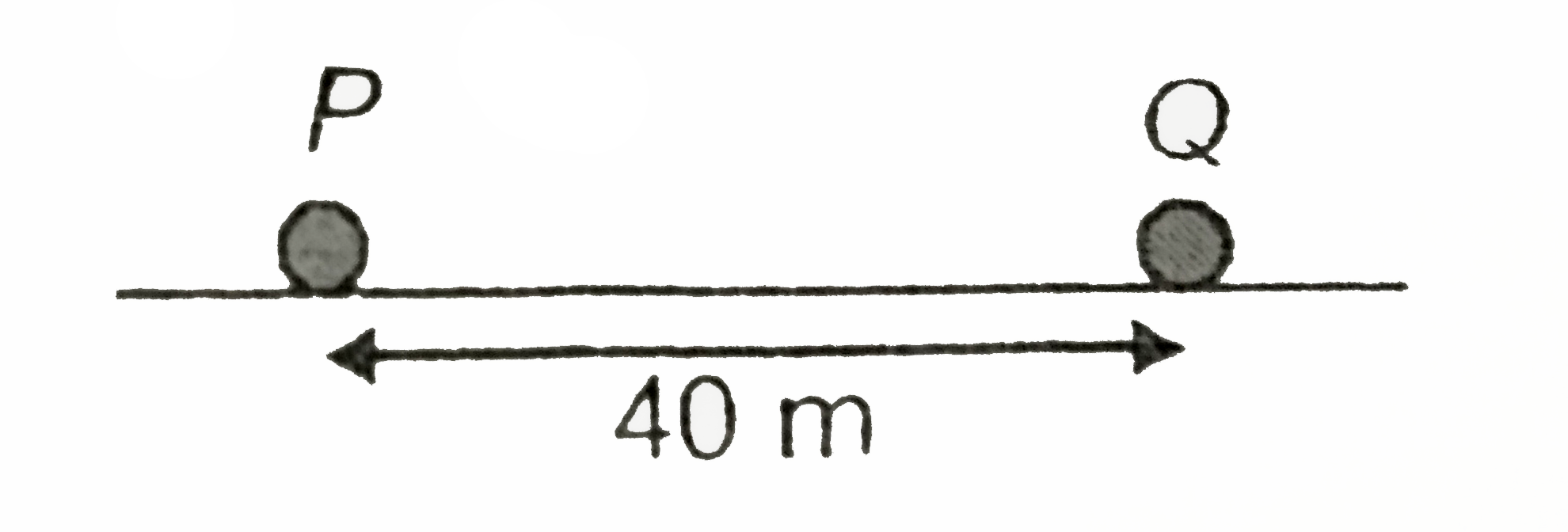
To particles P and Q are initially 40 m apart P behind Q. Particle P starts moving with a uniform velocity 10 m/s towards Q. Particle Q starting from rest has an acceleration `2m//s^(2)` in the direction of velocity of P. Then the minimum distance between P and Q will be

Promotional Banner

Similar Questions

Explore conceptually related problems

Two particles A and B are initially 40 m apart, A is behind B . Particle A is moving with uniform velocity of 10 m s^(-1) towared B . Particle B starts moving away from A with constant acceleration of 2 m s^(-1) . The minimum distance between the two is .

Two particles A and B are initially 40 m apart, A is behind B . Particle A is moving with uniform velocity of 10 m s^(-1) towared B . Particle B starts moving away from A with constant acceleration of 2 m s^(-1) . The time which there is a minimum distance between the two is .

Two particles A and B are initially 40 m apart, A is behind B . Particle A is moving with uniform velocity of 10 m s^(-1) towared B . Particle B starts moving away from A with constant acceleration of 2 m s^(-1) . The time which there is a minimum distance between the two is .

Two particles are moving along x-axis. Particle-1 is 40 m behind Particle-2. Particle-1 starts with velocity 12 m//s and acceleration 4 m//s^2 both in positive x-direction. Particle-2 starts with velocity 4 m//s and acceleration 12 m//s^2 also in positive x-direction. Find (a) the time when distance between them is minimum. (b) the minimum distacne between them.

Two particles are moving along x-axis. Particle-1 is 40 m behind Particle-2. Particle-1 starts with velocity 12 m//s and acceleration 4 m//s^2 both in positive x-direction. Particle-2 starts with velocity 4 m//s and acceleration 12 m//s^2 also in positive x-direction. Find (a) the time when distance between them is minimum. (b) the minimum distacne between them.

Two particles P and Q are initially at rest and 1 m aparts. P has a mass of 1 kg and Q a mass of 3 kg . P and Q attract each other with a constant force. At what distance from P's original position do the particles collide?

Starting from the rest , a body P travels with a uniform acceleration of 4m/s^2 and starting from rest from the same point 4s later , a body Q travels with a uniform acceleration of 16m/s_2 in the same direction as P . Find when and where they meet .

A particle P is moving along a straight line with a velocity of 3ms^(-1) and another particle Q has a velocity of 4ms^(-1) at an angle of 30^(@) to the path of P. Find the speed of Q relative to P.