

Home
Class 11
CHEMISTRY
Vladimir Markovnikov rule: Alkenes und...

Vladimir Markovnikov rule:
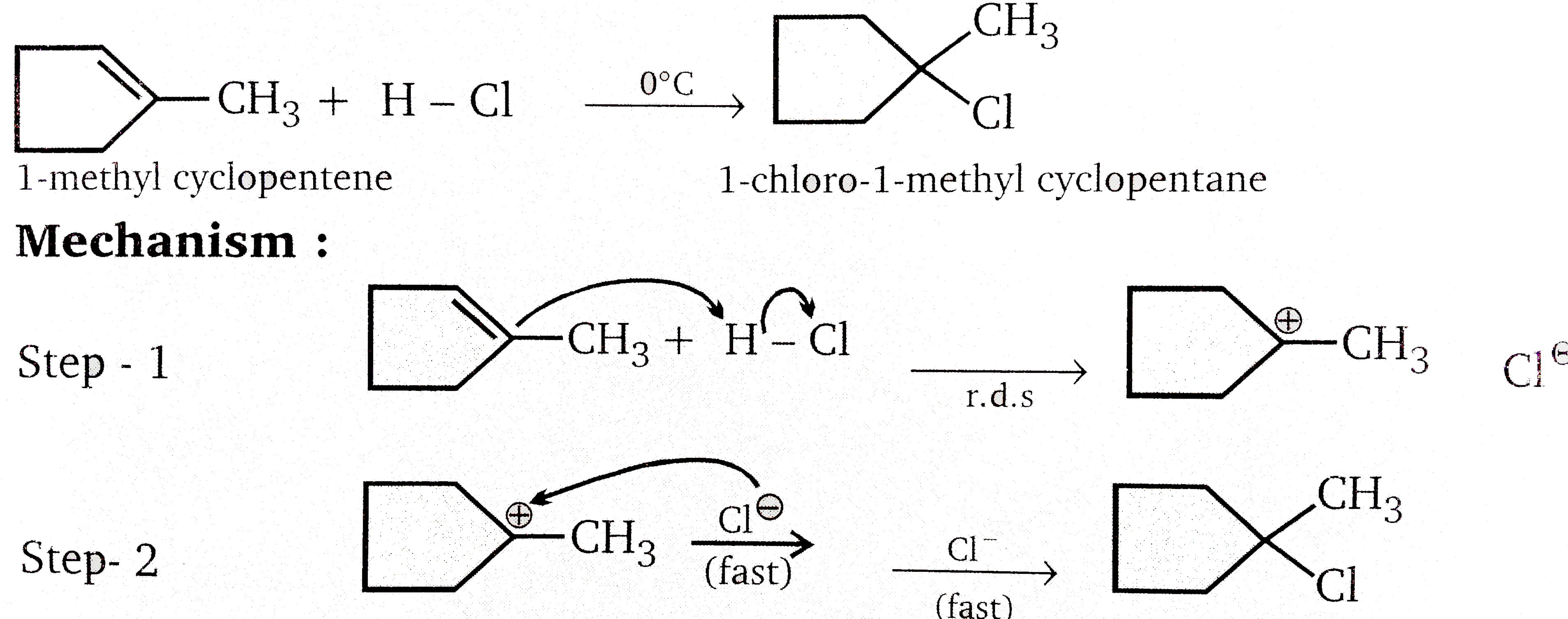
Alkenes undergo electrophilic addition reactions. It is triggered by the acid acting as a electrophile toward `pi`-electrons of the double bond.
Markovnikov's rule states that when an unsymmetrically substituted alkene reacts with a hydrogen halide, the hydrogen atom adds to the carbon that has the greater number of hydrogen, e.g.,

What is the energy profile for the given reaction?

Promotional Banner

Similar Questions

Explore conceptually related problems

Vladimir Markovnikov rule: Alkenes undergo electrophilic addition reactions. It is triggered by the acid acting as a electrophile toward pi -electrons of the double bond. Markovnikov's rule states that when an unsymmetrically substituted alkene reacts with a hydrogen halide, the hydrogen atom adds to the carbon that has the greater number of hydrogen, e.g., Which of the following is most reactive toward Markovnikov addition?

Vladimir Markovnikov rule : Alkenes undergo electrophilic addition reactions. It is triggered by the acid acting as a electrophile toward t-electrons of the double bond. Markovnikov's rule states that when an unsymmetrically substituted alkene reacts with a hydrogen halide, the hydrogen atom adds to the carbon that has the greater number of hydrogen, e.g., Which of the following is most reactive toward Markovnikov addition ?

Vladimir Markovnikov rule: Alkenes undergo electrophilic addition reactions. It is triggered by the acid acting as a electrophile toward pi -electrons of the double bond. Markovnikov's rule states that when an unsymmetrically substituted alkene reacts with a hydrogen halide, the hydrogen atom adds to the carbon that has the greater number of hydrogen, e.g., In which of following reactions, carbocation rearrangement is possible?

Vladimir Markovnikov rule : Alkenes undergo electrophilic addition reactions. It is triggered by the acid acting as a electrophile toward t-electrons of the double bond. Markovnikov's rule states that when an unsymmetrically substituted alkene reacts with a hydrogen halide, the hydrogen atom adds to the carbon that has the greater number of hydrogen, e.g., Identify the major products r_1, r_2, and r_3 in the given reactions.

Vladimir Markovnikov rule : Alkenes undergo electrophilic addition reactions. It is triggered by the acid acting as a electrophile toward t-electrons of the double bond. Markovnikov's rule states that when an unsymmetrically substituted alkene reacts with a hydrogen halide, the hydrogen atom adds to the carbon that has the greater number of hydrogen, e.g., In which of the following reactions, product is racemic mixture ?