Home
Class 12
PHYSICS
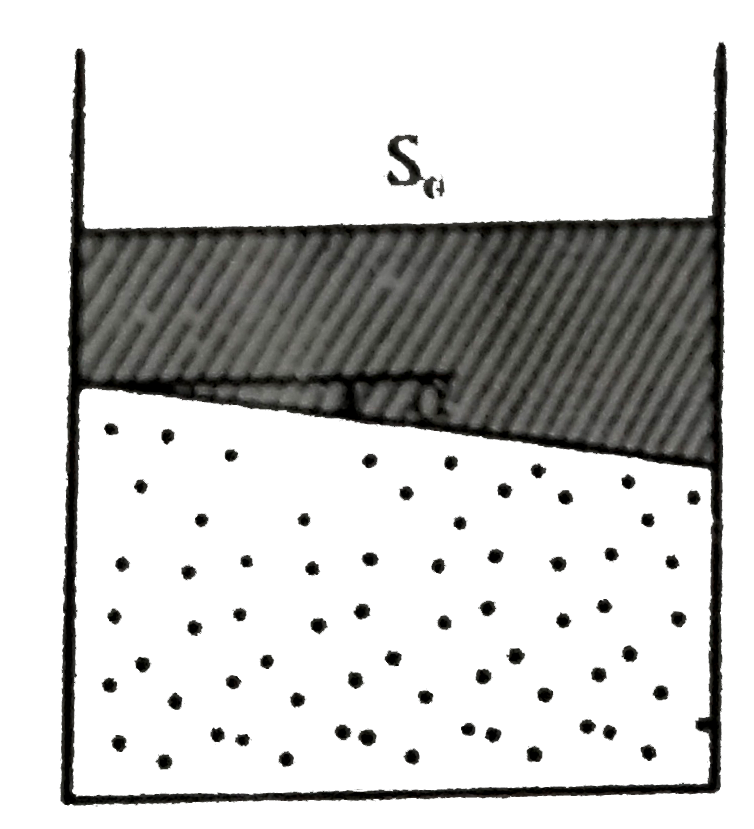
In the cylinder shown in the figure, air...

In the cylinder shown in the figure, air is enclosed under the piston. Piston mass M=60 kg, crosssectional area of the cylinder `S_(0)=20cm^(2)` atmospheric pressure `P_(0)=10^(5) pa alpha=37^(@)`. The air temperature is constant, the friction is negligible.

What is the pressure of the enclosed gas?

A

`3.4xx10^(5)` Pa

B

`4xx10^(5)` Pa

C

`4.75xx10^(5)` Pa

D

`2.8xx10^(5)` Pa

Text Solution

Verified by Experts

The correct Answer is:
B

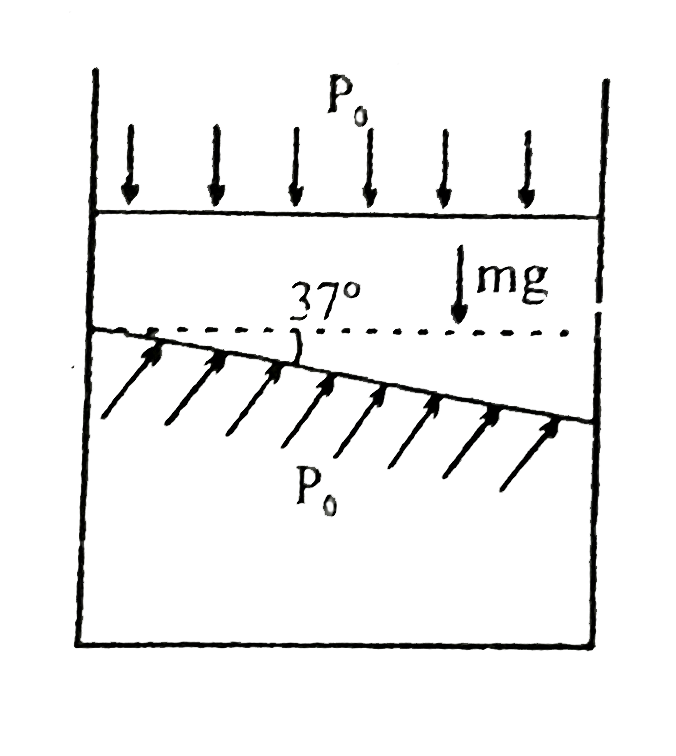
`P_(0)xxS_(0)+mg=PxxS_(0)sec37^(@)xxcos37^(@)`
`Rightarrow P=P_(0)+(mg)/S_(0)`
`Rightarrow 10^(5)+600/(20xx10^(-4))`
`=4xx10^(5)` Pa
Promotional Banner

Topper's Solved these Questions

  • MASTER PRACTICE PROBLEM

    BANSAL|Exercise Reasoning|75 Videos
  • MASTER PRACTICE PROBLEM

    BANSAL|Exercise Multiple objective|131 Videos
  • MASTER PRACTICE PROBLEM

    BANSAL|Exercise Additional topic|70 Videos
  • FLUID MECHANICS

    BANSAL|Exercise PYQS AIEEE|10 Videos
  • SEMICONDUCTORS

    BANSAL|Exercise CBSE Question|32 Videos

Similar Questions

Explore conceptually related problems

In the cylinder shown in the figure, air is enclosed under the piston. Piston mass M=60 kg, crosssectional area of the cylinder S_(0)=20 cm^(2) atmospheric pressure P_(0)=10^(5) pa alpha=37^(@) . The air temperature is constant, the friction is negligible. What is the mass of the goods that must be put on the piston so that the volume of the gas becomes half?

A cylinderical vessel contaning liquid is closed by a smooth piston of mass m. the area of cross-section of the piston is A. if the atmospheric pressure is P_(0), Find the pressure of the liquid just below the piston.

A cylindrical vessel containing a liquid is closed by a smooth piston of mass "100g" as shown in the figure.The radius of the piston is "10cm" .If the atmospheric pressure is P_(0) then the pressure difference of the liquid just below the piston and the atmospheric pressure is (g=10m/s^(2))

A cylidrical vesel containing a liquid is closed by a smooth piston of mass m as shown in the figure. The area of cross section of the piston is A. If the atmospheric pressure is P_0 , find the pressure of the liquid just below the piston. ,

A non - conducting piston of mass m and are S_(0) divides a non - conducting, closed cylinder as shown in the figure. A piston having mass m is connected with the top wall of the cylinder by a spring of force constant k. The top part is evacuated and the bottom part is evacuated and the bottom part contains an ideal gas at a pressure P_(0) in the equilibrium position. Adiabatic exponent gamma and in equilibrium length of each part is l. (neglect friction). Find the angular frequency for small oscillation.

In the arrangement shown in Fig. gas is thermally insulated. An ideal gas is filled in the cylinder having pressure P_(0) (gt atmospheric pressure P_(0) ). The spring of force constant K is initially unstretched. The piston of mass m and area S is frictionless. In equilibrium, the piston rises up by distance x_(0) , then

The fixed non-conducting cylinder shown in figure has a noconducting heavy piston of mass M that can slide without friction. The area of piston is S and the cylinder is filled with an ideal gas (lambda=1.5) with an initial volume V and an initial pressure P . Assume that the outside pressure on the piston is zero (vaccum). (Neglect acceleration due to gravity). For the temperature of the gas to drop to one half of its original value. the piston will have to move by a distance:

A closed and isolated cylinder contains ideal gas. An adiabatic separator of mass m, cross sectional area A divides the cylinder into two equal parts each with volume V_(0) and pressure P_(0) in equilibrium Assume the sepatator to move without friction. If the piston is slightly displaced by x, the net force acting on the piston is

In the arrangement shown in figure, the piston can smoothly move inside the cylinder. The mass of the piston is m = 100 g and its cross sectional area is A = 10 cm^(2) . The length of air column at temperature of T = 27^(@)C is 10 cm. Overall length of the cylinder is 20.4 cm. The container is turned upside down and the length of the air column in equilibrium was found to be l at 27^(@)C . Take R = (25)/(3)J mol^(-1) K^(-1) and assume air to be diatomic gas. g = 10 m//s^(2) , atmospheric pressure is 1.01 xx 10^(5) Nm^(2) (a) Find l (b) If the air in the container is supplied heat in upside down position, the piston slowly begins to move down, and ultimately it gets ejected out of the cylinder. Calculate the amount of heat that the air must absorb for the piston to come out.

BANSAL-MASTER PRACTICE PROBLEM-Comphrehension
  1. Consider a gas at tmperature T occupying a volume V consisting of a mi...

    Text Solution

    |

  2. Consider a gas at temperature T occupying a volume V consisting of a m...

    Text Solution

    |

  3. In the cylinder shown in the figure, air is enclosed under the piston....

    Text Solution

    |

  4. In the cylinder shown in the figure, air is enclosed under the piston....

    Text Solution

    |

  5. Two cylinder A and B having piston conneted by massless rod (as shown ...

    Text Solution

    |

  6. Two cylinder A and B having piston conneted by massless rod (as shown ...

    Text Solution

    |

  7. Two cylinder A and B having piston conneted by massless rod (as shown ...

    Text Solution

    |

  8. Two cylinder A and B having piston conneted by massless rod (as shown ...

    Text Solution

    |

  9. The figure shows P - V diagram of a thermodynamic cycle The work ...

    Text Solution

    |

  10. The figure shows P - V diagram of a thermodynamic cycle If T(A),T...

    Text Solution

    |

  11. The figure shows P - V diagram of a thermodynamic cycle Identify ...

    Text Solution

    |

  12. The figure shows P - V diagram of a thermodynamic cycle Choose th...

    Text Solution

    |

  13. The figure shows P - V diagram of a thermodynamic cycle Choose th...

    Text Solution

    |

  14. There is a cubical cavity inside a conducting sphere of radius R. A po...

    Text Solution

    |

  15. There is a cubical cavity inside a conducting sphere of radius R. A po...

    Text Solution

    |

  16. There is a cubical cavity inside a conducting sphere of radius R. A po...

    Text Solution

    |

  17. Figure shows a schematic view of an electrostatic analyzer. It can sor...

    Text Solution

    |

  18. Figure shows a schematic view of an electrostatic analyzer. It can sor...

    Text Solution

    |

  19. Figure shows a schematic view of an electrostatic analyzer. It can sor...

    Text Solution

    |

  20. There is a uniformly charged ring having radius R. An infinite line ch...

    Text Solution

    |

