Home
Class 12
PHYSICS
There is an insulator rod of length L an...

There is an insulator rod of length L and of negligible mass with two small balls of mass m and electric charge Q attached to its ends. The rod can rotate in the horizontal plane around a vertical axis crossing it at a distance `L//4` from one of its ends.
At first the rod is in unstable equilibrium in a horizontal uniform electric field of field strength E. Then we gently displace it from this position. Determine the maximum velocity attained by the ball that is closer to the axis in the subsequent motion

A

`sqrt((2QEL)/m)`

B

`sqrt((2QEL)/(5m)`

C

`sqrt((QEL)/(5m)`

D

`sqrt((4QEL)/(5m)`

Text Solution

Verified by Experts

The correct Answer is:
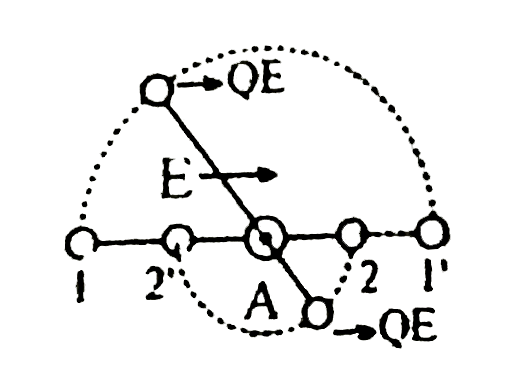
C


Position of maximum velocity is 1' and 2' for the balls as it is minimum potential energy position
Potential difference between 1 and `1'=V_(1)-V_(1)=Exx((3L)/4xx2)`
Potential difference between 2 and `2'=V_(2)-V_(2)=-Exx(L/4xx2)`
Change in electrostatic potential energy `=Qxx(V_(1)-V_(1))+Qxx(V_(2)-V_(2))=-QEL (loss in PE)`
=Gain in KE`=1/2mV^(2)+1/2m(2v)^(2)`
(where velocity of the ball closer to the axis is V & farther from axis is 2V)
`Rightarrow v=sqrt((QEL)/(5m))`
Promotional Banner

Topper's Solved these Questions

  • MASTER PRACTICE PROBLEM

    BANSAL|Exercise Reasoning|75 Videos
  • MASTER PRACTICE PROBLEM

    BANSAL|Exercise Multiple objective|131 Videos
  • MASTER PRACTICE PROBLEM

    BANSAL|Exercise Additional topic|70 Videos
  • FLUID MECHANICS

    BANSAL|Exercise PYQS AIEEE|10 Videos
  • SEMICONDUCTORS

    BANSAL|Exercise CBSE Question|32 Videos

Similar Questions

Explore conceptually related problems

There is an insulator rod of length L and of negligible mass with two small balls of mass m and electric charge Q attached to its ends. The rod can rotate in the horizontal plane around a vertical axis crossing it ata distance L//4 from one of its ends. At first the rod is in unstabel equilbrium in a gorizontal umifrom electric field of field strenght E. Then we gently displace it from this position. Determine the maximim velocity attained by the ball taht is closer to the axis in the subsequent motion

There is an insulator rod of length L and of negligible mass with two small balls of mass m and electric charge Q attached to its ends. The rod can rotate in the horizontal plane around a vertical axis crossing it ata distance L//4 from one of its ends. What is the time period of the SHM as mentioned in the above question?

There is an insulator rod of length L and of negligible mass with two small balls of mass m and electric charge Q attached to its ends. The rod can rotate in the horizontal plane around a vertical axis crossing it at a L//4 distance from one of its ends. What is the time period of the SHM as mentioned in previous question?

There is an insulator rod of length L and of negligible mass with two small balls of mass m and electric charge Q attached to its ends. The rod can rotate in the horizontal plane around a vertical axis crossing it at a L//4 distance from one of its ends. In what position is the rod to be set so that if displaced a little from that position it begins a hormonic oscillation about the axisA?

A uniform metal rod is rotated in horizontal plane about a vertical axis passing through its end at uniform rate. The tension in the rod is

The moment of inertia of a uniform thin rod of length L and mass M about an axis passing through a point at a distance of L/3 from one of its ends and perpendicular to the rod is

The moment of inertia of a uniform thin rod of length L and mass M about an axis passing through a point at a distance of L//3 from one of its ends and perpendicular to the rod is

A massless rod of length L has two equal charges (q) tied to its ends. The rod is free to rotate in horizontal plane about a vertical axis passing through a point at a distance (L)/(4) from one of its ends. A uniform horizontal electric field (E) exists in the region. (a) Draw diagrams showing the stable and unstable equilibrium positions of the rod in the field. (b) Calculate the change in electric potential energy of the rod when it is rotated by an angle Deltatheta from its stable equilibrium position. (c) Calculate the time period of small oscillations of the rod about its stable equilibrium position. Take the mass of each charge to be m.

A long uniform rod of length L, mass M is free to rotate in a horizontal plane about a vertical axis through its end. Two springs of constant K each are connected as shown. On equilibrium, the rod was horizontal. The frequency will be –

BANSAL-MASTER PRACTICE PROBLEM-Comphrehension
  1. There is a uniformly charged ring having radius R. An infinite line ch...

    Text Solution

    |

  2. There is a uniformly charged ring having radius R. An infinite line ch...

    Text Solution

    |

  3. There is an insulator rod of length L and of negligible mass with two ...

    Text Solution

    |

  4. There is an insulator rod of length L and of negligible mass with two ...

    Text Solution

    |

  5. There is an insulator rod of length L and of negligible mass with two ...

    Text Solution

    |

  6. It is possible to take a high quality photograph of a very fast moving...

    Text Solution

    |

  7. It is possible to take a high quality photograph of a very fast moving...

    Text Solution

    |

  8. It is possible to take a high quality photograph of a very fast moving...

    Text Solution

    |

  9. All bodies, no matter how hot or cold, continuously radiate photons. A...

    Text Solution

    |

  10. All bodies, no matter how hot or cold, continuously radiate photons. A...

    Text Solution

    |

  11. All bodies, no matter how hot or cold, continuously radiate photons. A...

    Text Solution

    |

  12. All bodies, no matter how hot or cold, continuously radiate photons. A...

    Text Solution

    |

  13. A fixed resistor is cannected in parallel with a variable resistor, bo...

    Text Solution

    |

  14. A fixed resistor is cannected in parallel with a variable resistor, bo...

    Text Solution

    |

  15. A fixed resistor is cannected in parallel with a variable resistor, bo...

    Text Solution

    |

  16. All bulbs consume same power. The resistance of bulb 1 is 36 Omega . ...

    Text Solution

    |

  17. All bulbs consume same power. The resistance of bulb 1 is 36 Omega . ...

    Text Solution

    |

  18. All bulbs consume same power. The resistance of bulb 1 is 36 Omega . ...

    Text Solution

    |

  19. A beam of electrons has radius r and contains 'n' electrons per cubic ...

    Text Solution

    |

  20. A beam of electrons has radius r and contains 'n' electrons per cubic ...

    Text Solution

    |

