Home
Class 12
PHYSICS
The ciliary muscles of eye control the c...

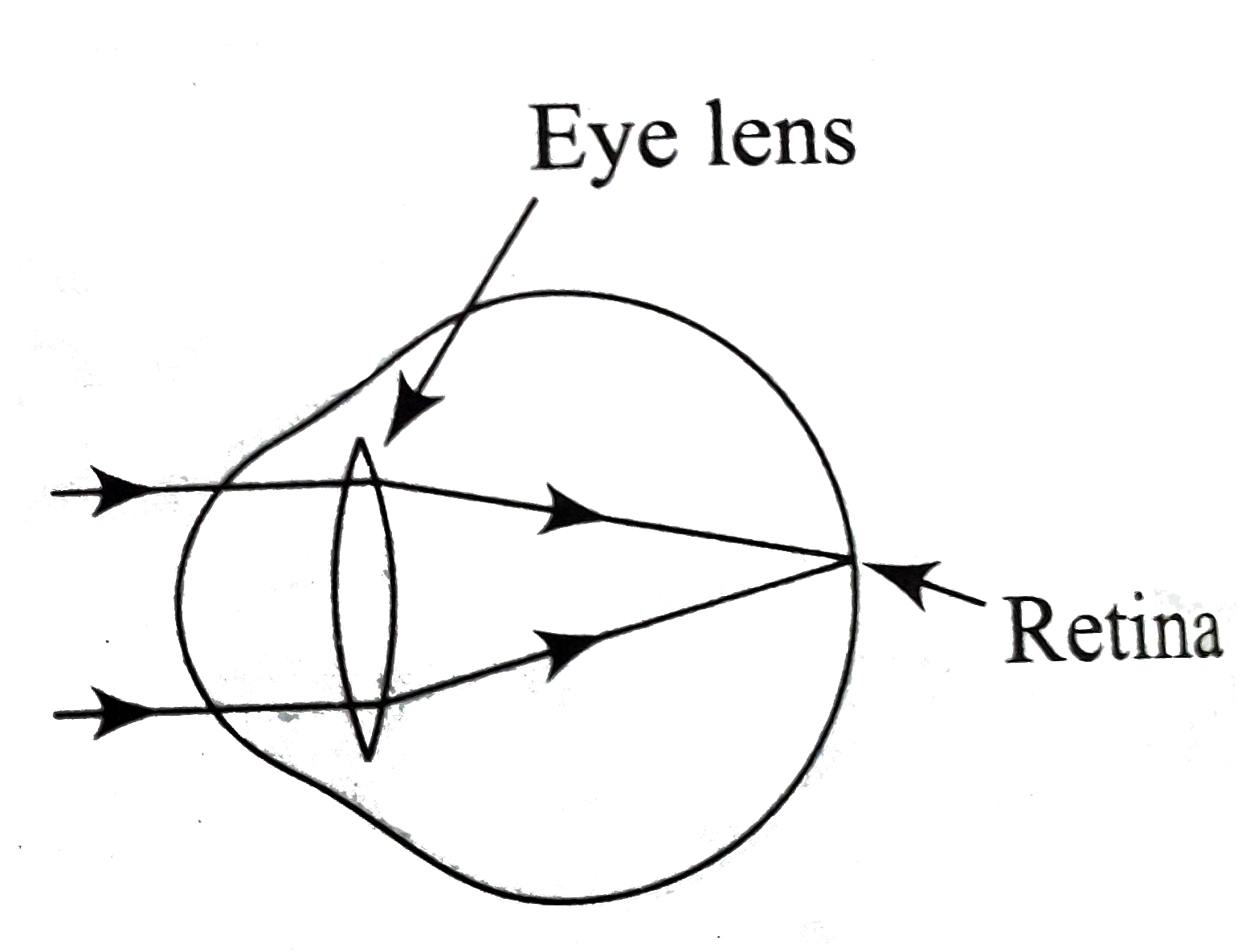
The ciliary muscles of eye control the curvature of the lens in the eye and hence can alter the effective focal length of the system. When the muscles are fully relaxed, the focal length is maximum. When the muscles are strained, the curvature of lens increases. That means radius of curvature decreases and focal length decreases. For a clear vision, the image must be on the retina. The image distance is therefore fixed for clear vision and it equals the distance of retina from eye lens. It is about 2.5cm for a grown up person.
A perosn can theoretically have clear vision of an object situated at any large distance from the eye. The smallest distance at which a person can clearly see is related to minimum possible focal length. The ciliary muscles are most strained in this position. For an average grown up person, minimum distance of the object should be around 25cm.
A person suffering from eye defects uses spectacles (eye glass). The function of lens of spectacles is to form the image of the objects within the range in which the person can see clearly. The image o the spectacle lens becomes object for the eye lens and whose image is formed on the retina.
The number of spectacle lens used for th eremedy of eye defect is decided by the power fo the lens required and the number of spectacle lens is equal to the numerical value of the power of lens with sign. For example, if power of the lens required is `+3D` (converging lens of focal length `100//3cm` ), then number of lens will be `+3`.
For all the calculations required, you can use the lens formula and lensmaker's formula. Assume that the eye lens is equiconvex lens. Neglect the distance between the eye lens and the spectacle lens.

Q. Maximum focal length of a eye lens of a normal person is

A

`1.2` cm

B

`2.5` cm

C

`infty`

D

`25//11` cm

Text Solution

Verified by Experts

The correct Answer is:

D

`1/v-1/u=1/f`
`v=2.5`cm i n all cases
`u=-x`
`1/2.5+1/x=1/f`
`f_(max) Rightarrow xis max. Rightarrow x=infty`
`f_(max)=2.5` cm
`f_(min) Rightarrow x is min`
`1/2.5+1/25=1/f`
`f_(min)=25/11` cm.]
Promotional Banner

Topper's Solved these Questions

  • MASTER PRACTICE PROBLEM

    BANSAL|Exercise Reasoning|75 Videos
  • MASTER PRACTICE PROBLEM

    BANSAL|Exercise Multiple objective|131 Videos
  • MASTER PRACTICE PROBLEM

    BANSAL|Exercise Additional topic|70 Videos
  • FLUID MECHANICS

    BANSAL|Exercise PYQS AIEEE|10 Videos
  • SEMICONDUCTORS

    BANSAL|Exercise CBSE Question|32 Videos

Similar Questions

Explore conceptually related problems

The ciliary muscles of eye control the curvature of the lens in the eye and hence can alter the effective focal length of the system. When the muscles are fully relaxed, the focal length is maximum. When the muscles are strained, the curvature of lens increases. That means radius of curvature decreases and focal length decreases. For a clear vision, the image must be on the retina. The image distance is therefore fixed for clear vision and it equals the distance of retina from eye lens. It is about 2.5cm for a grown up person. A perosn can theoretically have clear vision of an object situated at any large distance from the eye. The smallest distance at which a person can clearly see is related to minimum possible focal length. The ciliary muscles are most strained in this position. For an average grown up person, minimum distance of the object should be around 25cm. A person suffering from eye defects uses spectacles (eye glass). The function of lens of spectacles is to form the image of the objects within the range in which the person can see clearly. The image o the spectacle lens becomes object for the eye lens and whose image is formed on the retina. The number of spectacle lens used for th eremedy of eye defect is decided by the power fo the lens required and the number of spectacle lens is equal to the numerical value of the power of lens with sign. For example, if power of the lens required is +3D (converging lens of focal length 100//3cm ), then number of lens will be +3 . For all the calculations required, you can use the lens formula and lensmaker's formula. Assume that the eye lens is equiconvex lens. Neglect the distance between the eye lens and the spectacle lens. Q. A near sighted man can clearly see ojects only upto a distance of 100cm and not beyond this. The number of the spectacle lenses necessary for the remedy of this defect will be

The ciliary muscles of eye control the curvature of the lens in the eye and hence can alter the effective focal length of the system. When the muscles are fully relaxed, the focal length is maximum. When the muscles are strained, the curvature of lens increases. That means radius of curvature decreases and focal length decreases. For a clear vision, the image must be on the retina. The image distance is therefore fixed for clear vision and it equals the distance of retina from eye lens. It is about 2.5cm for a grown up person. A perosn can theoretically have clear vision of an object situated at any large distance from the eye. The smallest distance at which a person can clearly see is related to minimum possible focal length. The ciliary muscles are most strained in this position. For an average grown up person, minimum distance of the object should be around 25cm. A person suffering from eye defects uses spectacles (eye glass). The function of lens of spectacles is to form the image of the objects within the range in which the person can see clearly. The image o the spectacle lens becomes object for the eye lens and whose image is formed on the retina. The number of spectacle lens used for th eremedy of eye defect is decided by the power fo the lens required and the number of spectacle lens is equal to the numerical value of the power of lens with sign. For example, if power of the lens required is +3D (converging lens of focal length 100//3cm ), then number of lens will be +3 . For all the calculations required, you can use the lens formula and lensmaker's formula. Assume that the eye lens is equiconvex lens. Neglect the distance between the eye lens and the spectacle lens. Q. A far sighted man connot see objects clearly unless they are at least 100cm from his eyes. The number of the spectacle lenses that will make his range of clear vision equal to an average grown up person will be

The focal length of the lens of a normal human eye is about

The focal length of the eye lens increases when eye muscles

The focal length of a normal eye lens is about

BANSAL-MASTER PRACTICE PROBLEM-Comphrehension
  1. The spark plug in an automobile engine is an R-L circuit as shown in f...

    Text Solution

    |

  2. The spark plug in an automobile engine is an R-L circuit as shown in f...

    Text Solution

    |

  3. The ciliary muscles of eye control the curvature of the lens in the ey...

    Text Solution

    |

  4. If the eye is kept very close to a coverging lens (focal length = 10 c...

    Text Solution

    |

  5. If the eye is kept very close to a coverging lens (focal length = 10 c...

    Text Solution

    |

  6. For a given optical system, the principal axis is x-axis and coordinat...

    Text Solution

    |

  7. For a given optical system, the principal axis is x-axis and coordinat...

    Text Solution

    |

  8. For a given optical system, the principal axis is x-axis and coordinat...

    Text Solution

    |

  9. Consider a transparent hemisphere (n=2) in front of which a small obje...

    Text Solution

    |

  10. Consider a transparent hemisphere (n=2) in front of which a small obje...

    Text Solution

    |

  11. Consider a transparent hemisphere (n=2) in front of which a small obje...

    Text Solution

    |

  12. In the front of the upper slit of YDSE apparatus, a thin film of a liq...

    Text Solution

    |

  13. In the front of the upper slit of YDSE apparatus, a thin film of a liq...

    Text Solution

    |

  14. In the front of the upper slit of YDSE apparatus, a thin film of a liq...

    Text Solution

    |

  15. A 500 g teapot and an insulated thermos are in a 20^(@)C room. The tea...

    Text Solution

    |

  16. A 500 g teapot and an insulated thermos are in a 20^(@)C room. The tea...

    Text Solution

    |

  17. A 500 g teapot and an insulated thermos are in a 20^(@)C room. The tea...

    Text Solution

    |

  18. In a container of negligible heat capacity 200 gm ice at 0^(@)C and 10...

    Text Solution

    |

  19. In a container of negligible heat capacity 200 gm ice at 0^(@)C and 10...

    Text Solution

    |

  20. In a container of negligible heat capacity 200 gm ice at 0^(@)C and 10...

    Text Solution

    |
