Home
Class 12
PHYSICS
The energy-level scheme for the hypothet...

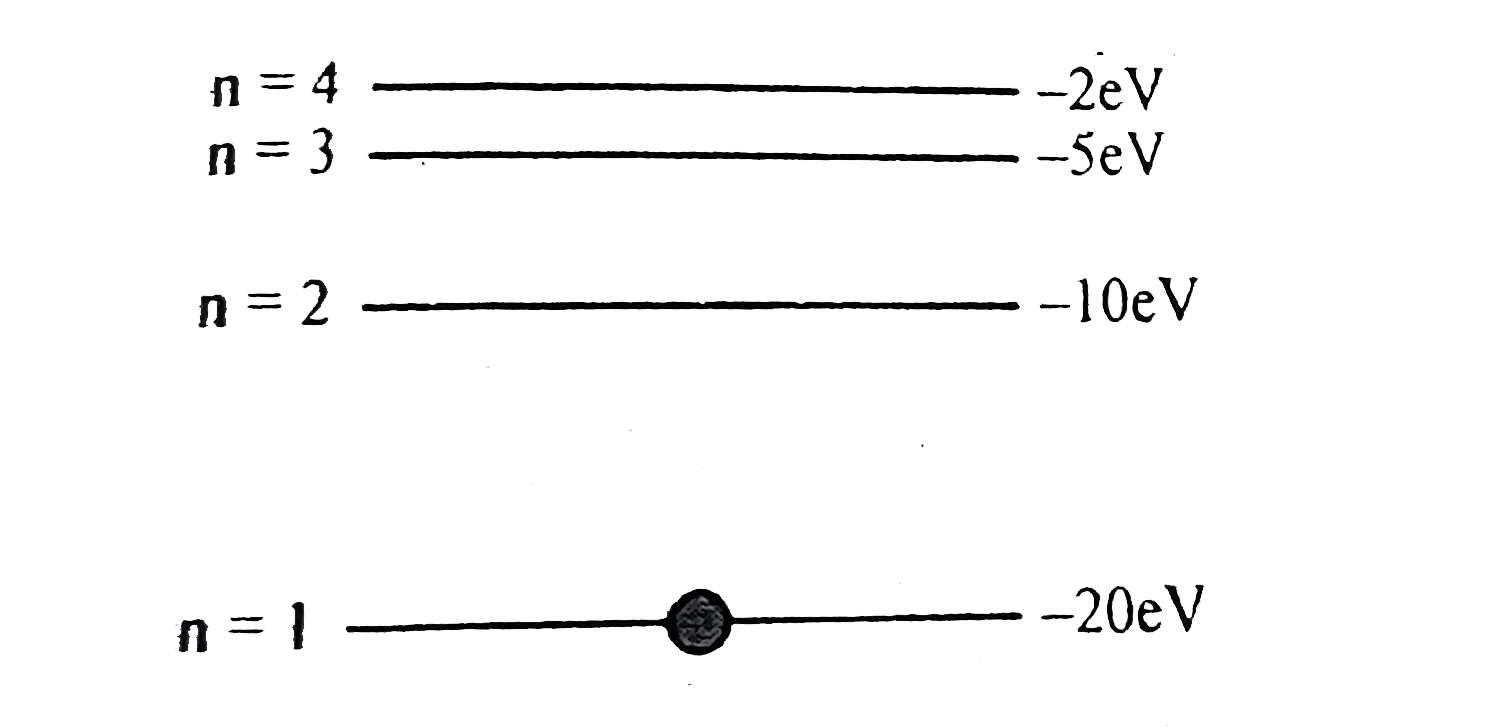
The energy-level scheme for the hypothetical one electron element Bansalium is shown in figure. The potential energy is taken to be zero for an electron at an infinite distance from the nucleus.

If photons emitted from Bansalium transitions `n=4 rightarrow n=2 and from n=2 rightarrow n=1` will eject photoelectrons from an unknown metal but the photon emitted from the transition `n=3 rightarrow n=2` will not, what are the limits (maximum and minimum possible values) of the work function of the metal ?

A

`8 eVlt philt10eV`

B

`5eVltphi lt 10 eV`

C

`5 eV lt phi lt 8 eV`

D

`5 eV lt phi lt 12 eV`

Text Solution

Verified by Experts

The correct Answer is:

C

`E_(4rightarrow2)=8eV`
`E_(2rightarrow1)=10eV`
`philt8eV`
`E_(3rightarrow2)=5eV`
`phigt5eV`
Promotional Banner

Topper's Solved these Questions

  • MASTER PRACTICE PROBLEM

    BANSAL|Exercise Reasoning|75 Videos
  • MASTER PRACTICE PROBLEM

    BANSAL|Exercise Multiple objective|131 Videos
  • MASTER PRACTICE PROBLEM

    BANSAL|Exercise Additional topic|70 Videos
  • FLUID MECHANICS

    BANSAL|Exercise PYQS AIEEE|10 Videos
  • SEMICONDUCTORS

    BANSAL|Exercise CBSE Question|32 Videos

Similar Questions

Explore conceptually related problems

The energy-level scheme for the hypothetical one electron element Bansalium is shown in figure. The potential energy is taken to be zero for an electron at an infinite distance from the nucleus. If a Bansalium atom is in ground state, which of the following photons cannot excite the atom to a higher state?

The energy-level scheme for the hypothetical one electron element Bansalium is shown in figure. The potential energy is taken to be zero for an electron at an infinite distance from the nucleus. A sample of atoms Bansalium are in all the 3 excited state shown above. What is the possible wavelength that can be emitted by atom in visible range?

The energy levels of a hypotherical one electron atom are shown in figure Find the wave number of the photon emitted for the transition n = 3 to n = 1

Calculate the wavelength of a photon emitted when an electron in H- atom maker a transition from n=2 to n=1

Energy of the lowest level of hydrogen atom is -13.6 eV . The energy of the photon emitted in the transition from n=3 to n=1 is

Electron in a hydrogen atom makes a transition from higher energy states to n=2. Calculate the maximum possible wavelengths in this transition.

The ground state energy of an atom is -13.6eV . The photon emitted during the transition of electron from n=3 to n=1 state, is incidenet on a photosensitive material of unknown work function. The photoelectrons are emitted from the materials with a maximum kinetic energy of 9 eV. the threshold wavelength of the material used is

BANSAL-MASTER PRACTICE PROBLEM-Comphrehension
  1. In the front of the upper slit of YDSE apparatus, a thin film of a liq...

    Text Solution

    |

  2. A 500 g teapot and an insulated thermos are in a 20^(@)C room. The tea...

    Text Solution

    |

  3. A 500 g teapot and an insulated thermos are in a 20^(@)C room. The tea...

    Text Solution

    |

  4. A 500 g teapot and an insulated thermos are in a 20^(@)C room. The tea...

    Text Solution

    |

  5. In a container of negligible heat capacity 200 gm ice at 0^(@)C and 10...

    Text Solution

    |

  6. In a container of negligible heat capacity 200 gm ice at 0^(@)C and 10...

    Text Solution

    |

  7. In a container of negligible heat capacity 200 gm ice at 0^(@)C and 10...

    Text Solution

    |

  8. The energy-level scheme for the hypothetical one electron element Bans...

    Text Solution

    |

  9. The energy-level scheme for the hypothetical one electron element Bans...

    Text Solution

    |

  10. The energy-level scheme for the hypothetical one electron element Bans...

    Text Solution

    |

  11. The first nuclear reaction ever observed was by ernest Rutherford in 1...

    Text Solution

    |

  12. The first nuclear reaction ever observed was by ernest Rutherford in 1...

    Text Solution

    |

  13. The first nuclear reaction ever observed was by ernest Rutherford in 1...

    Text Solution

    |

  14. .(29)^(64) Cu can decay by beta^(-) or beta^(+) emmision, or electron ...

    Text Solution

    |

  15. .(29)^(64) Cu can decay by beta^(-) or beta^(+) emmision, or electron ...

    Text Solution

    |

  16. .(29)^(64) Cu can decay by beta^(-) or beta^(+) emmision, or electron ...

    Text Solution

    |

  17. De-Broglie hypothesized that material particles have wave like propert...

    Text Solution

    |

  18. De-Broglie hypothesized that material particles have wave like propert...

    Text Solution

    |

  19. De-Broglie hypothesized that material particles have wave like propert...

    Text Solution

    |

  20. De-Broglie hypothesized that material particles have wave like propert...

    Text Solution

    |
