Home
Class 12
PHYSICS
Three simple harmonic motions in the sam...

Three simple harmonic motions in the same direction having each of amplitude "a" and the same period are superposed. If each differs in phase from the next by `pi//4` then

A

Resultant amplitude is `(sqrt(2)+1)` a

B

Phase of resultant motion relative to first is `90^(@)`

C

The energy associated with the resulting motion is `(3+2 sqrt(2))` time the energy associated with any single motion

D

Maximum speed of resultant SHM will be more than double of the initial SHM's

Text Solution

Verified by Experts

The correct Answer is:
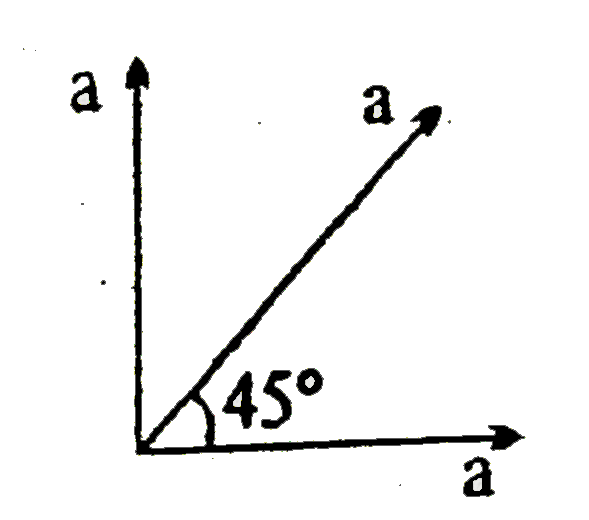
A, C, D

(A)The vector sum of these three is `(sqrt(2)+1)` a
(C) Energy associated with each wave `=Ka^(2)`
Energy with resultant motion `=K(sqrt(2)+1)^(2)a^(2) Rightarrow (3+2sqrt(2))`
(D) `V_(max)=Aomega`
`V_(initial)=aw`
`V_(resultant max =(sqrt(2)+1) a omega=2.14a omega`
:.`V_(resultant) 72 time V_(initial)`
Promotional Banner

Topper's Solved these Questions

  • MASTER PRACTICE PROBLEM

    BANSAL|Exercise Subjective|107 Videos
  • MASTER PRACTICE PROBLEM

    BANSAL|Exercise Additional topic|70 Videos
  • MASTER PRACTICE PROBLEM

    BANSAL|Exercise Reasoning|75 Videos
  • FLUID MECHANICS

    BANSAL|Exercise PYQS AIEEE|10 Videos
  • SEMICONDUCTORS

    BANSAL|Exercise CBSE Question|32 Videos

Similar Questions

Explore conceptually related problems

Three simple harmonic motions in the same direction having same amplitude and the same period are superposed. If each differs in phase from the next by lambda//2 then which of the following is wron. ( i ) Resultant amplitude is (sqrt(2)+1) a ( ii ) Phase of resultant motion relative to first is 90^(@) ( iii ) The energy associated with the resulting motion is 3 times the energy associated with any single motion

Three simle harmionic motions in the same direction having the same amplitude (a) and same period are superposed. If each differs in phase from the next by 45^@ , then.

Three simple harmonic motions in the same direction having the same amplitude and same period are superposed. If each differ in phase from the next by 45^(@) , then

Three simple harmonic motions in the same direction each of amplitude a and periodic time T , are superposed. The first and second and the second and third differ in phase from each other by (pi)/(4) , with the first and third not being identical . Then.

A particle is subjected to two simple harmonic motions in the same direction having equal amplitudes and equal frequency. If the resulting amplitude is equal to the amplitude of individual motions, the phase difference between them is

A particle is subjected to two simple hasrmonic motions in the same direction having equal amplitudes and equal frequency. If the resultant amplitude is equal to the amplitude of the individual motions, find the phase difference between the individual motions.

A particle is subjected to two simple harmonic motions in the same direction having equal amplitude and equal frequency. If the resultant amplitude is equal to the amplitude of individual motions, what is the phase difference between the motions.

A particle is subjected to two simple harmonic motion in the same direction having equal amplitudes and equal frequency. If the resultant amplitude is equal to the amplitude of the individual motions. Find the phase difference between the individual motions.

When two mutually perpendicular simple harmonic motions of same frequency, amplitude and phase are susperimposed

Three simple harmonic waves , identical in frequency n and amplitude A moving in the same direction are superimposed in air in such a way , that the first , second and the third wave have the phase angles phi , phi + ( pi//2) and (phi + pi) , respectively at a given point P in the superposition Then as the waves progress , the superposition will result in

BANSAL-MASTER PRACTICE PROBLEM-Multiple objective
  1. The system shown in the figure can move on a smooth surface. The sprin...

    Text Solution

    |

  2. Initially spring is compressed by x(0) and blocks are in contact when ...

    Text Solution

    |

  3. Three simple harmonic motions in the same direction having each of amp...

    Text Solution

    |

  4. Starting from the mean position a body oscillates simple harmonically ...

    Text Solution

    |

  5. A spring mass system is hanging from the ceiling of an elevator in equ...

    Text Solution

    |

  6. Two objects of masses m and 4m are at rest at an infinite separation. ...

    Text Solution

    |

  7. A solid sphere of uniform density and radius 4 units is located with i...

    Text Solution

    |

  8. The spherical planets have the same mass but densities in the ratio 1:...

    Text Solution

    |

  9. A particle at a distance r from the centre of a uniform spherical plan...

    Text Solution

    |

  10. In a solid sphere two small symmetrical cavities are created whose cen...

    Text Solution

    |

  11. Curved surface of a vessel has shape of a truneated cone having semive...

    Text Solution

    |

  12. A solid sphere of mass m, suspended through a string in a liquid as s...

    Text Solution

    |

  13. The mass of block is m(1) and that of liquid with the vessel is m(2) T...

    Text Solution

    |

  14. A body floats on water and also on an oil of density 1.25. Which of th...

    Text Solution

    |

  15. Each of the following system begins moving upwards with a constant acc...

    Text Solution

    |

  16. Water jet coming out of a stationary horizontal tube at speed v strike...

    Text Solution

    |

  17. Consider standing wave formed due to superposition of two plane waves ...

    Text Solution

    |

  18. In a resonance tube experiment, an 80 cm air column in resonance with ...

    Text Solution

    |

  19. Two particles of a medium disturbed by the wave propagtion are at x(1)...

    Text Solution

    |

  20. The particle displacement of a travelling longitudional wave is repres...

    Text Solution

    |

