Home
Class 12
PHYSICS
A conducting rod of length l is hinged a...

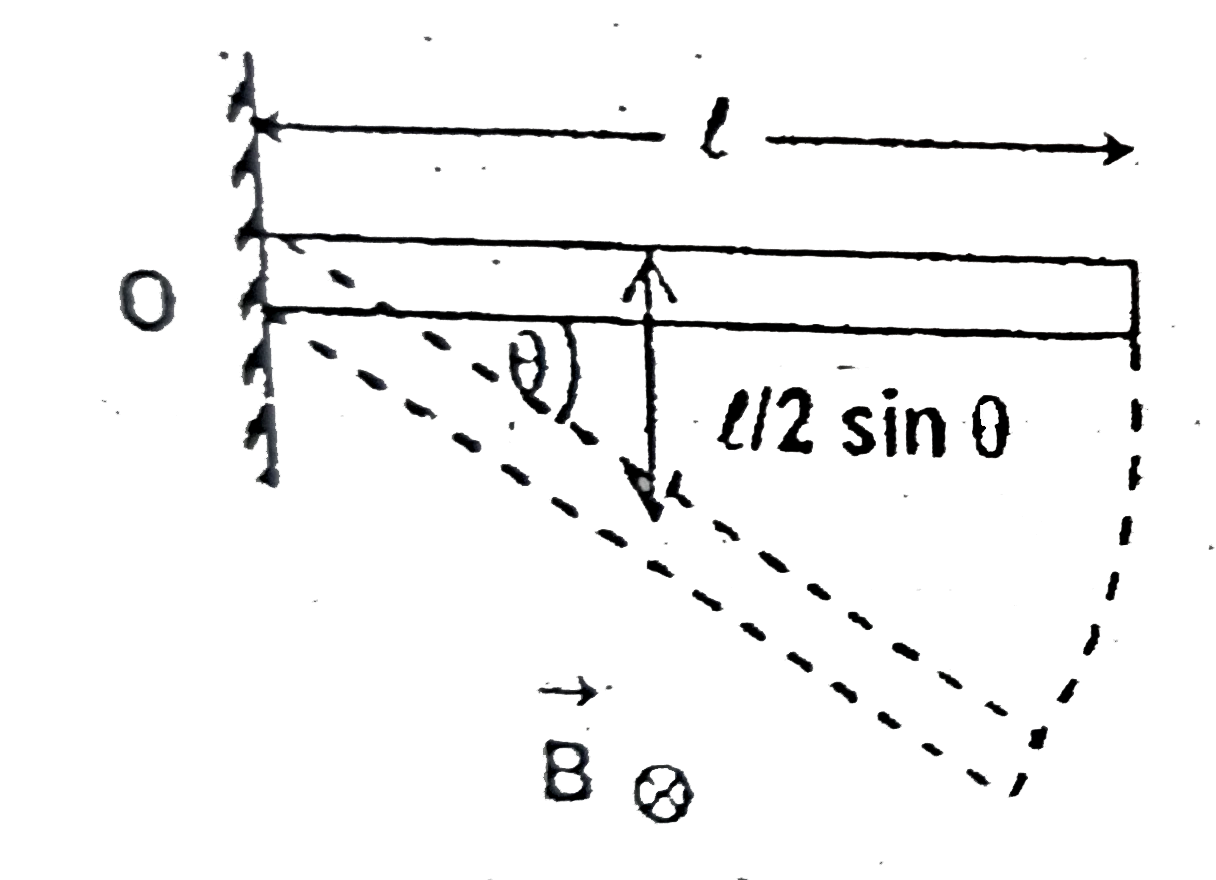
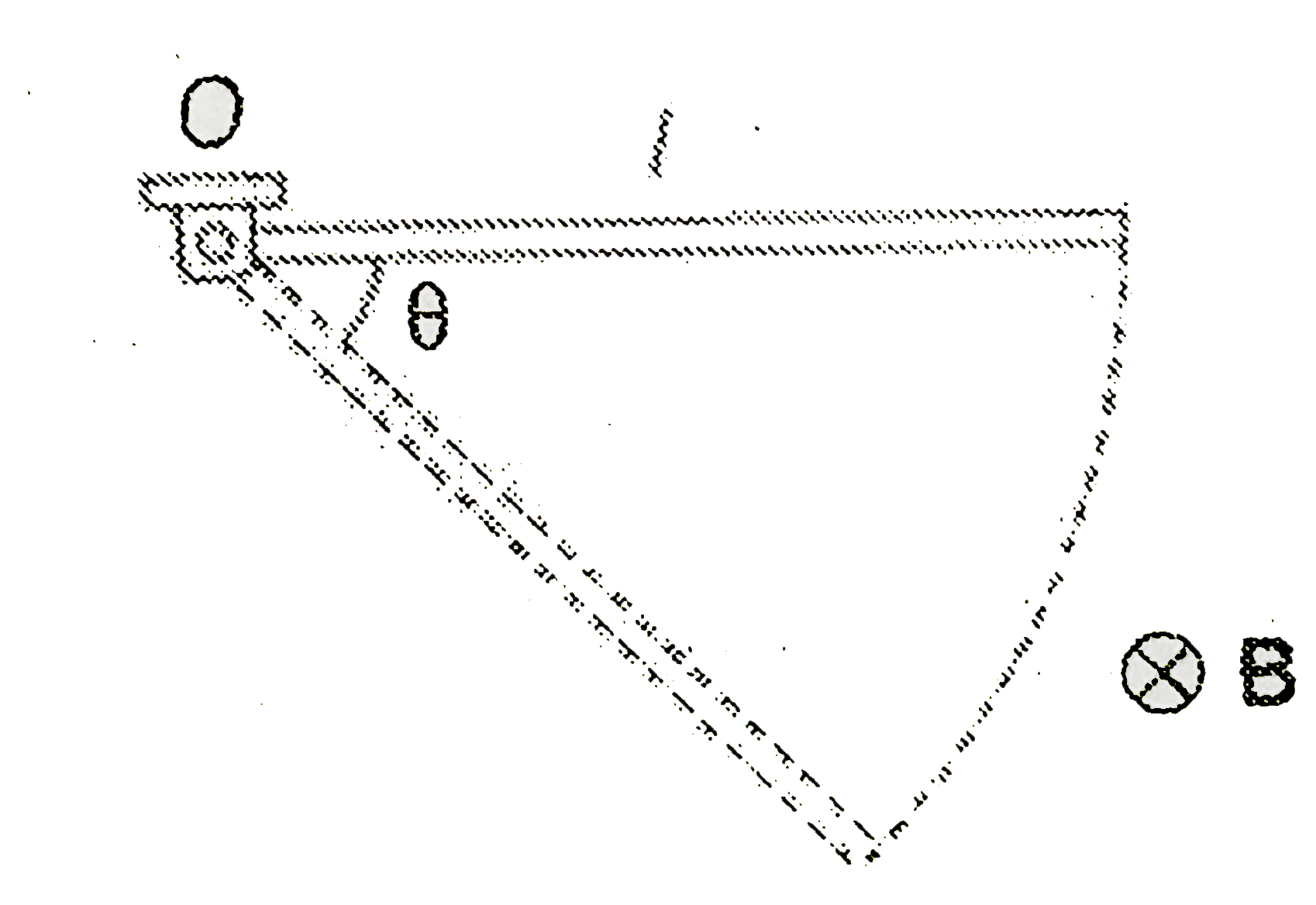
A conducting rod of length l is hinged at point O. It is a free to rotate in a verical plane. There exists a uniform magnetic field B in horizontal direction. The rod is released from the position shown. The potential difference between the two ends of the rod is proportional to

A

`l^(3//2)`

B

`l^(2)`

C

`sintheta//2`

D

`sin theta`

Text Solution

Verified by Experts

`mg(l//2)sintheta=(1)/(2)xx(ml^(2))/(3)omega^(2)`
`omega=sqrt((3gsintheta)/(l))`
Potential difference induced between two ends of the rod `=epsilon=(1)/(2)Bomegal^(2)`
`epsilon=(1)/(2)Bl^(3//2)sqrt(3gsintheta )`
Promotional Banner

Topper's Solved these Questions

  • GMP ASSESMENT

    FIITJEE|Exercise Assertion & Reason|15 Videos
  • GMP ASSESMENT

    FIITJEE|Exercise Multiple Question|58 Videos
  • GMP ASSESMENT

    FIITJEE|Exercise Numerical Based|61 Videos
  • GENERAL PHYSICS

    FIITJEE|Exercise MATRIX MATCH TYPE|3 Videos
  • GRAVITATION

    FIITJEE|Exercise Numerical based Question|2 Videos

Similar Questions

Explore conceptually related problems

A rod of length l rotates with a uniform angular velocity omega about its perpendicular bisector. A uniform magnetic field B exists parallel to the axis of rotation. The potential difference between the two ends of the lrod is

A conducting rod rotates with a constant angular velocity 'omega' about the axis which passes through point 'O' and perpendicular to its length . A uniform magnetic field 'B' exists parallel to the axis of the rotation . Then potential difference between the two ends of the rod is :-

A rod of length l rotates with a small but uniform angular velocity omega about its perpendicular bisector. A uniform magnetic field B exists parallel to the axis of rotation. The potential difference between the centre of the rod and an end is

A conducing rod of length l is falling with a velocity v perpendicular to a unifrorm horizontal magnetic field B . The potential difference between its two ends will be

A metal rod of length L is placed normal to a magnetic field and rotated through one end of rod in circular path with frequency f. The potential difference between it ends will be-

A metal rod of length l pivoted at is upper end. It is released from a horizontal position. There is a uniform magnetic field _|_ to its plane of rotation. When it becomes vertical, the p.d. across its ends is proportional to

A unifrom rod of length l and mass m is free to rotate in a vertical plane about A as shown in Fig. The rod initially in horizontal position is released. The initial angular acceleration of the rod is

FIITJEE-GMP ASSESMENT-Objective problems
  1. The power factor of the circuit in fig. is 1//sqrt(2). The capacitance...

    Text Solution

    |

  2. An electron moves on a straight line path Y Y' as shown in figure. A c...

    Text Solution

    |

  3. A conducting rod of length l is hinged at point O. It is a free to rot...

    Text Solution

    |

  4. In L-C-R series circuit

    Text Solution

    |

  5. A given LCR series circuit satisfes the condition for resonance with a...

    Text Solution

    |

  6. A liquid of refractive index 1.33 is placed between two identical plan...

    Text Solution

    |

  7. A converging lens of focal length 20 cm and diameter 5 cm is cut along...

    Text Solution

    |

  8. If final image after two refractions through the lens and one reflecti...

    Text Solution

    |

  9. A beam of light coming from infinty is passing through a biconvex lens...

    Text Solution

    |

  10. When the object is at distance mu1 and mu2 from the optical centre of ...

    Text Solution

    |

  11. A lens of any transparent material in air will behave as

    Text Solution

    |

  12. In Young's double slit experiment, white light is used. The seperation...

    Text Solution

    |

  13. In Young's double slit experiment, the intensity of light at a point o...

    Text Solution

    |

  14. YDSE is carried with two thin sheets of thickness 10.4mu m each and r...

    Text Solution

    |

  15. In Young's double slit experiment, we get 60 fringes in the field of v...

    Text Solution

    |

  16. In Young's doulbe-slit experiment the separation between two coherent ...

    Text Solution

    |

  17. A beam of light consisting of two wavelength 6300 A^(@) and lambda A^(...

    Text Solution

    |

  18. There is a equilateral prism of refractive index 3 on which a light ra...

    Text Solution

    |

  19. A current of (2.5+-0.05) A flows through a wire and develops a potenti...

    Text Solution

    |

  20. The dimension of L//C is equivalent to that of (L to inductance, C toc...

    Text Solution

    |