Home
Class 12
PHYSICS
In the figure shown, two identical block...

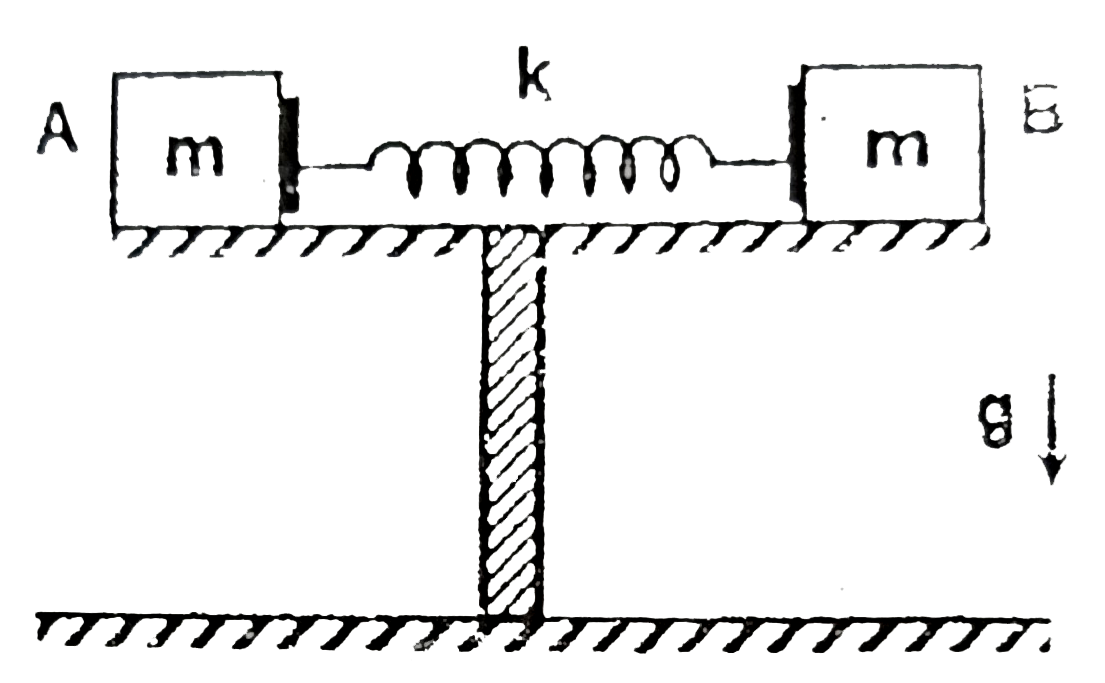
In the figure shown, two identical blocks `A` and `B` of mass `m=1//2 kg` each are placed on the two opposite edges of a table. A light spring of stiffness `k=pi^(2) N//m` and having natural length equal to the separation between the blocks, is placed between the blocks. Neither block is attached to the spring. The blocks are displaced towards each other by equal distance `x=2cm` and then released at time `t=0`.
Calculate the magnitude of the net impulse (in `SI` unit) on the system of the blocks and spring from `t=0` to `t=1.05 s`. Ignore any friction, and take `g=10m//s^(2)` and assume that the blocks do not reach the ground below the table, before `1.05 second`.

A

`8 N-S`

B

`0.2 N-S`

C

`0.1 N-S`

D

`0.4//3 N-S`

Text Solution

Verified by Experts

Gravity is the only external force for giving impulse to the system
Promotional Banner

Topper's Solved these Questions

  • GMP ASSESMENT

    FIITJEE|Exercise Assertion & Reason|15 Videos
  • GMP ASSESMENT

    FIITJEE|Exercise Multiple Question|58 Videos
  • GMP ASSESMENT

    FIITJEE|Exercise Numerical Based|61 Videos
  • GENERAL PHYSICS

    FIITJEE|Exercise MATRIX MATCH TYPE|3 Videos
  • GRAVITATION

    FIITJEE|Exercise Numerical based Question|2 Videos

Similar Questions

Explore conceptually related problems

A block of mass m is attached to two unstretched springs of spring constant k , each as shown. The block is displaced towards right through a distance x and is released The speed of the block as it passes through the mean position will be

A block of mass m is attached to two unstretched springs of spring constants k_1 and k_2 as shown in figure. The block is displaced towards right through a distance x and is released. Find the speed of the block as it psses through the mean position shown.

Two blocks of masses 6 kg and 3 kg are attached to the two ends of a massless spring of spring constant 2 pi^(2) N//m . If spring is compressed and released on a smooth horizontal surface then find the time period (in seconds) of each block.

Two blocks A and B of mass m and 2m are connected together by a light spring of stiffness k . The system is lying on a smooth horizontal surface with block A in contact with a fixed vertical wall as shown in the figure. The block B is pressed towards the wall by a distance x_0 and then released. There is not friction anywhere. If spring takes time Deltat to aquire its natural length then average force on the block A by the wall is

A block of mass m is attached to two unstretched springs of springs constant k_(1) and k_(2) as shown in figure. The block is displaced towards right through a distance x and is released. Find the speed of the block as it passes through the mean position shown.

Two identical blocks A and B of mass m joined together with a massless spring as shown in figure are placed on a smooth surface. If the block A moves with an acceleration a_0 , then the acceleration of the block B is

A block of mass m is attached to four unstretched massless springs of spring constant k_1 and k_2 as shown in figure. The block is displaced towards right through distance x and is released. Speed of block when displacement of block is x/2 from mean position is :

A block of mass m = 2 kg is attached to two unstretched spring of force constant k_(1)=100 N//m and k_(2)=125 N//m The block is displaced towards left through a distance of 10 cm and released. Find the speed of the block as it passes through the mean position.

Two identical blocks A and B of mass m each are connected to each other by spring of spring constant k. Block B is initially shifted to a small distance x_(0) to the left and then released. Choose the correct statements for this problem, after the spring attains it's natural length.

In the figure shown, a block A of mass m is rigidy attached to a light spring of stiffness k and suspended from a fixed support. Another block B of same mass is just placed on it and blocks are in equilibrium. Suddenly the block B is removed. Choose the correct options (s) afterward.

FIITJEE-GMP ASSESMENT-Objective problems
  1. A non conducting rod AB of length sqrt(3)R, uniformly distributed char...

    Text Solution

    |

  2. The entire network shown here, has uniform wire having resistance per ...

    Text Solution

    |

  3. A block of mass m=5kg is placed on the wedge of mass M=32kg as shown i...

    Text Solution

    |

  4. A small collar of mass m is given an intial velocity of magnitude v(0...

    Text Solution

    |

  5. An ideal gas undergoes a circular cycle as shown in the figure. Find t...

    Text Solution

    |

  6. A particle is projected from point P on inclined plane OA perpendicula...

    Text Solution

    |

  7. A square plate of mass 10kg and side 20m is moving along the groove wi...

    Text Solution

    |

  8. A particle A is moving in xy plane with the constant speed of 2pi m//s...

    Text Solution

    |

  9. Three capacitors (of capacitances C, 2C and 3C) and three resistors (o...

    Text Solution

    |

  10. Three point masses m, 2m and m, connected with ideal spring (of spring...

    Text Solution

    |

  11. Two capillary tubes of diameters 3.0 mm and 6.0 mm are joined together...

    Text Solution

    |

  12. In the figure shown, two identical blocks A and B of mass m=1//2 kg ea...

    Text Solution

    |

  13. Suppose 0.5 moles of an ideal gas undergoes an isothermal expansion as...

    Text Solution

    |

  14. A block of wood is floating in water such that 1//2 of it is submerge...

    Text Solution

    |

  15. Monochromatic radiation of wave length 640.2 nm (1nm=10^(-9)m) from a ...

    Text Solution

    |

  16. According to the Rydberg formula, the wavelengths of the first two spe...

    Text Solution

    |

  17. A bar of mass m is suspended horizontally on two vertical springs of s...

    Text Solution

    |

  18. One mole of an ideal monoatomic gas under goes a process V=aT^(2). The...

    Text Solution

    |

  19. The atomic mass number of Radium is A=226, its half life is 1622 years...

    Text Solution

    |

  20. A conducting movable rod AB lies across the frictionless parallel cond...

    Text Solution

    |

