Home
Class 12
PHYSICS
A spherical ball of mass M moving with i...

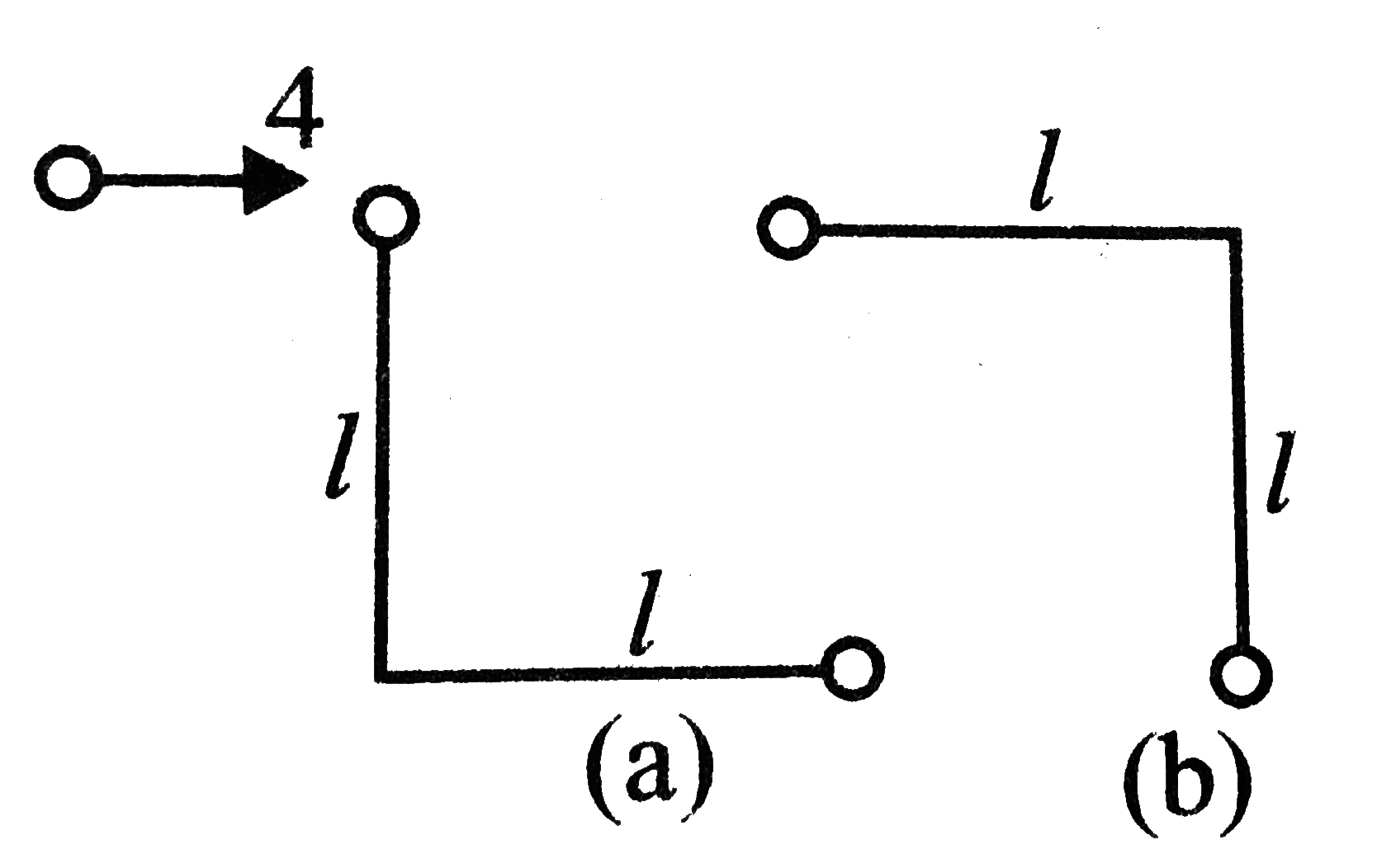
A spherical ball of mass `M` moving with initial velocity `V` collides elastically with another ball of mass `M`, which is fixed at one end of `L` shaped rigid massless frame as shown in Fig. (a). The `L` shaped frame contains another mass `M` connected at the other end.

How soon will the frame come to the orientation shown in Fig. (b) after collision?

A

`(7piL)/(4v)`

B

`(piL)/(2v)`

C

`(7piL)/(8v)`

D

`(piL)/(v)`

Text Solution

Verified by Experts

Use conservation of linear and angular momemtum along with conservation of kinetic energy. (elastic collision)
Promotional Banner

Topper's Solved these Questions

  • GMP ASSESMENT

    FIITJEE|Exercise Numerical Based|61 Videos
  • GMP ASSESMENT

    FIITJEE|Exercise Multiple Question|58 Videos
  • GENERAL PHYSICS

    FIITJEE|Exercise MATRIX MATCH TYPE|3 Videos
  • GRAVITATION

    FIITJEE|Exercise Numerical based Question|2 Videos

Similar Questions

Explore conceptually related problems

A spherical ball of mass M moving with initial velocity V collides elastically with another ball of mass M , which is fixed at one end of L shaped rigid massless frame as shown in Fig. (a). The L shaped frame contains another mass M connected at the other end. The speed of the striking mass after collision is

A spherical ball of mass M moving with initial velocity V collides elastically with another ball of mass M , which is fixed at one end of L shaped rigid massless frame as shown in Fig. (a). The L shaped frame contains another mass M connected at the other end. The angular speed of L frame immediately after collision

A ball of mass m moving with velocity v collides head on elastically with another identical ball moving with velocity - V. After collision

A ball of mass M moving with a velocity v collides perfectly inelastically with another ball of same mass but moving with a velocity v in the opposite direction. After collision

A ball of mass M moving with speed v collides perfectly inelastically with another ball of mass m at rest. The magnitude of impulse imparted to the first ball is

A ball of mass m moving with velocity v collides elastically with another ball of identical mass coming from the opposite direction with velocity 2v. Their velocities after collisions are-

A ball of mass 1kg moving with 4m^-1 along +x-axis collides elastically with an another ball of mass 2kg moving with 6m//s is opposite direction. Find their velocities after collision.

A ball of mass m_(1) moving with a certain speed collides elastically with another ball of mass m_(2) kept at rest . If the first ball starts moving in reversed direction after the impact then

FIITJEE-GMP ASSESMENT-Comprehension
  1. A spherical ball of mass M moving with initial velocity u collides ela...

    Text Solution

    |

  2. A spherical ball of mass M moving with initial velocity V collides ela...

    Text Solution

    |

  3. A spherical ball of mass M moving with initial velocity V collides ela...

    Text Solution

    |

  4. Figure shows 4 identical masses of mass m, arranged on a cube as shown...

    Text Solution

    |

  5. Figure shows 4 identical masses of mass m, arranged on a cube as shown...

    Text Solution

    |

  6. Figure shows 4 identical masses of mass m, arranged on a cube as shown...

    Text Solution

    |

  7. The word fluid means a substance having particles which readily of its...

    Text Solution

    |

  8. The word fluid means a substance having particles which readily of its...

    Text Solution

    |

  9. The word fluid means a substance having particles which readily of its...

    Text Solution

    |

  10. When we raise the temperature of a body, the molecules and atoms move ...

    Text Solution

    |

  11. When we raise the temperature of a body, the molecules and atoms move ...

    Text Solution

    |

  12. When we raise the temperature of a body, the molecules and atoms move ...

    Text Solution

    |

  13. A beaker containing an ideal fluid executes plane SHM in a horizontal ...

    Text Solution

    |

  14. A beaker containing an ideal fluid executes plane SHM in a horizontal ...

    Text Solution

    |

  15. A beaker containing an ideal fluid executes plane SHM in a horizontal ...

    Text Solution

    |

  16. The plates each of area A of a parallel plate caoacitor are given char...

    Text Solution

    |

  17. The plates each of area A of a parallel plate caoacitor are given char...

    Text Solution

    |

  18. The plates each of area A of a parallel plate caoacitor are given char...

    Text Solution

    |

  19. Four capacitors of capacitance C, 2C, 3C & 4C respectively are connect...

    Text Solution

    |

  20. Four capacitors of capacitance C, 2C, 3C & 4C respectively are connect...

    Text Solution

    |

