Home
Class 12
PHYSICS
A beaker containing an ideal fluid execu...

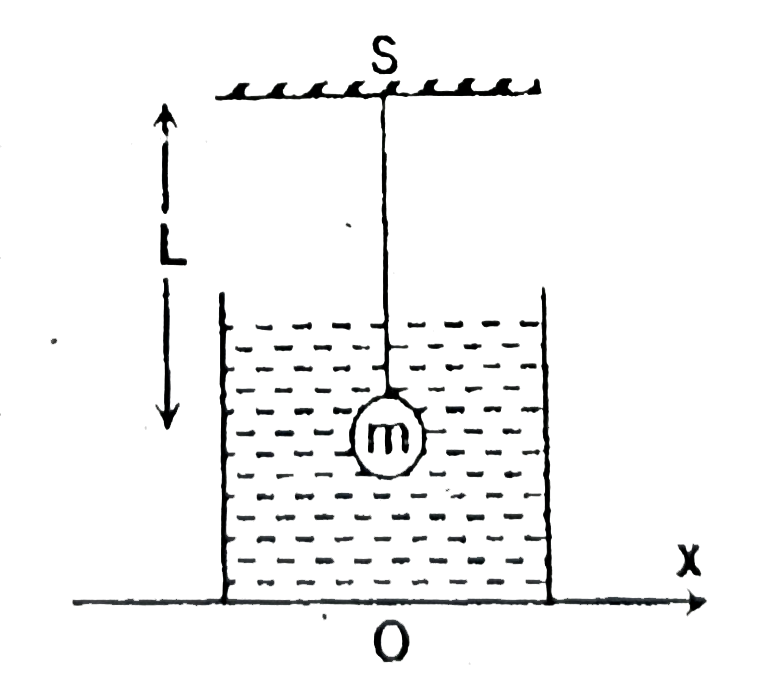
A beaker containing an ideal fluid executes plane `SHM` in a horizontal plane according to the equation `x=(sqrt(3)g)/(omega^(2))sinomegat`, `O` being the mean position. A bob is suspended at `S` through a string of length `L` as shown in the figure. The line `SO` is vertical. Assuming `L gtgt (sqrt(3)g)/(omega^(2))`.
The magnitude of maximum buoyant force and the time with it occurs for the second time are, respectively

A

`2g`, `pi//2omega`

B

`g`, `3pi//omega`

C

`2g`, `3pi//2`

D

`g`, `pi//omega`

Text Solution

Verified by Experts

(`C`) `2rhoVg`, `3pi//2omega`
Magnitude of component of Buoyant force `=rhova`
Where a is acceleration of beaker, `a=-sqrt(3) g sin omega t`
Net buoyant force `=sqrt(rho^(2)v^(2)g^(2)+rho^(2)v^(2)a^(2))`
`=rhovgsqrt(1+3sin^(2)omega t)`
Magnitude of maximum buoyant force `=2rhovg`
`sin^(2)omegat=1` at `t=(pi)/(2omega)`, `(3pi)/(2omega)`
`:. 2rhovg`, `(3pi)/(2omega)`
Promotional Banner

Topper's Solved these Questions

  • GMP ASSESMENT

    FIITJEE|Exercise Numerical Based|61 Videos
  • GMP ASSESMENT

    FIITJEE|Exercise Multiple Question|58 Videos
  • GENERAL PHYSICS

    FIITJEE|Exercise MATRIX MATCH TYPE|3 Videos
  • GRAVITATION

    FIITJEE|Exercise Numerical based Question|2 Videos

Similar Questions

Explore conceptually related problems

A beaker containing an ideal fluid executes plane SHM in a horizontal plane according to the equation x=(sqrt(3)g)/(omega^(2))sinomegat , O being the mean position. A bob is suspended at S through a string of length L as shown in the figure. The line SO is vertical. Assuming L gtgt (sqrt(3)g)/(omega^(2)) . The direction of buoyant force at time t=pi//2omega is best represented by

In YDSE set up (see fig.), the light sources executes SHM between P and Q according to the equation x = A sin omega t , S being the mean position. Assume d rarr 0 and A lt lt L . omega is small enough to neglect Doppler effect. If the sources were stationary at S, intenstiy at O would be I_(0) Read the paragraph carefully and answer the following questions. When the source comes toward the point Q,

In YDSE set up (see fig.), the light sources executes SHM between P and Q according to the equation x = A sin omega t , S being the mean position. Assume d rarr 0 and A lt lt L . omega is small enough to neglect Doppler effect. If the sources were stationary at S, intenstiy at O would be I_(0) Read the paragraph carefully and answer the following questions. The fractional change in intensity of the central maximum as function of time is

A block can slide along incline plane as shown in figure. The acceleration of chamber is ( 2)/( sqrt( 3))g m//s^(2) horizontally as shown. Find the time when the block collide with the vertical wall AB of the chamber ( take g = 10 m//s^(2) )

In YDSE set up (see fig.), the light sources executes SHM between P and Q according to the equation x = A sin omega t , S being the mean position. Assume d rarr 0 and A lt lt L . omega is small enough to neglect Doppler effect. If the sources were stationary at S, intenstiy at O would be I_(0) Read the paragraph carefully and answer the following questions. The fringe width beta can be expressed as

The periodic time of a particle executing a linear S.H.M. is (2pi)/(omega) . If its velocity at a dis"tan"ce b from the mean position is sqrt(3)bomega , then the path length of the particle is

A car is moving with constant speed of 10m/s on a horizontal circular path of radius 10sqrt(3m) . A bob of mass m suspended through a light string from the roof of the car. What is the angle made by the string with the vertical if the bob is stationary with respect to the car? (g = 10 m/ s^(2) )

Check the dimensional correctness of the following equations : (i) T=Ksqrt((pr^3)/(S)) where p is the density, r is the radius and S is the surface tension and K is a dimensionless constant and T is the time period of oscillation. (ii) n=(1)/(2l)sqrt((T)/(m)) , when n is the frequency of vibration, l is the length of the string, T is the tension in the string and m is the mass per unit length. (iii) d=(mgl^3)/(4bd^(3)Y) , where d is the depression produced in the bar, m is the mass of the bar, g is the accelaration due to gravity, l is the length of the bar, b is its breadth and d is its depth and Y is the Young's modulus of the material of the bar.

FIITJEE-GMP ASSESMENT-Comprehension
  1. When we raise the temperature of a body, the molecules and atoms move ...

    Text Solution

    |

  2. A beaker containing an ideal fluid executes plane SHM in a horizontal ...

    Text Solution

    |

  3. A beaker containing an ideal fluid executes plane SHM in a horizontal ...

    Text Solution

    |

  4. A beaker containing an ideal fluid executes plane SHM in a horizontal ...

    Text Solution

    |

  5. The plates each of area A of a parallel plate caoacitor are given char...

    Text Solution

    |

  6. The plates each of area A of a parallel plate caoacitor are given char...

    Text Solution

    |

  7. The plates each of area A of a parallel plate caoacitor are given char...

    Text Solution

    |

  8. Four capacitors of capacitance C, 2C, 3C & 4C respectively are connect...

    Text Solution

    |

  9. Four capacitors of capacitance C, 2C, 3C & 4C respectively are connect...

    Text Solution

    |

  10. Four capacitors of capacitance C, 2C, 3C & 4C respectively are connect...

    Text Solution

    |

  11. There are infinite equipotential lines all parallel to BC in a right a...

    Text Solution

    |

  12. There are infinite equipotential lines all parallel to BC in a right a...

    Text Solution

    |

  13. There are infinite equipotential lines all parallel to BC in a right a...

    Text Solution

    |

  14. In the given (Fig.) all the symbols have their usual meanings. At t = ...

    Text Solution

    |

  15. In the given (Fig.) all the symbols have their usual meanings. At t = ...

    Text Solution

    |

  16. In the given (Fig.) all the symbols have their usual meanings. At t = ...

    Text Solution

    |

  17. In the region between the plane z=0 and z=a (a gt 0), the uniform elec...

    Text Solution

    |

  18. In the region between the plane z=0 and z=a (a gt 0), the uniform elec...

    Text Solution

    |

  19. In the region between the plane z=0 and z=a (a gt 0), the uniform elec...

    Text Solution

    |

  20. A standing wave y = 2A sin kx cos omegat is set up in the wire AB fixe...

    Text Solution

    |

