Home
Class 11
PHYSICS
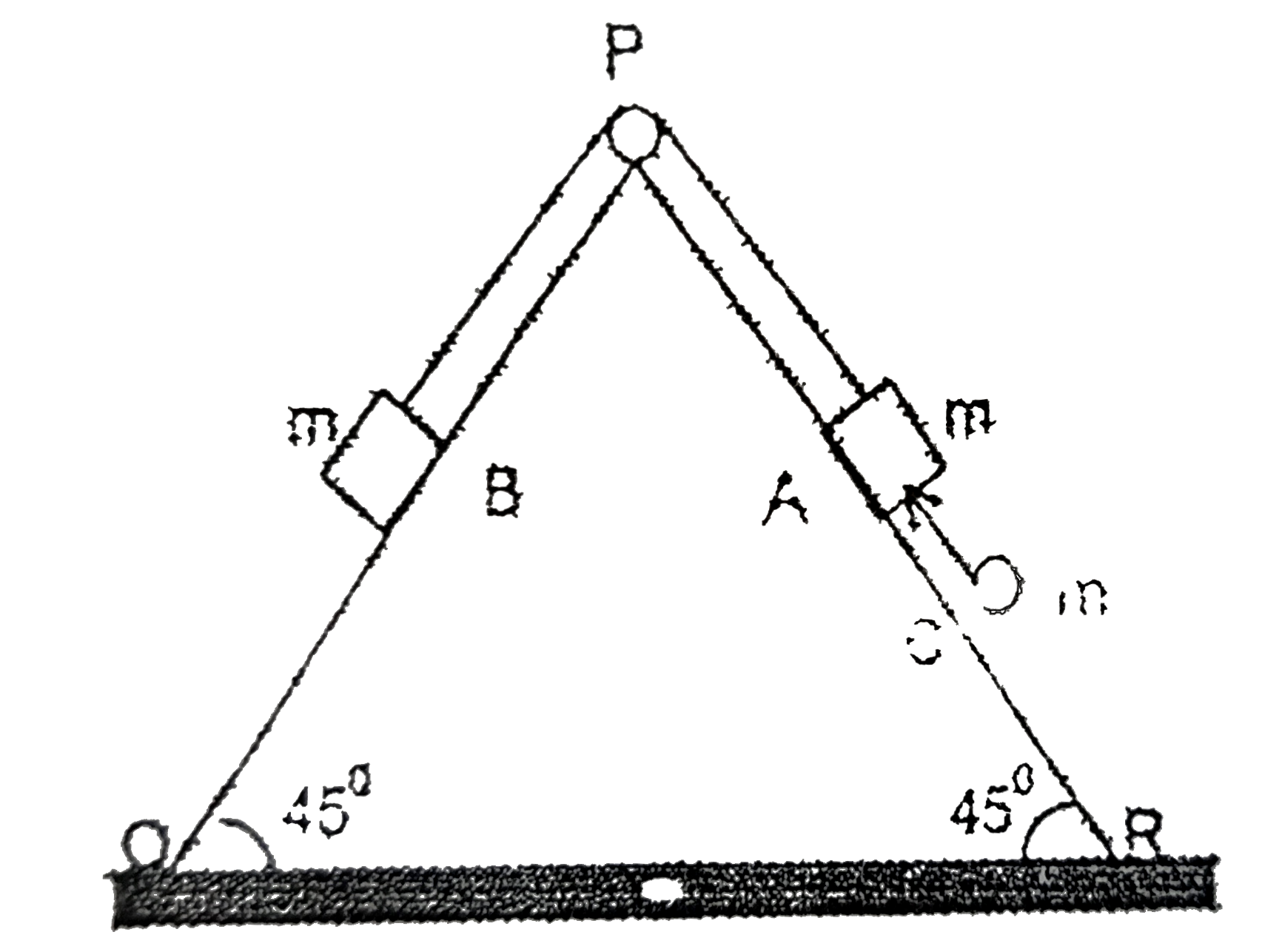
PQR is a wedge fixed to the floor. Two b...

`PQR` is a wedge fixed to the floor. Two blocks `A` & `B` of equal mass `m=1kg` is placed on either side of wedge connected through a string passing over the pulley `P`. Initially `PB=PA`. Another block `C` of mass `m=1kg` moving with a velocity `10m//s` collides inelasically with `A`. All the surfaces are smooth and pulley & string are massless.
(`a`) What should be the minimum length of the string `AB` so that block `A` does not hit the pulley ?
(`b`) What is the loss in meechanical energy from the instant `C` hits `A` to the instant when `B` starts moving upward ? (`g=10m//s^(2)`)

Text Solution

Verified by Experts

(`a`) Conservation of momentum,
`m_(c )v_(c )=(m_(A)+m_(C ))xxv_(1)`, `v_(1)=` common velocity of (`A+C`) mass.
`:. V_(1)=(m_(c )v_(c ))/(m_(A)+m_(C ))=(1xx10)/(2)=5m//s`.
String slacks and `B` starts moving downward under `ac c=g sin 45^(@)`.
`:. (A+C)` moves under retardation of `g sin45^(@)` and come to rest after time
`5=10xx(1)/(sqrt(2))t rArr t=0.707 sec`.
Distance moved in this time
`S_(1)=(v_(1)^(2))/(2gsin45^(@))=(5xx5xxsqrt(2))/(2xx10)=(5)/(4)sqrt(2)=1.76m`.
Now, string will again become taut and `(A+C)` will experience a jerk.
Velocity of `B` at this time `=5m//s`
`:.` Conservation of momentum
for `B : 1xx5-J=1xxv_(2)`, `J=`impulse generated
for `(A+C) : J=2xxv_(2)`, `v_(2)=` common velocity of `(A+C)` after string has become taut
`:. v_(2)=(5)/(3)m//s`
Now `(A+C)` will start moving upward with `v_(2)` velocity under retardation
`a=((m_((A+C))-m_(B))/(m_(A+C)+m_(B)))gsin45^(@)=((2-1)/(3))xx10xx(1)/(sqrt(2))=(10)/(3sqrt(2))m//s^(2)`
`:. (A+C)` will come to rest after moving distance
`S_(2)=((5//3)xx(5//3))/(2xx(10//3sqrt(2)))=(5)/(6sqrt(2))m=0.59m`
`:. ` Net length risen by `(A+C)=S_(1)+S_(2)=2.35m`.
`:. ` Length of the string must be at least `l=2xx2.35=4.7m`
(`b`) Energy loss in collision `=(1)/(2)m_(C )v_(c)^(2)-(1)/(2)(m_(A)+m_(C ))v_(1)^(2)`
`=(1)/(2)xx1xx100-(1)/(2)xx2xx25=25J`
Loss in impulsive jerk
`=(1)/(2)m_(B)v_(1)^(2)-(1)/(2)(m_(a)+m_(A)+m_(c ))v_(2)^(2)=(1)/(2)xx1xx25-(1)/(2)xx3xx(25)/(9)`
`=(25)/(2)[1-(1)/(3)]=(25)/(3)J`
`:. ` Net loss `=25+(25)/(3)=(4xx25)/(3)=(100)/(3)=33.33J`
Promotional Banner

Topper's Solved these Questions

  • ELASTICITY & WAVES

    FIITJEE|Exercise Example|16 Videos

Similar Questions

Explore conceptually related problems

Two blocks of masses of 40 kg and 30 kg are connected by a weightless string passing over a frictionless pulley as shown in the figure.

Two blocks A and B , each of mass 10 kg , are connected by a light string passing over a smooth pulley as shown in the figure. Block A will remain at rest if the friction on it is

Two masses of 10 kg and 20 kg are connected with an inextensible string passing over two smooth pulleys as shown in the figure. The acceleration of 20 kg mass will be :

Two masses m and 2m are connected by a massless string, which passes over a pulley as shown in figure. The masses are held initially with equal lengths of the strings on either side of the pulley. Find the velocity of masses at the instant the lighter mass moves up a distance of 15m. ( g = 10 m//s^(2) )

In the arrangement shown in fig. the block of mass m=2kg lies on the wedge of mass M=8kg . The initial acceleration of the wedge, if the surfaces are smooth, is

Two blocks of masses m_(1) and m_(2)(m_(1) gt m_(2)) connected by a massless string passing over a frictionless pulley Magnitude of acceleration of blocks would be

Figure shows an arrangement of pulleys and two blocks. All surfaces are frictionless . All pulleys and strings are massless. All string are smooth and massless. The acceleration of block A is :

In the situation shown below a block A of mass 5 kg is kept on the wedge B of mass 8 kg. All surfaces are smooth and string is massless, smooth and inextensible. Then acceleration of wedge B in m/ s^2 is?
