Home
Class 11
PHYSICS
A particle m starts with zero velocity a...

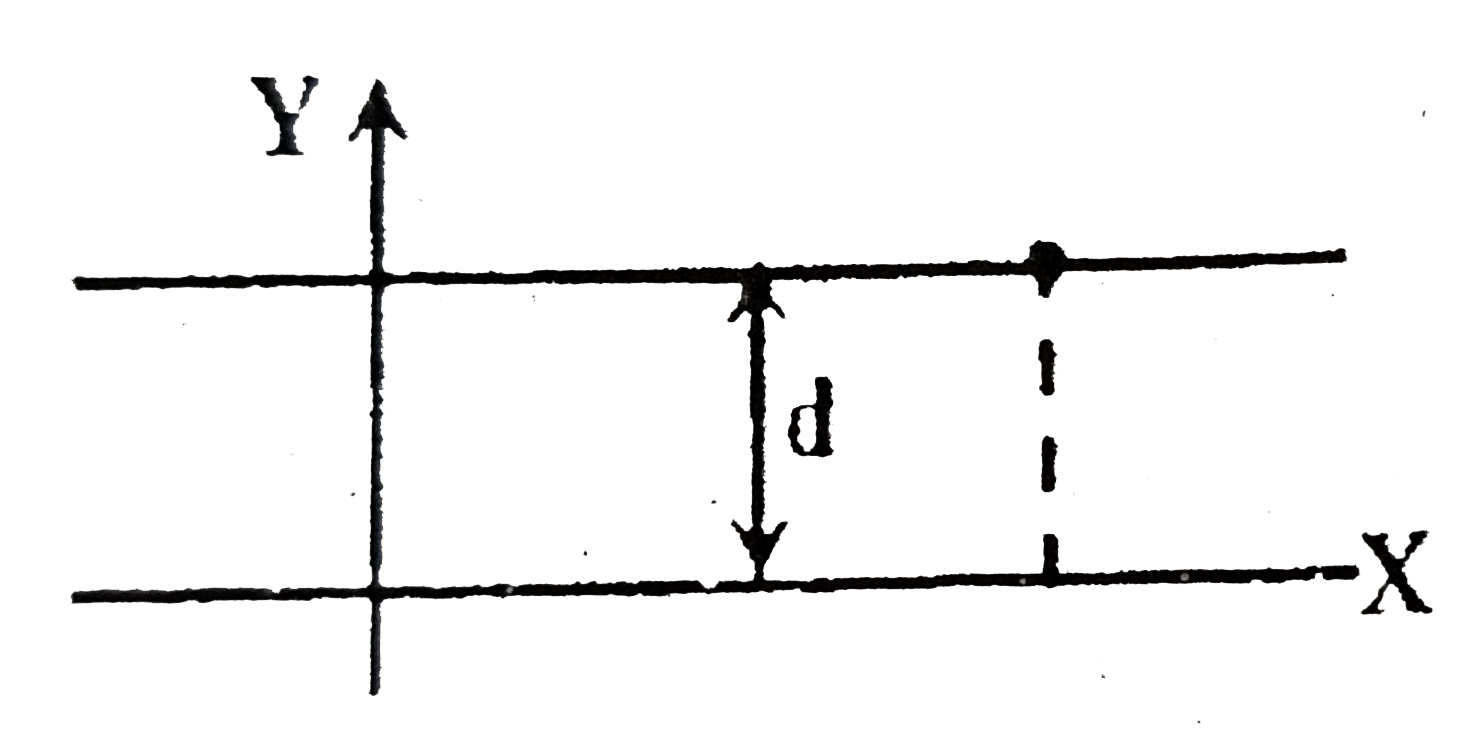
A particle `m` starts with zero velocity along a line `y=4d`. The position of particle `m` varies as `x=A sin omegat`, At `omegat=pi//2`, its angular momentum with respect to the origin

A

`mAomegad`

B

`momegad//A`

C

`mAd//omega`

D

zero

Text Solution

Verified by Experts

At `omegat=pi//2`
`u=Aomegacost=0`
So, angular momentum of particle `m` with respect to the origin should be zero.
Promotional Banner

Topper's Solved these Questions

  • LAWS OF MOTION

    FIITJEE|Exercise Example|12 Videos
  • SIMPLE HARMONIC MOTION

    FIITJEE|Exercise Example|15 Videos

Similar Questions

Explore conceptually related problems

A particle moves with a constant velocity pralel to the X-axis. Its angular momentum with respect to the origin

Position of a particle varies as y = cos^(2) omegat - sin^(2) omegat . It is

A body of mass m is moving with a constant velocity along a line parallel to the x-axis, away from the origin. Calculate its angular momentum with respect to the origin?

A particle performs uniform circular velocity along a line parallel to the x-axis, away from the origin. Its angular momentum with respect to the origin.

A body of mass m is moving with a constant velocity along a line parallel to the x-axis, away from the origin. Its angular momentum with respect to the origin

A mass m is moving with a constant velocity along a line parallel to the x-axis, away from the origin. Its angular momentum with respect to the origin.

A point particle travels in a straight line at constant speed. The closest it comes to the origin of coordinatesisa distance l With respect to this origin, does the particle have nonzero angular momentum ? As the particle moves along its straight line path, does its angular momentum with respect to origin change.

A x and y co-ordinates of a particle are x=A sin (omega t) and y = A sin(omegat + pi//2) . Then, the motion of the particle is

A particle mass 1 kg is moving along a straight line y=x+4 . Both x and y are in metres. Velocity of the particle is 2m//s . Find the magnitude of angular momentum of the particle about origin.

FIITJEE-ROTATIONAL MECHANICS-Example
  1. In the figure shown, a solid sphere of mass 'm' and radius r is releas...

    Text Solution

    |

  2. A cube of side a and mass M is pivoted on a horizontal axis such that ...

    Text Solution

    |

  3. A spool of thread of mass m and moment of inertia I is attached to the...

    Text Solution

    |

  4. A sphere of radius R is projected with a reverse spin omega(0) down a ...

    Text Solution

    |

  5. A plank of mass M is moving on a smooth horizontal surface with speed ...

    Text Solution

    |

  6. A solid sphere is rolling on a rough surface, whose centre of mass is ...

    Text Solution

    |

  7. When a body rolls without sliding up an inclined plane the frictional ...

    Text Solution

    |

  8. A particle m starts with zero velocity along a line y=4d. The position...

    Text Solution

    |

  9. A sphere of radius R and mass M collides elastically with a cubical bl...

    Text Solution

    |

  10. A body of mass m and radius r is released from rest along a smooth inc...

    Text Solution

    |

  11. Ler l be the moment of inertia of a uniform square plate about an axi...

    Text Solution

    |

  12. When a car negotiates a curve, the normal force exerted on the inner a...

    Text Solution

    |

  13. A massless string is wrapped around a hollow cylinder having mass m an...

    Text Solution

    |

  14. A cubical box of side length L rests on a rough horizontal surface hav...

    Text Solution

    |

  15. Two identical unifrom rods OA and OB each of length l and mass m are c...

    Text Solution

    |

  16. Two identical unifrom rods OA and OB each of length l and mass m are c...

    Text Solution

    |

  17. Two identical unifrom rods OA and OB each of length l and mass m are c...

    Text Solution

    |