Home
Class 12
PHYSICS
A particle of mass m moves in the XY pla...

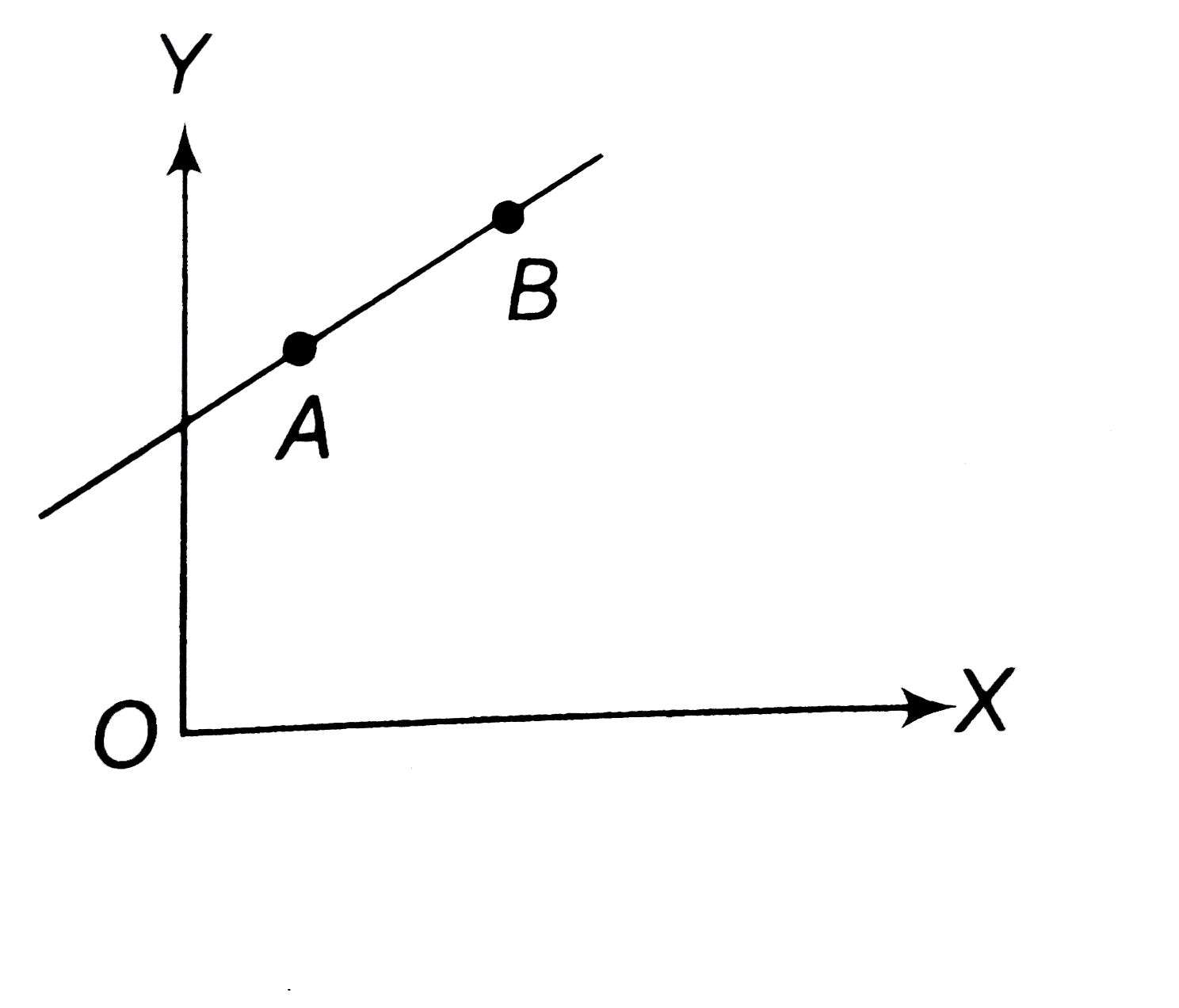
A particle of mass `m` moves in the `XY` plane with a velocity `v` along the straight line `AB`. If the angular momentum of the particle with respect to origin `O` is `L_(A)` when it is at A and `L_(B)` when it is at B, then

A

`L_(A) gt L_(B)`

B

`L_(A)=L_(B)`

C

the relationship between `L_(A)` and `L_(B)` depends upon the slope of the line `AB`

D

`L_(A) lt L_(B)`

Text Solution

Verified by Experts

The correct Answer is:

b
Promotional Banner

Topper's Solved these Questions

  • RE-NEET 2024

    NEET PREVIOUS YEAR (YEARWISE + CHAPTERWISE)|Exercise Question|50 Videos
  • SOLID AND SEMICONDUCTOR DEVICES

    NEET PREVIOUS YEAR (YEARWISE + CHAPTERWISE)|Exercise Exercise|105 Videos

Similar Questions

Explore conceptually related problems

A particle of mass m is moving on the XY-plane along a straight line y = d, with constant velocity v. Its angular momentum about the origin

A particle of mass m moves along line PC with velocity v as shown. What is the angular momentum of the particle about O ?

A particle of mass m moves along line PC with velocity v as shown. What is the angular momentum of the particle about P?

A particle moves on a straight line with a uniform velocity. The angular momentum of the particles is

A particle of mass 300 g is moving with a speed of 20 ms^-1 along the straight line y = x - 4sqrt2 . The angular momentum of the particle about the origin is (where y & x are in metres)

A particle of mass m is moving with constant velocity v parallel to the x-axis as shown in the figure. Its angular momentum about origin O is

A particle of mass 1 kg is moving alogn the line y=x+2 with speed 2m//sec . The magnitude of angular momentum of the particle about the origin is

A particle of mass m=5 kg is moving with a uniform speed v=3 sqrt(2) in the XOY plane along the line Y=X+4 . The magnitude of the angular momentum of the particle about the origin is

NEET PREVIOUS YEAR (YEARWISE + CHAPTERWISE)-ROTATIONAL MOTION-Exercise
  1. A thin rod of length L and mass M is bent at its midpoint into two hal...

    Text Solution

    |

  2. The ratio of the radii of gyration of a circular disc to that of a cir...

    Text Solution

    |

  3. A particle of mass m moves in the XY plane with a velocity v along the...

    Text Solution

    |

  4. A wheel has angular acceleration of 3.0 rad//s^2 and an initial angula...

    Text Solution

    |

  5. A uniform rod of length l and mass m is free to rotate in a vertical p...

    Text Solution

    |

  6. A tube of length L is filled completely with an incomeressible liquid ...

    Text Solution

    |

  7. The moment of inertia of a uniform circular disc of radius R and mass ...

    Text Solution

    |

  8. Two bodies have their moments of inertia I and 2 I respectively about ...

    Text Solution

    |

  9. Three particles, each of mass m grams situated at the vertices of an e...

    Text Solution

    |

  10. Consider a system of two particles having masses m(1) and m(2). If the...

    Text Solution

    |

  11. A round disc of moment of inertia I2 about its axis perpendicular to i...

    Text Solution

    |

  12. The ratio of the radii of gyration of a circular disc about a tangenti...

    Text Solution

    |

  13. A ball rolls without slipping. The radius of gyration of the ball abou...

    Text Solution

    |

  14. A thin circular ring of mass M and radius R is rotating about its a...

    Text Solution

    |

  15. A rod of length L is of non uniform cross-section. Its mass per unit l...

    Text Solution

    |

  16. A solid sphere of radius R is placed on a smooth horizontal surface. A...

    Text Solution

    |

  17. A circular disc is to be made by using iron and aluminium, so that it ...

    Text Solution

    |

  18. A disc is rotating with angular velocity omega. If a child sits on it,...

    Text Solution

    |

  19. A wheel of bicycle is rolling without slipping on a level road. The ve...

    Text Solution

    |

  20. A particle of mass M is revolving along a circule of radius R and noth...

    Text Solution

    |
