Home
Class 12
CHEMISTRY
X(C(4)H(9)Br) underset(Delta) overset(al...

`X(C_(4)H_(9)Br) underset(Delta) overset(alc.KOH)to Yoverset(Br_(2)//"CC"l_(4)) rarrZ underset(Delta) overset(NaNH_(2)(2eq.))to W underset(("Tollen's reagent")) overset(AgNO_(3)+NH_(4)OH)to`white ppt
Which of the following statement(s) is//are incorrect?

A

`Y` and `W` are chain isomers

B

`Y` and `W` are functional isomers

C

`W` can be converted into `Y` with `H_(2)//Pt`

D

`W` can be converted into `Y` with Lindlar catalyst

Text Solution

Verified by Experts

The correct Answer is:
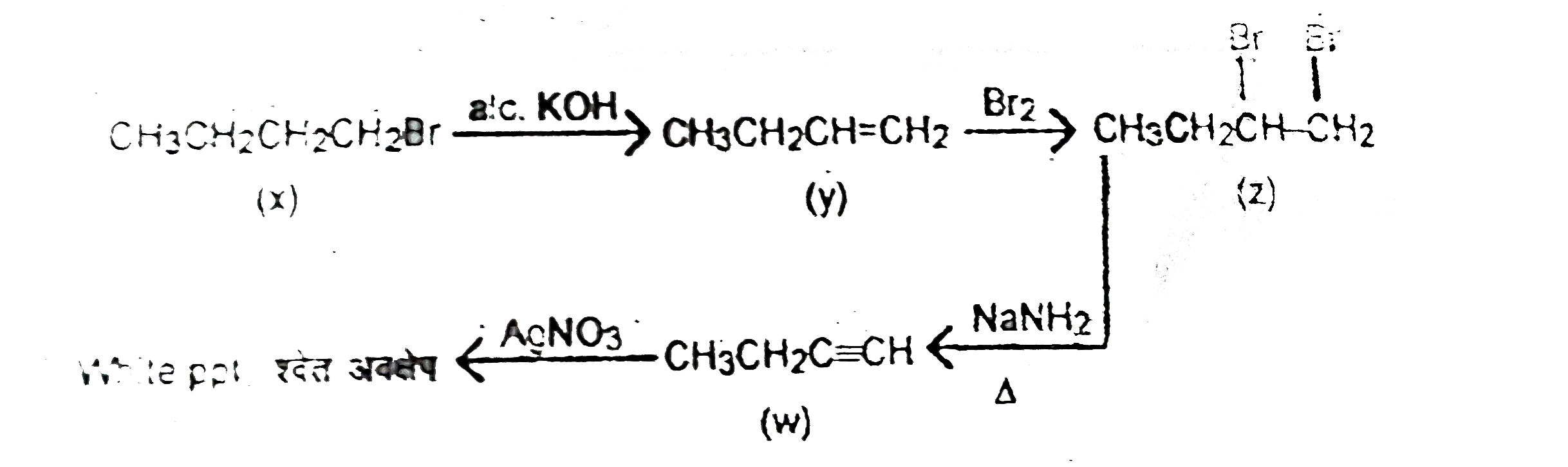
A, B, C


So, `X` is `CH_(3)-CH_(2)-CH_(2)-CH_(2)B`
Promotional Banner

Topper's Solved these Questions

  • TEST PAPERS

    RESONANCE|Exercise PT-03|1 Videos
  • THERMODYNAMICS

    RESONANCE|Exercise exercise-3 part-III Advanced level Solutions (STAGE-II)|45 Videos

Similar Questions

Explore conceptually related problems

X(C_(4)H_(9)Br) underset(Delta) overset(alc.KOH)to Yoverset(Br_(2)//"CC"l_(4)) rarrZ underset(Delta) overset(NaNH_(2)(2eq.))to W underset(("Tollen's reagent")) overset(AgNO_(3)+NH_(4)OH)to white ppt Reductive ozonolysis of Y yields

CH_(3)CH_(2)Br underset(Delta)overset(Aq.KOH)to A underset(Delta)overset(KMnO_(4)//H^(+))to B underset(Delta)overset(NH_(3))to C underset("Alkali")overset(Br_(2))toD , D is

PhNO_(2) underset(NH_(4)Cl)overset(Zn)to A underset("Tollen's Reagent")overset(AgNO_(3), NH_(4)OH)toB (organic compound). Which is/are incorrect?

X(C_(4)H_(9)Br)overset("alc."KOH)rarrYoverset(Br_(2))rarrZ("Dibromide")overset(NaNH_(2))rarrW("gas")underset(Sol^(n))overset(AgNO_(3))rarr"white ppt".X,Y "and" Z "are"

CHequivCHunderset(Pd//BaSO_(4))overset(H_(2))to[A]overset(Br_(2))to[B]underset("Heat")overset(KOH(alc.))to[C]

R-COOHunderset(Delta)overset(ND_(3))to(A)underset(Delta)overset(Br_(2),KOH)to(B)overset(NaNO_(2)+HCl)to(C)

CH_(3)-underset(Br)underset(|)CH-CH_(2)-overset(O)overset(||)C-CH_(3)underset(Delta)overset(N_(2)H_(4),overset(Ө)OH)rarr product :

underset(NH_(3)(l))overset(2eq.KNH_(2))tounderset("then "H_(3)O^(o+))overset(n-C_(4)H_(9)-Br)to(P), end product (P) of the above reaction is:

CH_(3)-underset(CH_(3))underset(|)overset(Br)overset(|)C-CH_(3) underset("-HBr")underset(Delta)overset(Alc. NH_(3))to Y . Y is this reaction is ________ .

overset ((i)NaNH_(2),NH_(3)) underset((ii)CH_(3)Br)to (A) overset (H_(2)) underset ("Lindlar catalyst ") to (B) ,

RESONANCE-TEST SERIES-CHEMISTRY
  1. Metallic gold frequently is found in aluminosilicate rocks and it is f...

    Text Solution

    |

  2. X(C(4)H(9)Br) underset(Delta) overset(alc.KOH)to Yoverset(Br(2)//"CC"l...

    Text Solution

    |

  3. X(C(4)H(9)Br) underset(Delta) overset(alc.KOH)to Yoverset(Br(2)//"CC"l...

    Text Solution

    |

  4. If 0.1 molar solution of glucose (Molecular weight =180) is separated...

    Text Solution

    |

  5. Amongst the following ions which one has the highest magnetic moment v...

    Text Solution

    |

  6. The oxidation number of cobalt in K[Co(CO)(4)] is:

    Text Solution

    |

  7. Choose the incorrect statement about corrosion on the metal surface.

    Text Solution

    |

  8. The standard electrode potential for Daniel cell is 1.1V. Calculate th...

    Text Solution

    |

  9. Electrode potential for Mg electrode varies according to the equation ...

    Text Solution

    |

  10. The number of moles of water which must be electrolyzed to produce 22....

    Text Solution

    |

  11. Choose the incorrect statement from the following:

    Text Solution

    |

  12. Select in incorrect match

    Text Solution

    |

  13. Select the incorrect statement.

    Text Solution

    |

  14. Silicones repel water due to:

    Text Solution

    |

  15. The colour developed when Na(2)S is added to Na(2)[Fe(CN)(5)NO] is,

    Text Solution

    |

  16. Select incorrect statement

    Text Solution

    |

  17. Which of the following interface cannot be obtained?

    Text Solution

    |

  18. Which of the following statement is true?

    Text Solution

    |

  19. CH(3)-CH(2)-OH In the given reaction A & B are respectively:

    Text Solution

    |

  20. Which of the following reaction correctly reports the major product?

    Text Solution

    |

