Home
Class 11
PHYSICS
A non-viscous liquid of constant density...

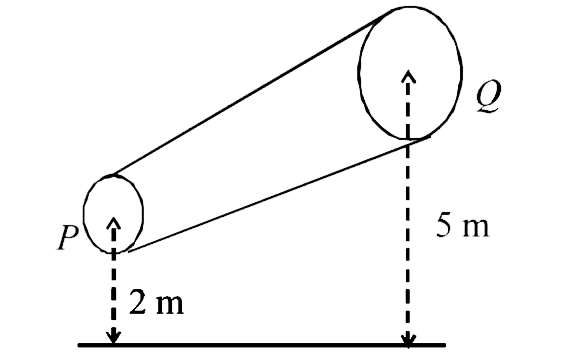
A non-viscous liquid of constant density `1000kg//m^3` flows in a streamline motion along a tube of variable cross section. The tube is kept inclined in the vertical plane as shown in Figure. The area of cross section of the tube two point P and Q at heights of 2 metres and 5 metres are respectively `4xx10^-3m^2` and `8xx10^-3m^2`. The velocity of the liquid at point P is `1m//s`. Find the work done per unit volume by the pressure and the gravity forces as the fluid flows from point P to Q.

Text Solution

Verified by Experts

The correct Answer is:
25

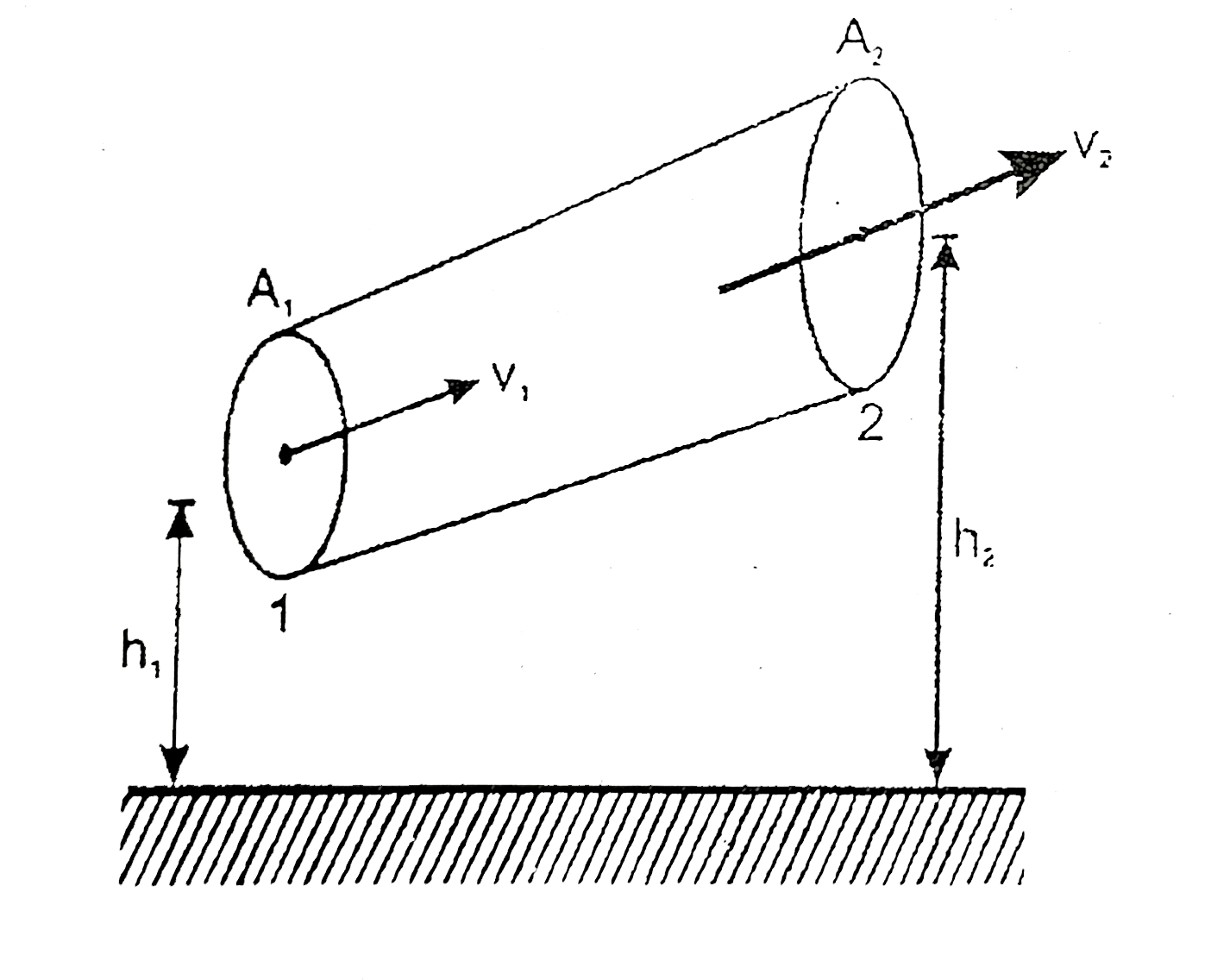
Given : `A_(1) = 4 xx 10^(-3)m^(2), A_(2) = 8 xx 10^(-3)m^(2)`
`h_(1) = 2m, h_(2) = 5m`
`v_(1) = 1m//s` and `rho = 10^(3) kg//m^(3)`
From continuity equation, we have
`A_(1)v_(1) = A_(2)v_(2)` or `v_(2) = ((A_(1))/(A_(2))v_(1))`
or `v_(2) = ((4 xx 10^(-3))/(8 xx 10^(-3))) (1 m//s)`
`v_(2) = (1)/(2) m//s`
Applying Beronulli's equation at section `1` and `2`
`P_(1) + (1)/(2) rhov_(1)^(2) + rhogh_(1) = P_(2) + (1)/(2)rhov_(2)^(2) + rhogh_(2)`
or `P_(1) - P_(2) = rhog (h_(2) - h_(1)) + (1)/(2) rho (v_(2)^(2) - v_(1)^(2)).......(2)`

`(i)` Work done per unit volume by the pressure as the fluid flows form `P` to `Q`.
`W_(1) = P_(1) - P_(2)`
`= rhog (h_(2) - h_(1)) + (1)/(2)rho (v_(2)^(2) - v_(1)^(2))` [From Eq. `(1)`]
`= {(10^(3))(9.8)(5 - 2) + (1)/(2)(10^(3))((1)/(4)-1)}J//m^(2)`
`= [29400 - 375] J//m^(3)`
`= 29025 J//m^(3)`
`1161 alpha = 29025 J//m^(3)`
`alpha = 25`
Promotional Banner

Topper's Solved these Questions

  • FLUID MECHANICS

    RESONANCE|Exercise Exercise- 2 PART - III|8 Videos
  • FLUID MECHANICS

    RESONANCE|Exercise Exercise- 2 PART - IV|10 Videos
  • FLUID MECHANICS

    RESONANCE|Exercise Exercise- 2 PART - I|18 Videos
  • ELECTROSTATICS

    RESONANCE|Exercise Exercise|52 Videos
  • FULL TEST 1

    RESONANCE|Exercise Exercise|30 Videos

Similar Questions

Explore conceptually related problems

(i) Air (density= rho ) flows through a horizontal venturi tube that discharges to the atmosphere. The area of cross section of the tube is A_(1) and at the constriction it is A_(2) . The constriction is connected to a water (density =rho_(0) ) tank through a vertical pipe of lenght H. Find the volume flow rate (Q) of the air through tube that is needed to just draw the water into the tube. (ii) A non viscous liquid of constant density rho flows in a stremline motion along a tube of variable cross section. The tube is kept inclined in the vertical plane as shown in the figure. The area of cross section of the tube at two points P and Q at heights of h_(1) and h_(2) are respectively A_(1) and A_(2) . The velocity of the liquid at point P is v. Find the work done on a small volume DeltaV of fluid by the neighbouring fluid as the small volume moves from P to Q.

A non-viscous liquid of constant density 500 kg//m^(3) flows in a variable cross-sectional tube. The area of cross section of the tube at two points P and Q at heights of 3 m and 6 m are 2 xx 10^(-3) m^(3) and 4 xx 10^(-3) m^(3) , respectively. Find the work done per unit volume by the forces of gravity as the fluid flows from point P to Q .

A non viscous liquid of constant density 10^(3) kg//m^(3) flows in stream line motion along a vertical tube PQ of variable cross-section. Height of P and Q are 2m and 2.5m respectively. Area of tube at Q is equal to 3 times the area of tube at 'P'. Then work done per unit volume by pressure as liquid flows from P and Q. Speed of liquid at 'P' is 3 m//s .

Water flows through the tube shown in figure. The areas of cross section of the wide and the narrow portions of the tube are 5cm^2 and 2cm^2 respectively. The rate of flow of water through the tube is 500 cm^3s^-1 . Find the difference of mercury levels in the U-tube.

A liquid of density rho comes out with a velocity v from a horizontal tube of area of cross-section A. The reaction force exerted by the liquid on the tube is F :

Water flows through the tubes shown in figure. The areas of cross-section of the wide and the narrow portions of the tube are 5 cm^(2) and 2 cm^(2) respectively. The rate of flow of water through the tube is 500 cm^(3)//s . Find the difference of mercury levels in the U-tube.

A V-shaped glass tube of uniform cross section is kept in a vertical plane as shown. A liquid is poured in the tube. In equilibrum the level of liquid in both limds of tube. Find the angular frequency of small oscillation of liquid.

Figure shows a liquid of densith 1200kgm^-3 flowing steadily in a tube of varying cross section. The cross section at a point A is 1.0cm^2 and that at B is 20mm^2 , the points A and B are in the same horizontal plane.The speed of the liquid at A is 10 cms^-1 . Calculate the difference in pressure at A and B.

