

Home
Class 12
CHEMISTRY
An ideal gas in thermally insulated vess...

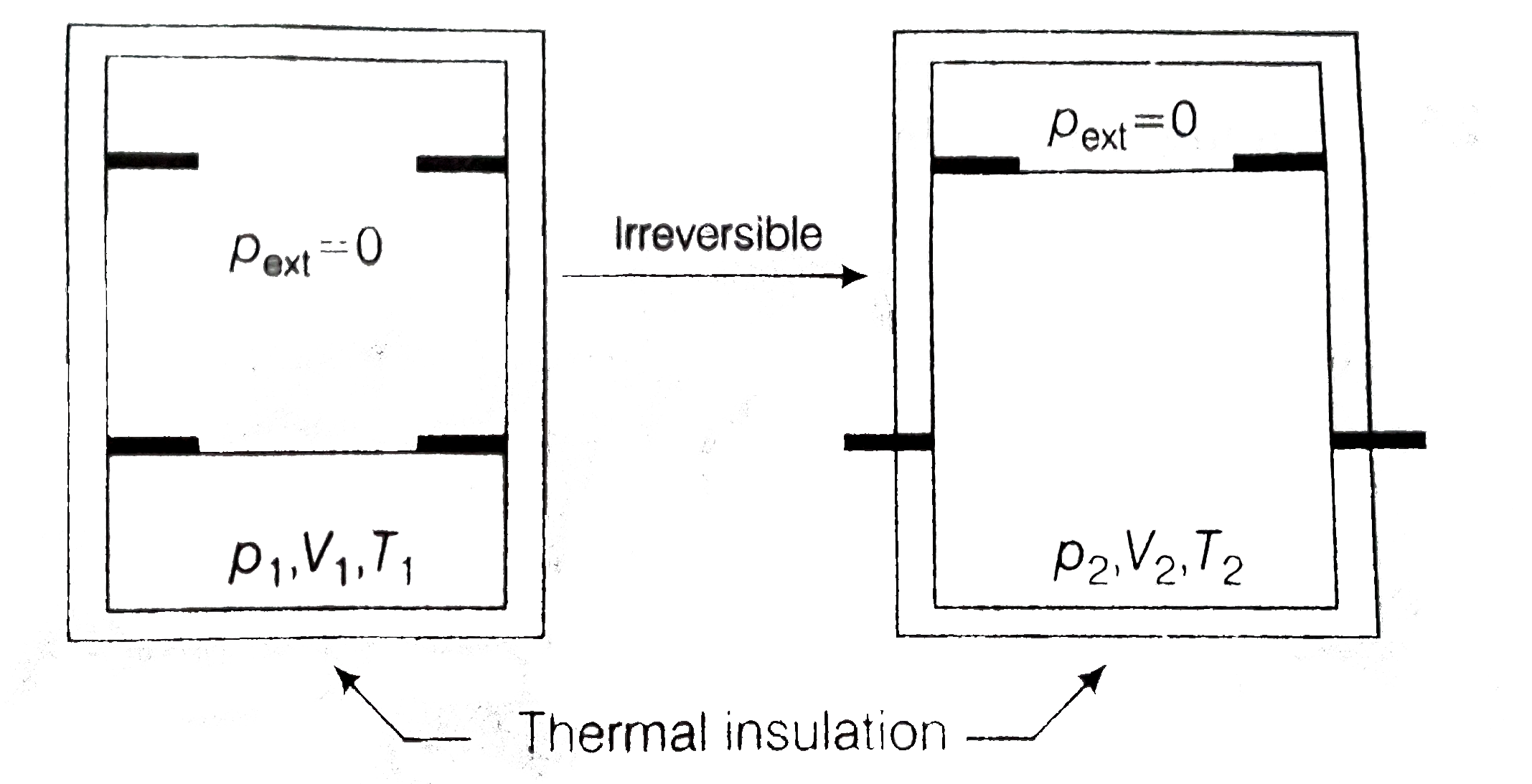
An ideal gas in thermally insulated vessel at internal `(pressure)=P_(1), (volume)=V_(1)` and absolute `temperature = T_(1)` expands irreversiby against zero external, pressure , as shown in the diagram,
The final internal pressure, volume and absolute temperature of the gas are `p_(2), V_(2) and T_(2)`, respectively . For this expansion

A

`q=0`

B

`T_(2)=T_(1)`

C

`p_(2)V_(2)= p_(1)V_(1)`

D

`P_(2)V_(2)^(gamma) =P_(1)V_(2)^(gamma)`

Text Solution

Verified by Experts

The correct Answer is:
a,b,c
Promotional Banner

Topper's Solved these Questions

  • SURFACE CHEMISTRY

    IIT-JEE PREVIOUS YEAR (CHEMISTRY)|Exercise JEE Main And Advanced|17 Videos

Similar Questions

Explore conceptually related problems

An ideal gas in a thermally insulated vessel at internal pressure =P_(1) , volume =V_(1) and absolute temperature =T_(1) expands irreversibly against zero external pressure, as shown in the diagram. The final internal pressure, volume and absolute temperature of the gas are P_(2), V_(2) and T_(2) respectively. For this expansion.

A gas enclosed in a vessel has pressure P, volume V and absolute temperature T, write the formula for number of molecule N of the gas.

Two containers of equal volume contain the same gas at pressure P_(1) and P_(2) and absolute temperature T_(1) and T_(2) , respectively. On joining the vessels, the gas reaches a common pressure P and common temperature T . The ratio P//T is equal to

Two identical vessels contain the same gas at pressure P_(1) and P_(2) at absolute temperature T_(1) and T_(2) , respectively. On joining the vessels with a small tube as shown in the figure. The gas reaches a common temperature T and a common pressure P. Determine the ratio P//T

If ideal gas expand against vaccum, insulated container then what will be final volume, final pressure & final temperature

One mole of an ideal monoatomic gas at temperature T and volume 1L expands to 2L against a constant external pressure of one atm under adiabatic conditions, then final temperature of gas will be:

IIT-JEE PREVIOUS YEAR (CHEMISTRY)-THERMODYNAMICS AND THERMOCHEMISTRY-JEE Main And Advanced
  1. For an endothermic reaction, where Delta H represents the enthalpy of ...

    Text Solution

    |

  2. The difference between the heats of reaction at constant pressure and ...

    Text Solution

    |

  3. An ideal gas in thermally insulated vessel at internal (pressure)=P(1)...

    Text Solution

    |

  4. Benzene and naphthalene form an ideal solution at room temperature. Fo...

    Text Solution

    |

  5. The reversible expansion of an ideal gas under adiabatic and isotherma...

    Text Solution

    |

  6. For an ideal gas, consider only P-V work in going from an initial stat...

    Text Solution

    |

  7. Among the following, the intensive property is (properties are) :

    Text Solution

    |

  8. Among the following , the state funcation (s) is (are)

    Text Solution

    |

  9. Identify the extensive quantities from the following (i) refractive ...

    Text Solution

    |

  10. Assertion (A) : There is a natural asymmetry between converting work t...

    Text Solution

    |

  11. Assertion (A): For every chemical reaction at equilibrium, standard Gi...

    Text Solution

    |

  12. Assertion: The heat absorbed during the isothermal expansion of an ide...

    Text Solution

    |

  13. A fixed mass m of a gas is subjected to transfromation of states from ...

    Text Solution

    |

  14. A fixed mass m of a gas is subjected to transformation of state: K to ...

    Text Solution

    |

  15. Match the thermodynamic processes given under column I with the expres...

    Text Solution

    |

  16. Match the transformations In column I with appropriate options in colu...

    Text Solution

    |

  17. Enthalpy is an ……………….. property.

    Text Solution

    |

  18. When Fe(S) is dissovled in aqueous hydrochloric acid in a closed vesse...

    Text Solution

    |

  19. The heat content of the products is more than that of the reactants in...

    Text Solution

    |

  20. A system is said to be………..if it can neither exchange matter nor energ...

    Text Solution

    |