Home
Class 12
CHEMISTRY
Plots showing the variation of the rate ...

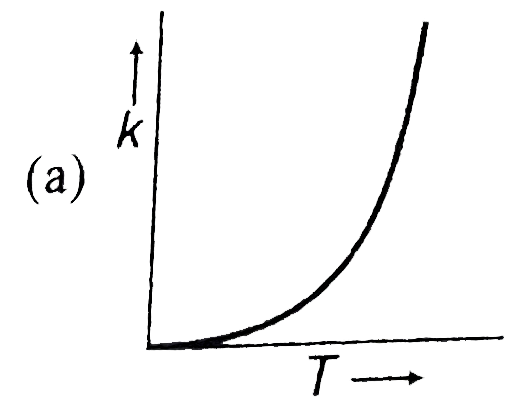
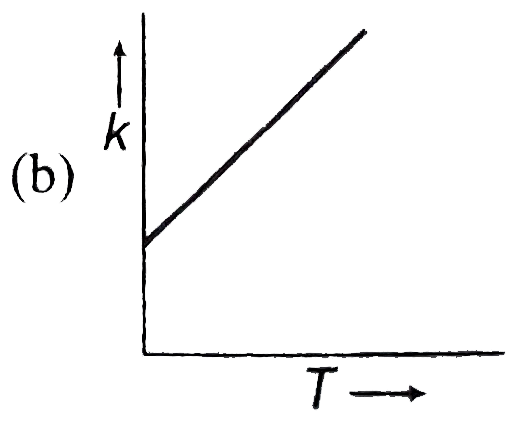
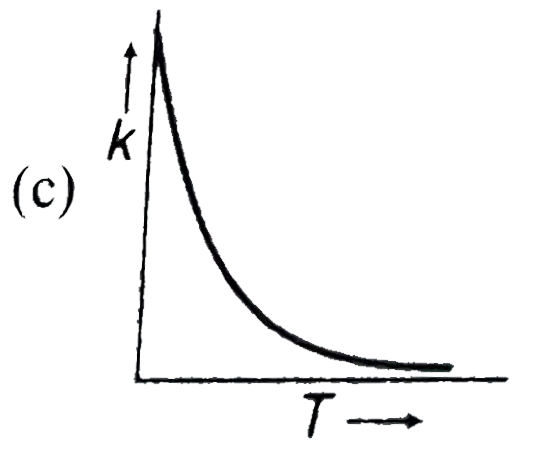
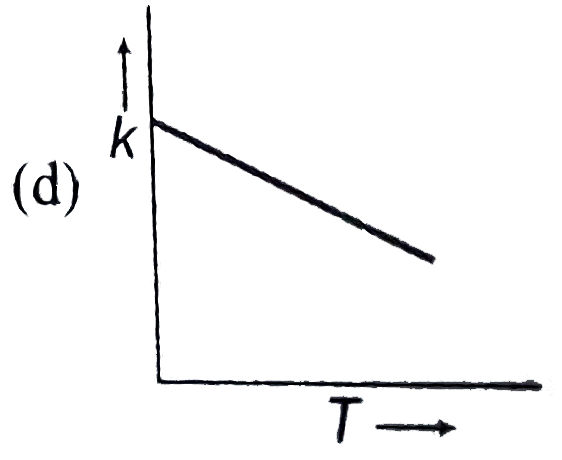
Plots showing the variation of the rate constant `(k)` with temperature `(T)` are given below. The plot that follows the Arrhenius equation is

A

B

C

D

Text Solution

Verified by Experts

The correct Answer is:

a
Promotional Banner

Topper's Solved these Questions

  • CHEMICAL BONDING

    IIT-JEE PREVIOUS YEAR (CHEMISTRY)|Exercise MATCH THE COLUMN|1 Videos
  • COORDINATION COMPOUNDS

    IIT-JEE PREVIOUS YEAR (CHEMISTRY)|Exercise PHYSICS|16 Videos

Similar Questions

Explore conceptually related problems

Which of the following graph is incorrect for variation of rate constant (K) with temperature for a reaction obeying Arrhenius equation ?

Accroding to Arrhenius equation, the rate constnat (k) is related to temperature (T)as

The variation of rate constant with temperature can be explained by Arrhenius equation. However , the can be explained by Activation energy is found to be temperature dependent/In such cases (d "in" K)/(dT)=(E_(a))/(RT^(2)) should be used to predict variation of rate constant with tempreature. On the basic of this information , answer the question that follow : If Arrhenius constant and E_(a) (activation energy0 are assumed to be constant then which of the following graph will be correct

Which one of the following given graphs represents the variation of rate constant (k) with temperature (t) for an endothermic reaction ?

Which one of the following given graphs represents the variation of rate constant (k) with temperature (f) for an endothermic reaction ?

The variation of rate constant with temperature is given by the integrated from of the Arrhenius equation, log_10k = (-Ea)/(2.303 RT) + constant where k = rate cosntant and Ea is the experimental activation energy. If for a certain reaction, log_10k = (-3163.0)/T + 11.899 , calculate Ea.

The variation of rate constant with temperature can be explained by Arrhenius equation. However , the can be explained by Activation energy is found to be temperature dependent/In such cases (d"in"K)/(dT)=(E_(a))/(RT^(2)) should be used to predict variation of rate constant with tempreature. On the basic of this information , answer the question that follow : If for a reaction in K=20-(20)/(T)+3 in T then E_(a) at 300 K will be

IIT-JEE PREVIOUS YEAR (CHEMISTRY)-CHEMICAL KINETICS-JEE Main And Advanced
  1. In the reaction, P+Q rarr R+S the time taken for 75% reaction of P i...

    Text Solution

    |

  2. The rate of a reaction doubles when its temperature changes form 300 K...

    Text Solution

    |

  3. Plots showing the variation of the rate constant (k) with temperature ...

    Text Solution

    |

  4. For a first order reaction A rarr P, the temperature (T) dependent rat...

    Text Solution

    |

  5. Under the same reaction conditions, the intial concentration of 1.386 ...

    Text Solution

    |

  6. Conisder a reaction aG+bH rarr Products. When concentration of both th...

    Text Solution

    |

  7. which one of the following statements (s) in incorrect about order of ...

    Text Solution

    |

  8. A follows first order reaction. (A) rarr Product The concentration...

    Text Solution

    |

  9. In a first order reaction, the concentration of the reactant decreases...

    Text Solution

    |

  10. Conisder the chemical reaction N(2)(g) + 3H(2)(g) rarr 2NH(3)(g) T...

    Text Solution

    |

  11. If I is the intenisty of an absorbed light and c is the concentration ...

    Text Solution

    |

  12. The rate constant for the reaction, 2N(2)O(5) rarr 4NO(2) + O(2) is 3....

    Text Solution

    |

  13. The half- life periof of a radioactive element is 140 days. After 560 ...

    Text Solution

    |

  14. A catalyst is a substance which

    Text Solution

    |

  15. The specific rate constant of a first order reaction depends on the

    Text Solution

    |

  16. The rate constant of a reaction depends on

    Text Solution

    |

  17. According to the Arrhenius equctions

    Text Solution

    |

  18. For the first order reaction 2N(2)O(5)(g) rarr 4NO(2)(g) + O(2)(g)

    Text Solution

    |

  19. the following statement (s) is are correct

    Text Solution

    |

  20. A catalyst

    Text Solution

    |
