

Home
Class 12
CHEMISTRY
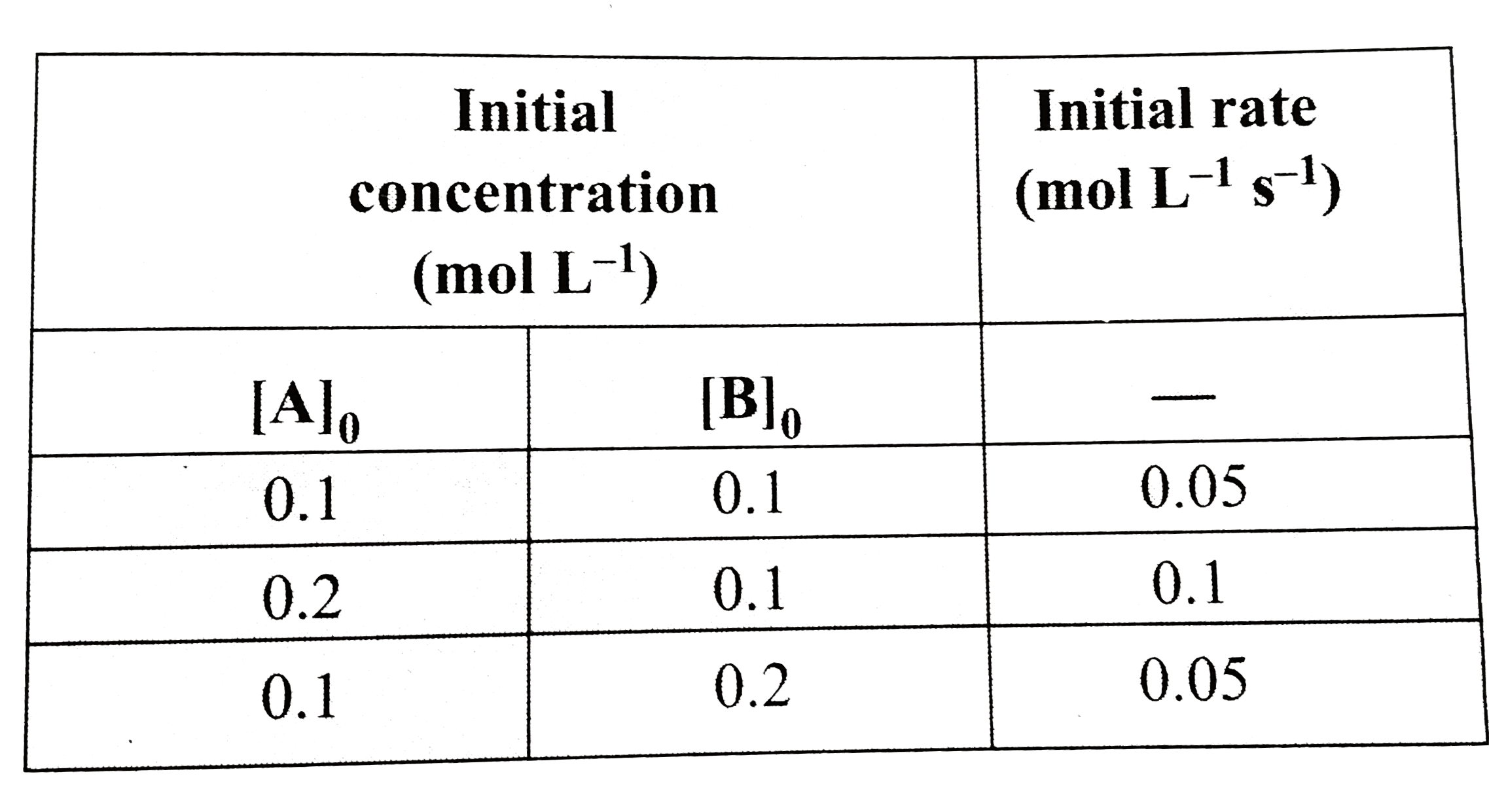
For the given reaction A+B rarr Produc...

For the given reaction
`A+B rarr` Products,
the following data are given.

(a) Write the rate equation.
(b) Calculate the rate constant.

Promotional Banner

Topper's Solved these Questions

  • CHEMICAL BONDING

    IIT-JEE PREVIOUS YEAR (CHEMISTRY)|Exercise MATCH THE COLUMN|1 Videos
  • COORDINATION COMPOUNDS

    IIT-JEE PREVIOUS YEAR (CHEMISTRY)|Exercise PHYSICS|16 Videos

Similar Questions

Explore conceptually related problems

For the given reaction, A + B rarr Products Following data are given (a) Write the rate equation (b) Calculate the rate constant

For the given reaction, A+B rarr Products following data were obtained (i) Write the rate law expression. (ii) Find the rate constant.

form the gaseous reaction 2A + B_(2) rarr 2AB , the following rate data were obtained at 300 K . Calculate the rate constant for the reaction and the rate of formation of AB when [A] is 0.02 and [B_(2)] is 0.04 mol L^(-1) at 300K .

(a) For a reaction , A+B rarr Product the rate law is given rate = k[A]^(1)[B]^(2) .What is the order of the reaction ? (b) write the unit of rate constant k for the first order reaction

For the reaction between A and B A+B to product the following rate data were obtained . the reaction is

For a hypothetical reaction: A+B rarr Products, the rate law is r = k[A][B]^(0) . The order of reaction is

For a reaction in which A and B form C , the following data were obtained form theee experiments: What is the rate equation of the equation and what is the value of rate constant ?

For the reaction A + B rarr products, doubling the concentration of A the rate of the reaction is doubled, but on doubling the concentration of B rate reamins unaltered. The overall order of the reaction is

For a hypothetical reaction aA + bB rarr Product, the rate law is: rate = K[A]^(x)[B]^(y) , then

IIT-JEE PREVIOUS YEAR (CHEMISTRY)-CHEMICAL KINETICS-JEE Main And Advanced
  1. An organic compound undergoes first decompoistion. The time taken for ...

    Text Solution

    |

  2. 2X(g) rarr 3Y(g)+2Z(g) {:("Time (in min)",0,100,200,):} |{:("Parti...

    Text Solution

    |

  3. For the given reaction A+B rarr Products, the following data are g...

    Text Solution

    |

  4. The rate of first order reaction is 0.04 mol L^(-1) s^(-1) at 10 min a...

    Text Solution

    |

  5. A hydrogenation reaction is carried out at 500 K. If the same reaction...

    Text Solution

    |

  6. The rate constant for an isomerization reaction, A rarr B is 4.5 xx 10...

    Text Solution

    |

  7. the rate constant of a reaction is 1.5xx10^(7) s^(-1) at 50^(@)C and ...

    Text Solution

    |

  8. The rate constant for the first order decompoistion of a certain react...

    Text Solution

    |

  9. One of the hazards of nuclear explosion is the generation of .^(90)Sr ...

    Text Solution

    |

  10. At 380^(@)C , the half-life periof for the first order decompoistion o...

    Text Solution

    |

  11. form the following data for the reaction between A and B, (a) Cal...

    Text Solution

    |

  12. The gas phase decomposition of dimethyl ether follows first order kine...

    Text Solution

    |

  13. A first order reaction A rarr B requires activation energy of 70 kJ mo...

    Text Solution

    |

  14. Two reaction, (I)A rarr Products and (II) B rarr Products, follow firs...

    Text Solution

    |

  15. The nuclide ratio, .(1)^(3) H to .(1)^(1) H in a sample of water is 8....

    Text Solution

    |

  16. The decompoistion of N(2)O(5) according to the equation 2N(2)O(5)(g) r...

    Text Solution

    |

  17. In a Arrhenius equation for a certain reaction, the values of A and E(...

    Text Solution

    |

  18. AN experiment requires minimum beta activity produced at the rate of 3...

    Text Solution

    |

  19. A first order gas reaction has k = 1.5 xx 10^(-6) s^(-1) at 200^(@)C. ...

    Text Solution

    |

  20. While studying the decompoistion of gaseous N(2)O(5), it is observed t...

    Text Solution

    |