

Home
Class 11
CHEMISTRY
Prove that the formation of NaCI(2) is h...

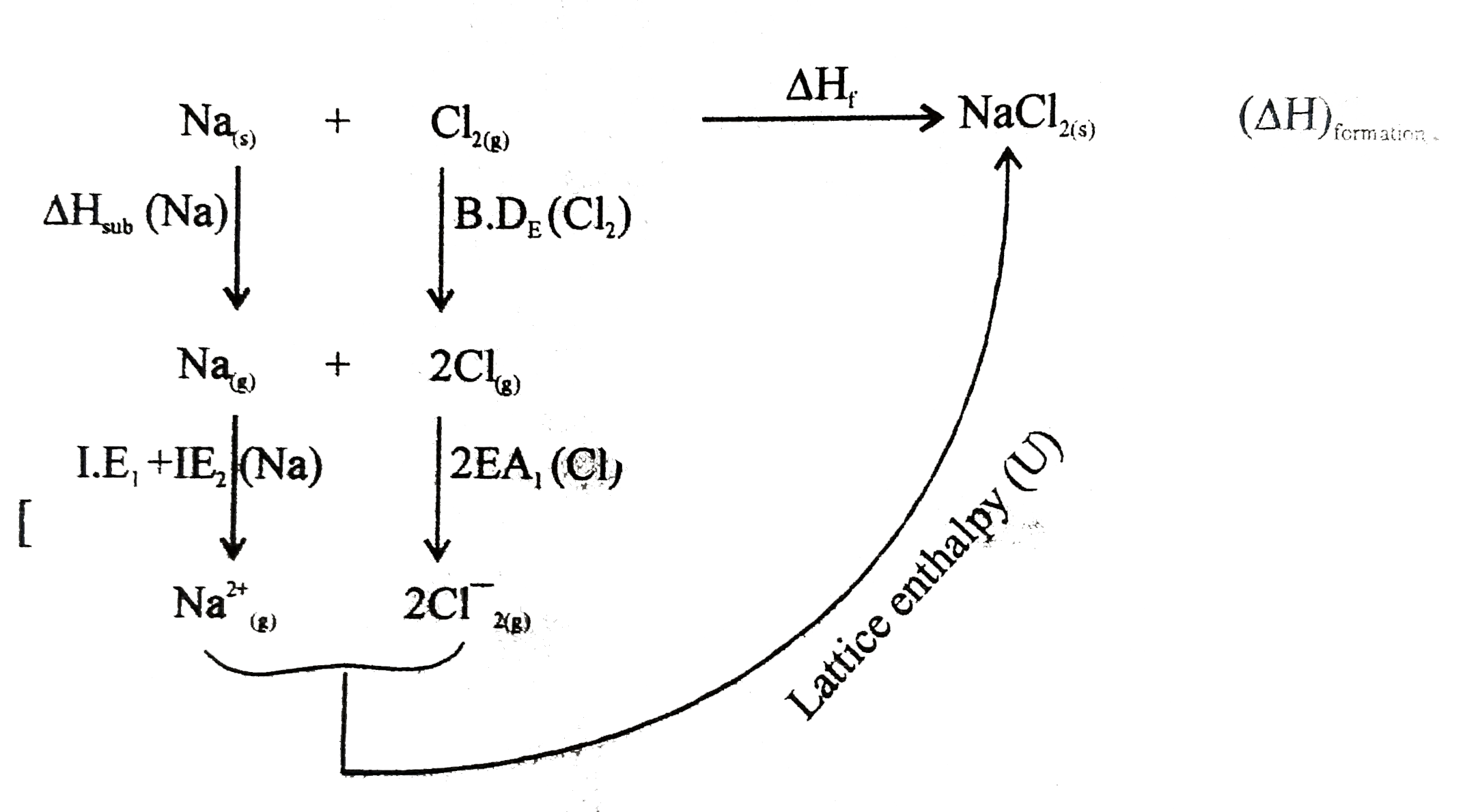
Prove that the formation of `NaCI_(2)` is highly endothermic and energetically unfavorable from the following data using Born-Haber Cycle
`{:("Heat of sublimation of"Na,=,109kJ//mol),(1^(st)IE of Na,=,494 kJ//mol),(1^(st)IE of Na^(+),=,4563 kJ//mol),("Bond Energy of" CI_(2),=,242 kJ//mol),("Electron gain enthalpy of"CI,=,-347 kJ//mol),("Lattice energy of" NaCI_(2),=,2560 kJ//mol):}`

Text Solution

Verified by Experts

The correct Answer is:
`[2154 kJ//mol]`


`DeltaH_(f) = (DeltaH)_("sub")` of `Na +(IE_(1) +IE_(2))` of `Na + BDE(CI_(2)) +2EA_(1) (CI)+U`
After putting the value `(DeltaH)` value is obtain with positive significance. Therefore formation of `NaCI_(2)` is highly endothermcic & energetically unfavorable
Promotional Banner

Topper's Solved these Questions

Similar Questions

Explore conceptually related problems

Calculate the lattice enthalpy of KCl from the following data by Born- Haber's Cycle. Enthalpy of sublimation of K = 89 kJ mol^(–1) Enthalpy of dissociation of Cl = 244 kJ mol^(–1) Ionization enthalpy of potassium = 425 kJ mol^(–1) Electron gain enthalpy of chlorine = –355 kJ mol^(–1) Enthalpy of formation of KCl = –438 kJ mol^(-1)

Calculate heat of solution of NaCI form the following data: Hydration energy of Na^(o+)= - 389 kJ mol^(-1) Hydration energy of CI^(Θ)= - 382 kJ mol^(-1) Lattic energy of NaCI= - 776 kJ mol^(-1)

Find bond enthalpy of C=O (in kJ/mol) using following information : DeltaH_("atomisation")[C(s)]=700 kJ/mol DeltaH_(f)[CO_(2)(g)]=-400 kJ/mol BE_(o=o=500 kJ/mol Resonance energy of CO_(2)=-150 kJ/mol

{:(A^(-) (g) rarr A^(2+)(g),,DeltaH = 1100KJ//mol),(A(g)rarrA^(2+)(g),,DeltaH = 1200 KJ//mol):} Electron gain enthalpy of A is P xx 10^(2) KJ//mol . What is the value of P ?

The enthalpy of formation of ammonia when calculated from the following bond energy data is (B.E. of N-H, H-H, N-=N is "398 kJ mol"^(-1), "435 kJ mol"^(-1),"945.36 kJ mol"^(-1) respectively)

BANSAL-PERIODIC TABLE-EXERCISE-3
  1. Compare the following giving reasons Acidic nature of oxides: CaO, CO,...

    Text Solution

    |

  2. The ionisation potentials of atoms A and B are 400 and 300 kcal mol^(-...

    Text Solution

    |

  3. If internuclear distance between CI atoms in CI(2) is 10Å & between H ...

    Text Solution

    |

  4. The As-CI bond distance in AsCI(3) is 2.20 Å. Estimate the SBCR (singl...

    Text Solution

    |

  5. The Pt-CI distance is 2.32 A in several crystaline compounds What is...

    Text Solution

    |

  6. The IE values of Al((g)) = Al^(+) +e is 577.5 kJ mol^(-) and DeltaH fo...

    Text Solution

    |

  7. For the gaseous reaction K+F rarrK^(o+)+F^(ɵ) Delta H = 19 kcal mo...

    Text Solution

    |

  8. Calculate E.N. of chlorine atom on Pauling scale if I.E. of CI^(-) is ...

    Text Solution

    |

  9. Calculate the electronegativity of fluorine from the following data: ...

    Text Solution

    |

  10. Calculate the E.N. of CI from the bond energy of CIF (61 K Cal//"mol")...

    Text Solution

    |

  11. How many chlorine atoms will be ionised CI rarr CI^(+) +e^(-1) by the ...

    Text Solution

    |

  12. A mixture contains F and Cl atoms . The removal of an electron form e...

    Text Solution

    |

  13. Calculate the lattice energy of NaCI crystal from the following data b...

    Text Solution

    |

  14. Calculate the electron affinity of iodine with the help of the followi...

    Text Solution

    |

  15. The lattice enthalpy of solid NaCI is 772 kJ mol^(-1) and enthalpy of ...

    Text Solution

    |

  16. From the following information {:(A^(-)(g)rarrA^(+2)(g)+3e^(-),Delta...

    Text Solution

    |

  17. For ionic compound A^(2+) 2B^(-) & 2C^(+)D^(2-) (a) A(4)(S) +B(2)(g)...

    Text Solution

    |

  18. Prove that the formation of NaCI(2) is highly endothermic and energeti...

    Text Solution

    |

  19. Given: DeltaH(EG) of A^(+) =- 5x DeltaH(EG) of A^(2+) =- 8x DeltaH...

    Text Solution

    |

  20. What is the maximum number of electron possible in Ni^(+) having same ...

    Text Solution

    |