Home
Class 11
PHYSICS
A light spring of spring constant k is k...

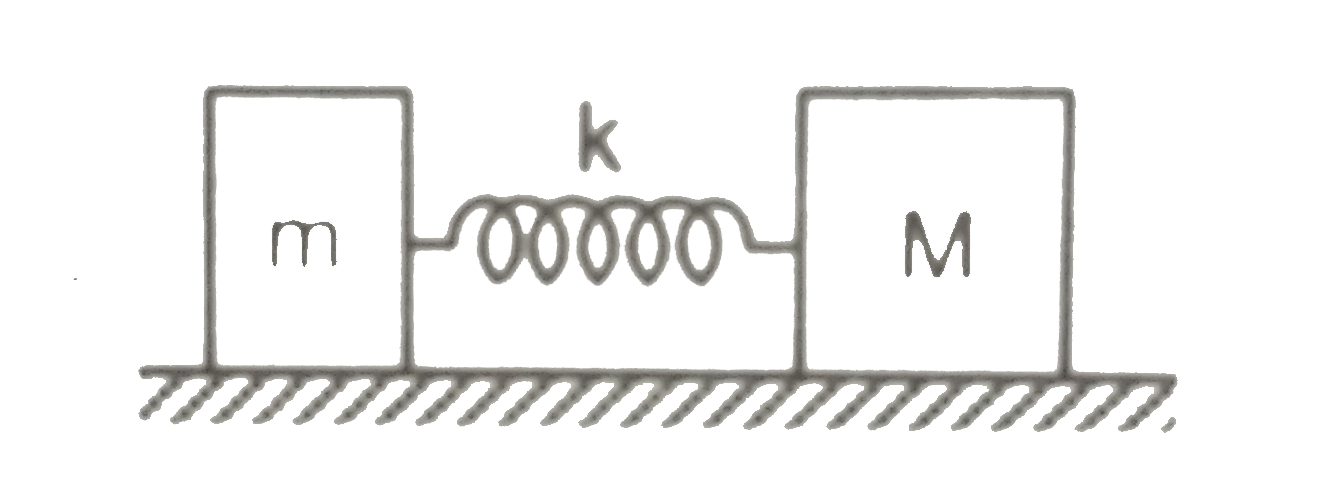
A light spring of spring constant k is kept compressed between two blocks of masses m and M on a smooth horizontal surface. When released, the blocks acquire velocities in opposite directions. The spring loses contact with the blocks when it acquires natural length. The spring was initially compressed through a distance d find the final speeds of the two blocks.

Text Solution

Verified by Experts

As net external force acting on the system is zero `("net" F_(ext)=0)`
`therefore`Applying conservation of momentum in horizontal direction

`P_(f)=P_(i)`
`MV_(2)-mv_(1)=0`…(i)
applying conservation of mechanical energy (as no work is done)
`(1)/(2)kx^(2)=(1)/(2)mv_(1)^(2)+(1)/(2)MV_(2)^(2)`.....(ii)
`v_(1)=sqrt((MK)/(m(m+M))),v_(2)=sqrt((mK)/(M(m+M)))`
Promotional Banner

Topper's Solved these Questions

  • CENTRE OF MASS & MOMENTUM CONSERVATION

    BANSAL|Exercise Solved Examples|15 Videos
  • CENTRE OF MASS & MOMENTUM CONSERVATION

    BANSAL|Exercise Practice Exercise|20 Videos
  • GRAVITATION

    BANSAL|Exercise EXERCISE -4 Section - B|6 Videos

Similar Questions

Explore conceptually related problems

A light spring of spring constant k is kept compressed between two blocks of masses m and M on a smooth horizontal surface. When released, the blocks acquire velocities in opposite directions. The spring loses contact with the blocks when it acquires natural length. I fhte spring was initially compressed through a distance d find the final speeds of the two blocks.

A light spring of constant k is kept compressed between two blocks of masses m and M on a smooth horizontal surface. When released, the block acquire velocities in opposite directions. The spring loses contact with the blocks when it acquires natural length. if the spring was initially compressed through a distance x , find the final speeds of the two blocks.

A light spring of force constant 'K' is held between two blocks of masses 'm' and '2m'. The two blocks and the spring system rests on a smooth horizontal floor. Now th blocks are moved towards each other compressing the springs by 'x' and suddenly released. The relative velocity between the blocks when the spring attains its natural length will be

In the fig 4.24 a block of mass m moves with velocity v_(0) toward a stationaly block of a mass M on a smooth horizontal surface. Find the maximum compression in the spring of stiffnesss constant K.

The two blocks A and B of same mass connected to a spring and placed on a smooth surface. They are given velocities (as shown in the figure) when the spring is in its natural length :

Two blocks of masses m_(1) and m_(2) are kept on a smooth horizontal table as shown in figure. Block of mass m_(1) (but not m_(2) is fastened to the spring. If now both the blocks are pushed to the left so that the spring is compressed a distance d. The amplitude of oscillatin of block of mass m_(1) after the system is released is

An ideal spring is permanently connected between two blocks of masses M and m . The blocks-spring system can move over a smooth horizontal table along a straight line along the length of the spring as shown in Fig.The blocks are brought nearer to compress the spring and then released. In the subsequent motion,

Two blocks A and B of masses m & 2m placed on smooth horizontal surface are connected with a light spring. The two blocks are given velocities as shown when spring is at natural length. (i) Find velocity of centre of mass (b) maximum extension in the spring

A block of mass m moving with velocity v_(0) on a smooth horizontal surface hits the spring of constant k as shown. Two maximum compression in spring is

A spring, placed horizontally on a rough surface is compressed by a block of mass m, placed on the same surface so as to store maximum energy in the spring. If the coefficient of friction between the block and the surface is mu , the potential energy stored in the spring is

