Home
Class 11
PHYSICS
A ball of mass 5 kg moving velocity 3m//...

A ball of mass 5 kg moving velocity `3m//s` impinges direction on another ball of mass 2 kg moving with velocity `0.5m//s` towards the first ball. Find the velocity after impact, if `e=(4)/(7)`

Text Solution

Verified by Experts
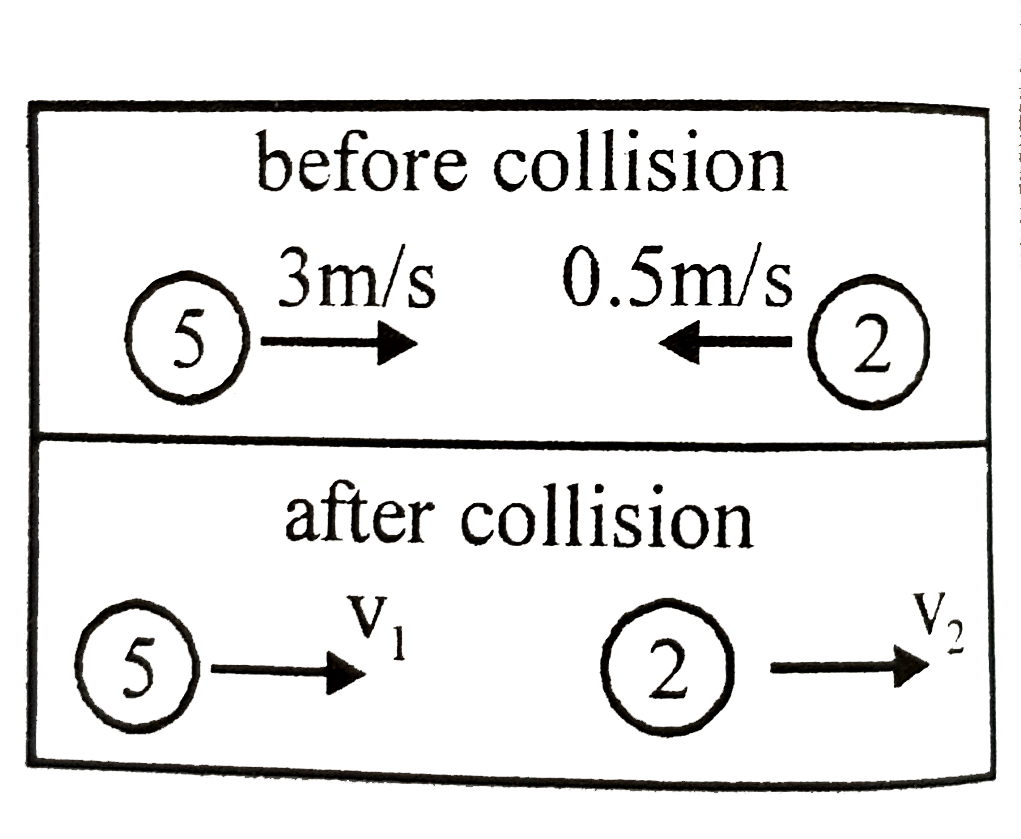
By conservation of momentum
`m_(1)u_(1)+m_(2)u_(2)=m_(1)v_(1)+m_(2)v_(2)`
`5xx3+2(-0.5)=5v_(1)+2v_(2)`
`14=5v_(1)+2v_(2)`………(i)
By Newton's Law of collision `e=(v_(2)-v_(1))/(u_(1)+u_(2))=(v_(2)-v_(1))/(3-5)`
`v_(2)-v_(1)=(4)/(7)xx3.5=2m//s`........(ii)
Promotional Banner

Topper's Solved these Questions

  • CENTRE OF MASS & MOMENTUM CONSERVATION

    BANSAL|Exercise Solved Examples|15 Videos
  • CENTRE OF MASS & MOMENTUM CONSERVATION

    BANSAL|Exercise Practice Exercise|20 Videos
  • GRAVITATION

    BANSAL|Exercise EXERCISE -4 Section - B|6 Videos

Similar Questions

Explore conceptually related problems

A ball of mass 4 kg moving with a velocity of 12 m//s impinges directly on another ball of mass 8 kg moving with velocity of 4 m//s in the same direction. Find their velocities after impact and calculate the loss of KE due to impact if e =0.5 .

A ball of mass 1kg moving with 4m^-1 along +x-axis collides elastically with an another ball of mass 2kg moving with 6m//s is opposite direction. Find their velocities after collision.

A body of mass 1 kg moving with velocity 5 m/s collides with another body of mass 2 kg moving with velocity 1.5 m/s in opposite direction. If the coefficient of restitution is 0.8, their velocities aftter collision respectively are

A ball of mass M moving with a velocity v collides perfectly inelastically with another ball of same mass but moving with a velocity v in the opposite direction. After collision

A ball of mass 2kg moving with speed 5m/s collides directly with another ball of mass 3kg moving in the same direction with speed 4m/s. The coefficient os restitution is 2/3. Find the velocities of both ball after the collision.

A ball of mass '2m' moving with velocity u hat(i) collides with another ball of mass 'm' moving with velocity - 2 u hat(i) . After the collision, mass 2m moves with velocity (u)/(2) ( hat(i) - hat(j)) . Then the change in kinetic energy of the system ( both balls ) is

