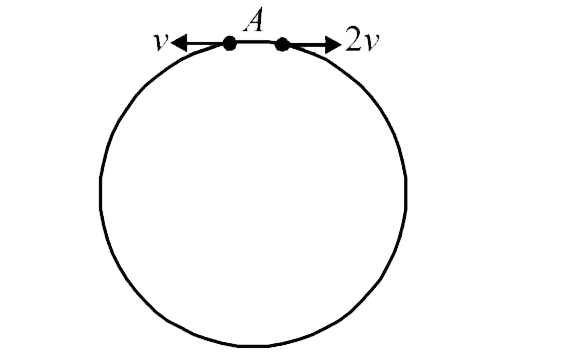
A
B
C
D
Text Solution
Verified by Experts
The correct Answer is:




Topper's Solved these Questions
CENTRE OF MASS & MOMENTUM CONSERVATION
BANSAL|Exercise EXERCISE-4 (SECTION-A) (Comprehension)|3 VideosCENTRE OF MASS & MOMENTUM CONSERVATION
BANSAL|Exercise EXERCISE-4 (SECTION-B) (JEE-ADVANCED Previous Year Questions)|8 VideosCENTRE OF MASS & MOMENTUM CONSERVATION
BANSAL|Exercise EXERCISE-3 (Miscellaneous Exercise)|30 VideosGRAVITATION
BANSAL|Exercise EXERCISE -4 Section - B|6 Videos
Similar Questions
Explore conceptually related problems
BANSAL-CENTRE OF MASS & MOMENTUM CONSERVATION-EXERCISE-4 (SECTION-A) (JEE-ADVANCED Previous Year Questions)
- A car P is moving with a uniform speed 5sqrt3 m//s towards a carriage ...
Text Solution
|
- Two blocks of masses 10 kg and 4 kg are connected by a spring of negli...
Text Solution
|
- Two balls having linear momenta vecp(1)=phati and vecp(2)=-phati, und...
Text Solution
|
- There object A ,B and C are kept is a straing line a fritionlas horize...
Text Solution
|
- Two small particles of equal masses stant moving in opposite directio...
Text Solution
|
- Look at the drawing given in the figure which has been drawn with ink ...
Text Solution
|
- A point mass of 1 kg collides elastically with a stationary point mass...
Text Solution
|
- A ball of mass 0.2 kg rests on a vertical post of height 5 m. A bullet...
Text Solution
|
- A particle of mass m is projected from the ground with an initial spee...
Text Solution
|
- A bob of mass m, suspended by a string of length l1 is given a minimum...
Text Solution
|
- A tennis ball dropped on a barizoontal smooth surface , it because bac...
Text Solution
|