Home
Class 11
PHYSICS
A thin rod of length 'L' is lying along ...

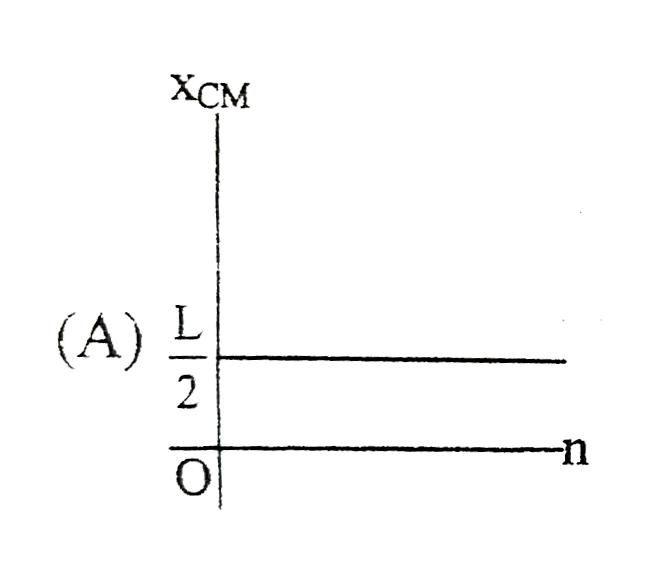
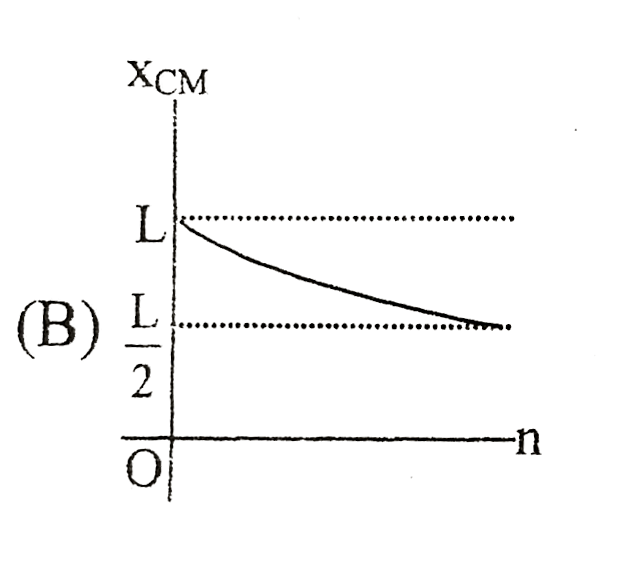
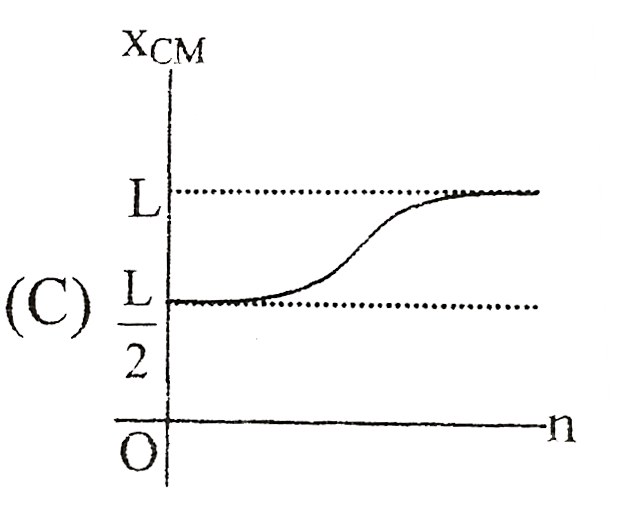
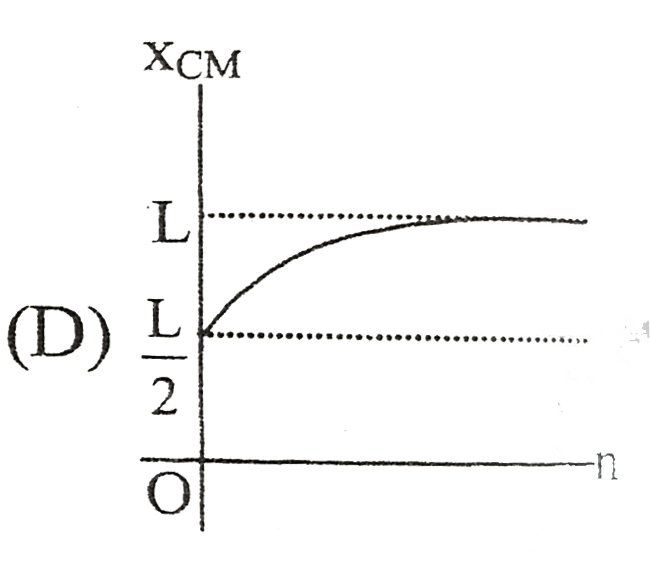
A thin rod of length 'L' is lying along the x-axis with its ends at x=0 and x=L its linear (mass/length) varies with `x as k((x)/(L))^n`, where n can be zero of any positive number. If to position `x_(CM)` of the centre of mass of the rod is plotted against 'n', which of the following graphs best apporximates the dependence of `x_(CM)` on n?

A

B

C

D

Text Solution

Verified by Experts

The correct Answer is:

D

`x_(cm)=(int"xdm")/(int"dm")=(int"x k"(x^(n))/(L^(n))"dx")/(intk(x^(n))/(L^(n))"dx")`
`=(int_(0)^(L)x^(n+1)"dx")/(int_(0)^(L)x^(n)"dx")=((L^(n+2))/(n+2))/((L^(n+1))/(n+1))`
`x=((n+1)/(n+2))L`
`at =0" "x_(cm)=(L)/(2)` at `nrarroo" "x_(cm)=L`
Promotional Banner

Topper's Solved these Questions

  • CENTRE OF MASS & MOMENTUM CONSERVATION

    BANSAL|Exercise EXERCISE-4 (SECTION-A) (Comprehension)|3 Videos
  • GRAVITATION

    BANSAL|Exercise EXERCISE -4 Section - B|6 Videos

Similar Questions

Explore conceptually related problems

A thin rod of length L is lying along the x-axis with its ends at x = 0 and x = L. Its linear density (mass/length) varies with x as k((x)/(L))^n where n can be zero or any positive number. If the position X_(CM) of the centre of mass of the rod is plotted against n, which of the following graphs best approximates the dependence of X_(CM) on n?

A thin rod of length 6 m is lying along the x-axis with its ends at x=0 and x=6m. Its linear density *mass/length ) varies with x as kx^(4) . Find the position of centre of mass of rod in meters.

A thin rod of length 6 m is lying along the x-axis with its ends at x = 0 and x = 6m . It linear density (mass/length) varies with x as kx^(4) . Find the position of centre of mass of rod in meters.

A rod of length L is placed along the x-axis between x = 0 and x = L. The linear density (mass/length) lamda of the rod varies with the distance x from the origin as lamda = Rx. Here, R is a positive constant. Find the position of centre of mass of this rod.

A rod of length L is placed along the x-axis between x = 0 and x = L. The linear density (mass/ length) lambda of the rod varies with the distance x from the origin as lambda = Rx . Here, R is a positive constant. Find the position of centre of mass of this rod.

A rod of length L is placed along the x-axis between x=0 and x=L . The linear mass density (mass/length) rho of the rod varies with the distance x from the origin as rho=a+bx . Here, a and b are constants. Find the position of centre of mass of this rod.

A rod of length L is placed along the x-axis between x=0 and x=L. The linear mass density is lambda such that lambda=a+bx . Find the mass of the rod.

A rod of length L is placed along the X-axis between x=0 and x=L . The linear density (mass/length) rho of the rod varies with the distance x from the origin as rhoj=a+bx. a. Find the SI units of a and b. b. Find the mass of the rod in terms of a,b, and L.

The mass per unit length of a non- uniform rod OP of length L varies as m=k(x)/(L) where k is a constant and x is the distance of any point on the rod from end 0 .The distance of the centre of mass of the rod from end 0 is
