Home
Class 11
PHYSICS
A rod of length l with thermally insulat...

A rod of length `l` with thermally insulated lateral surface is made of a material whose thermal conductivity varies as `K=sc//T` where `c` is a constant. The ends are kept at temperatures `T_(1)` and `T_(2)`. Find the temperature at a distance `x` from te first end where the temperature is `T_(1)` and the heat flow density.

Text Solution

Verified by Experts
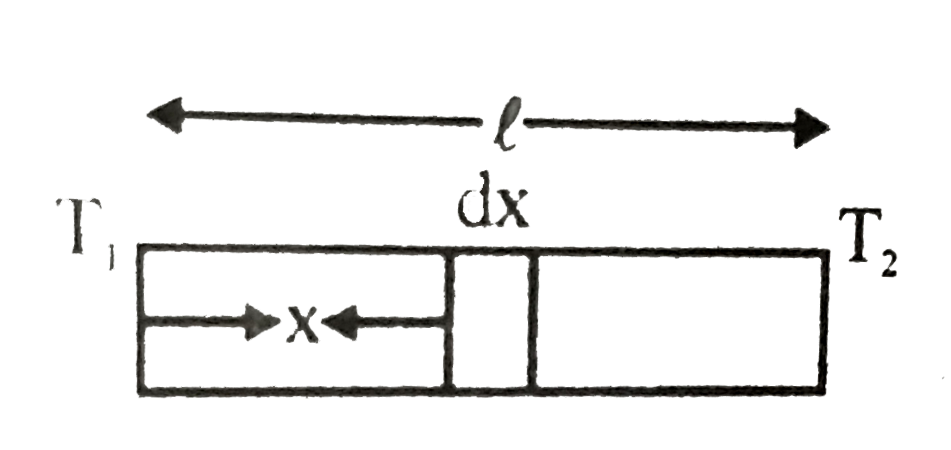
Given `K=(C )/(T)`

Consider an element of length `'dx'` at a distance of `'x'` from the end having temperature `T_(1)`
Consider temperature at one end of the element to be `'T'` and at after end to be `'T+dT'` Then
`(dH)/(dt)=i(kAdT)/(dx)` `[K=(C )/(T)]`
`implies i=(-C )/(T)=(AdT)/(dx)`
`int_(0)^(x)i dx=-int_(T_(1))^(T)(CAdT)/(T)`
` i x=-CA "in" ((T)/(T_(1))`..........`(i)`
`int_(0)^(l)i dx= -int_(T_(1))^(T_(2))(CAdT)/(T)`
`il=-CA"in"((T_(2))/(T_(1)))`......`(ii)`
divide `(i)` with `(ii)` given
`(x)/(l)=("in"((T)/(T_(1))))/(In((T_(2))/(T_(1))))`
`((T_(2))/(T_(1)))^(x//l)=(T)/(T_(1))impliesT=T_(1)((T_(2))/(T_(1)))^(x//l)`
Heat flow (rate) `i=KA(dT)/(dx)=(C )/(l)xxAxx(T)/(l)ln((T_(1))/(T_(2)))=(CA)/(l)ln((T_(1))/(T_(2)))`
Current density `=(i)/(A)=(C )/(l)|ln((T_(1))/(T_(2)))|`
Promotional Banner

Similar Questions

Explore conceptually related problems

A rod of length l with thermally insulated lateral surface is made of a matrical whose thermal conductivity varies as K =C//T where C is a constant The ends are kept at temperature T_(1) and T_(2) The temperature at a distance x from the first end where the temperature is T_(1), T =T_(1)((T_(2))/(T_(1)))^(nx//2l) Find the value of n? .

A rod of length l with thermally insulated lateral surface consists of material whose heat conductivity coefficient varies with temperature as k= a//T , where a is a constant. The ends of the rod are kept at temperatures T_1 and T_2 . Find the function T(x), where x is the distance from the end whose temperature is T_1 .

A rof of length l with thermally insulated lateral surface consists of material whose heat conductivity coefficient varies with temperature as x = alpha//T , where alpha is a constant. The ends of the rod are kept at temperatures T_1 and T_2 . Find the function T (x) , where x is the distance from the end whose temperature is T_1 , and the heat flow density.

A rod of length L with sides fully insulated is made of a material whose thermal conductivity K varies with temperature as K=(alpha)/(T) where alpha is constant. The ends of rod are at temperature T_(1) and T_(2)(T_(2)gtT_(1)) Find the rate of heat flow per unit area of rod .

A rod of length l (laterally thermally insulated) of the uniform cross sectional area A consists of a material whose thermal conductivity varies with temperature as K=(K_(0))/(a+bT') where K_(0) , a and b are constants. T_(1) and T_(2)(lt T_(1)) are the temperatures of the ends of the rod. Then, the rate of flow of heat across the rod is

Two walls of thickness d and d and thermal conductivities k and k are in contact. In the steady state, if the temperature at the outer T_(1) and T_(2) , the temperature at the common wall is

Two identical rods are made of different materials whose thermal conductivities are K_(1) and K_(2) . They are placed end to end between two heat reservoirs at temperatures theta_(1) and theta_(2) . The temperature of the junction of the rod is

A hollow tube has a length l, inner radius R_(1) and outer radius R_(2) . The material has a thermal conductivity K. Find the heat flowing through the walls of the tube if (a) the flat ends are maintained at temperature T_(1) and T_(2) (T_(2)gtT_(1) (b) the inside of the tube is maintained at temperature T_(1) and the outside is maintained at T_(2) .

Two bodies at different temperature T_(1) and T_(2) . If brought in thermal contact do not mecesserily settle to the mean temperature (T_(1)+T_(2))//2 .

A rod of length l and cross-section area A has a variable thermal conductivity given by K = alpha T, where alpha is a positive constant and T is temperature in kelvin. Two ends of the rod are maintained at temperature T_(1) and T_(2) (T_(1)gtT_(2)) . Heat current flowing through the rod will be

