Home
Class 12
MATHS
A certain sample of cuprous sulphide is ...

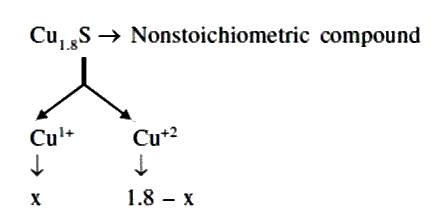
A certain sample of cuprous sulphide is found to have composition `Cu_(1.8) S`, because of presence of some `Cu_(2+)` ions in the lattice. What is the mole % of `Cu_(2+)` in crystal ?

Text Solution

Verified by Experts

The correct Answer is:
`11.11`


by law of conservation of charge
`2 xx x + (1.8 -x) xx 1 = 2`
`2x + 1.8 -x 2`
`x = 2-1.8`
`x = 0.2`
`% Cu^(2+) = (0.2)/(1.8) xx 100= 11.11%`.
Promotional Banner

Similar Questions

Explore conceptually related problems

A certain sample of cuprous sulphide is found to have composition Cu_(1.8)S, , because of imcroporation of Cu^(2+) ion in the lattice, What is the mole % of Cu^(2+) in total content in this crystal?

Ammonia is used in detection of Cu^(2+) ion because

Consider the following statement: S_(1) : Cu^(2+) ions are reduced to Cu^(+) by potassium iodide and potassium cyanide both, when taken in excess S_(2) : H_(2)S will precipitate the sulphide of all the metals from the solutions of chlorides of Cu,Zn and Cd if the solution is aqueous. S_(3) :The presence of magnesium is confirmed in qualitative analysis by the formation of a white crystal S_(4) :Calomel on reaction with potassium iodide gives red precipitate. and arrange in the order of true/false.

The equilibrium constant at 278K for Cu(s)+2Ag^(o+)(aq) hArr Cu^(2+)(aq)+2Ag(s) is 2.0xx10^(15) . In a solution in which copper has displaced, some silver ions from the solution, the concentration of Cu^(2+) ions from the solution, the concentration of Cu^(2+) ions is 1.8xx10^(-2) mol L^(-1) and the concentration of Ag^(o+) ions is 3.0xx10^(-9) mol L^(-1) . Is the system at equilibrium?

How does ammonia react with blue solution having Cu^(2+) ions ?

How much charge is required for the reduction of 1 mole of Cu^(2+) to Cu .

How much charge is present on 1 mole of Cu^(+2) ion in faraday. (1 Faraday = 96500 coulomb)

