Home
Class 12
PHYSICS
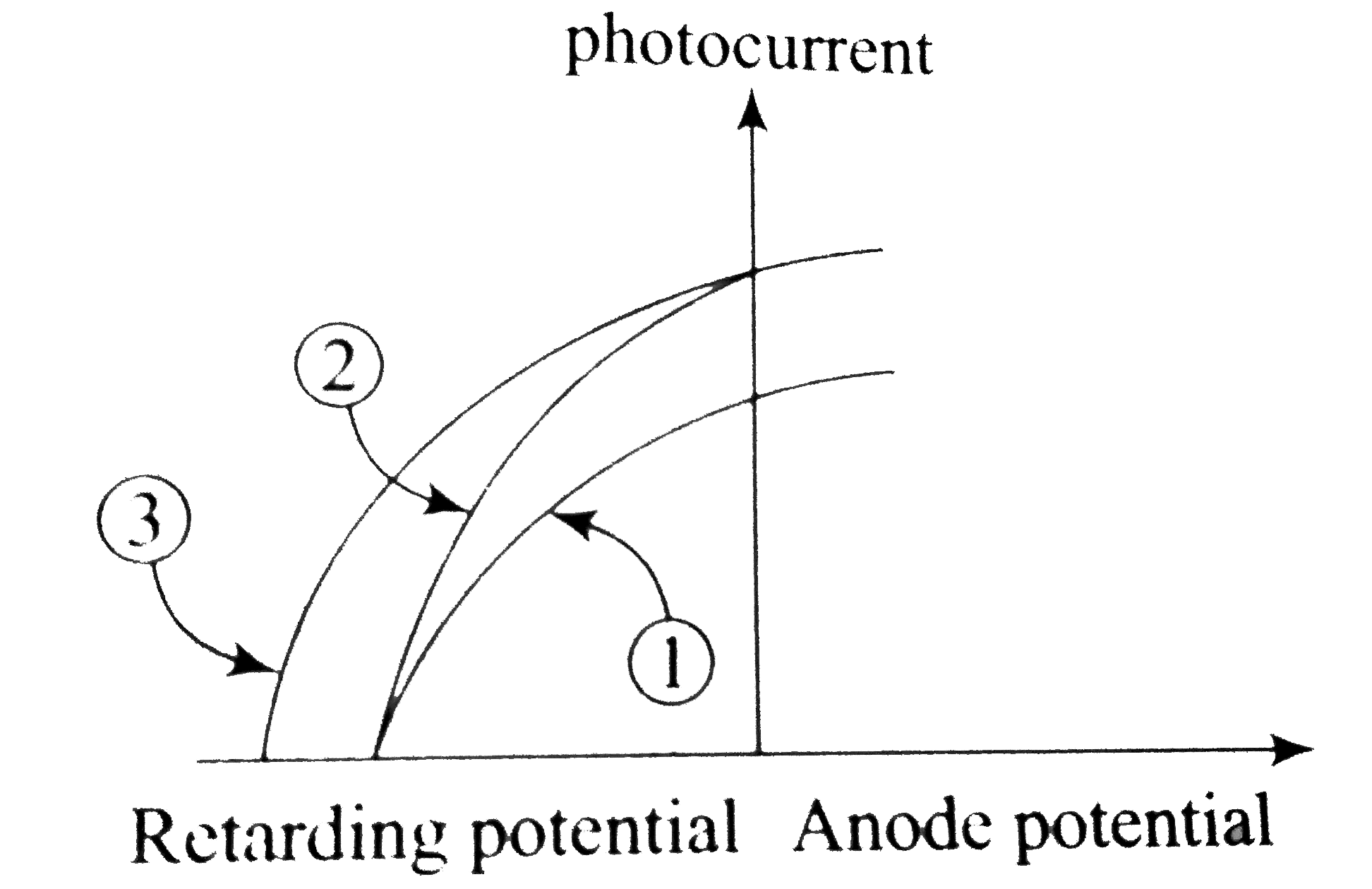
The figure shows a plot of photo current...

The figure shows a plot of photo current versus anode potential for a photosensitive surface for three different radiations. Which one of the following is a correct statement ?

A

Curves a and b represent incident radiations of different frequencies and different intensities

B

curves a and b represent incident radiations of same frequency but of different intensities.

C

curves b and c represent incident radiations of different frequencies and different intensities.

D

Curves b and c represent incident radiations of same frequency having same intensity

Text Solution

Verified by Experts

The correct Answer is:

B
Promotional Banner

Topper's Solved these Questions

  • ELECTROMAGNETIC INDUCTION

    NEET PREVIOUS YEAR (YEARWISE + CHAPTERWISE)|Exercise PHYSICS|38 Videos
  • ELECTROSTATICS

    NEET PREVIOUS YEAR (YEARWISE + CHAPTERWISE)|Exercise Electrostatics|76 Videos

Similar Questions

Explore conceptually related problems

The fig. shows the variation of photon current with anode potential for a photo-senstive surface for three different radiation. Let I_(a), I_(b) and I_(c) be the intensities and f_(a), f_(b) and f_(c) be the frequency for the curves a,b and c respectively.

In the following figure shows the variation of photocurrent with potential of the collector plate for a photosensitive surface for three different radiations. Let I_(a), I_(b) and I_(c) be the intensities and f_(a), f_(b) and f_(c) be the frequencies for the curves a, b, and c, respectively.

In photoelectric experiment the plot between anode potential and photoelectric current is shown in figure 2.3.1. Which of the following is correct:

Refer to the plot of temperature versus time (figure) showing the changes in the state if ice on heating (not to scale). Which of the following is correct ? .

Refer to the plot of temperature versus time showing the changes in the state of ice on heating (not to scale). Which of the following is correct ?

The graph of Fig. shows the variation of photoelectric current (I) versus applied voltage (V) for the two different photosensitive materials for two different intensities of the incident radiation. Identify the pairs of curves that correspond to different materials but same intensity of incident radiation.

NEET PREVIOUS YEAR (YEARWISE + CHAPTERWISE)-ELECTRONS AND PHOTONS-All Questions
  1. A source S(1) is producing 10^(15) photons/s of wavelength 5000 Å Anot...

    Text Solution

    |

  2. The number of photoelectrons emitted for light of a frequency v (highe...

    Text Solution

    |

  3. The figure shows a plot of photo current versus anode potential for a ...

    Text Solution

    |

  4. Monochromatic light of wavelength 667 nm is produced by a helium neon ...

    Text Solution

    |

  5. A particle of mass 1 mg has the same wavelength as an electron moving ...

    Text Solution

    |

  6. In the phenomenon of electric discharge through gases at low pressure ...

    Text Solution

    |

  7. The work function of a surface of a photosensitive material is 6.2 eV...

    Text Solution

    |

  8. Monochromatic light of frequency 6.0 xx 10^(14) Hz is produced by a la...

    Text Solution

    |

  9. A 5 W source emits monochromatic light of wavelength 5000 Å. When plac...

    Text Solution

    |

  10. The momentum of a photon of energy 1 MeV "in" kg m//s will be

    Text Solution

    |

  11. In a discharge tube ionization of enclosed gas is produced due to coll...

    Text Solution

    |

  12. A photocell employs photoelectric effect to convert

    Text Solution

    |

  13. A photosensitive metallic surface has work function , h v(0). If photo...

    Text Solution

    |

  14. The work function for metals A , B and C are respectively 1.92 eV , 2....

    Text Solution

    |

  15. According to Einstein's photoelectric equation , the graph between the...

    Text Solution

    |

  16. A photoelectric cell is illuminated by a point source of light 1 m awa...

    Text Solution

    |

  17. Which of the following is not the property of a cathode rays

    Text Solution

    |

  18. If particles are moving with same velocity , then maximum de - Broglie...

    Text Solution

    |

  19. A caesium photocell , with a steady potential difference of 60 V acros...

    Text Solution

    |

  20. If we express the energy of a photon in KeV and the wavelength in angs...

    Text Solution

    |
