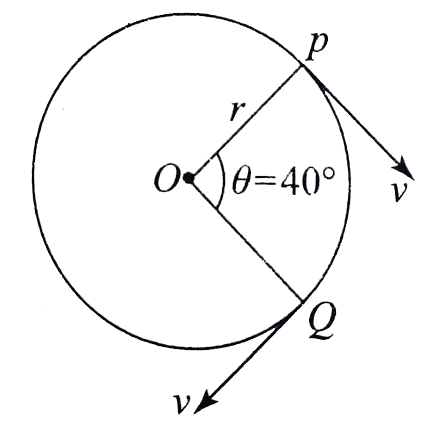
A
B
C
D
Text Solution
Verified by Experts
The correct Answer is:



Topper's Solved these Questions
Similar Questions
Explore conceptually related problems
ERRORLESS -VECTORS-Exercise
- Given that vecA+vecB+vecC=0, out of three vectors two are equal in mag...
Text Solution
|
- Two forces F(1)=1N and F(2)=2N act along the lines x=0 and y=0, respec...
Text Solution
|
- At what angle must the two forces (x+y) and (x-y) act so that the resu...
Text Solution
|
- Following forces start acting on a particle at rest at the origin of t...
Text Solution
|
- The resultant of vec(A)+vec(B) is vec(R )(1). On reversing the vector ...
Text Solution
|
- Figure below shows a body of mass M moving with the uniform speed on a...
Text Solution
|
- A particle is moving on a circular path of radius r with uniform veloc...
Text Solution
|
- vecA=2hati+4hatj+4hatk and vecB=4hati+2hatj-4hatk are two vectors. The...
Text Solution
|
- If vecA=2hati+3hatj-hatk and vecB=-hati+3hatj+4hatk then projection of...
Text Solution
|
- Two constant forces F(1)=2hati-3hatj+3hatk(N) and F(2)=hati+hatj-2hatk...
Text Solution
|
- For the any two vecrtors vecA and vecB, if vecA.vecB=|vecAxxvecB|, the...
Text Solution
|
- Which of the following is the unit vector perpendicular to vecA and ve...
Text Solution
|
- Two vectors P=2hati+bhatj+2hatk and Q=hati+hatj+hatk will be parallel ...
Text Solution
|
- Which of the following is not true? If vecA=3hati+4hatj and vecB=6hati...
Text Solution
|
- The area of the triangle formed by 2hati+hatj-hatk and hati+hatj+hatk ...
Text Solution
|
- Two trains along the same straight rails moving the constant speed 60k...
Text Solution
|
- A steam boat goes across a lake and comes back : (a) on a quiet day wh...
Text Solution
|
- To a person, going eastward in a car with a velociyt of 25km//hr, a tr...
Text Solution
|
- A swimmer can swim in still water with speed v and the river is flowin...
Text Solution
|
- A bus is moving with a velocity 10 ms^-1 on a straight road. A scooter...
Text Solution
|