Home
Class 12
PHYSICS
Four point charges of +100 esu,-50 esu +...

Four point charges of +100 esu,-50 esu +20 esu and +30 esu are placed respectively at the four vertices A,B,C,D of a square of side 10 cm. Find the electric intensity and potential at the point of intersection of the diagonals.

Text Solution

Verified by Experts
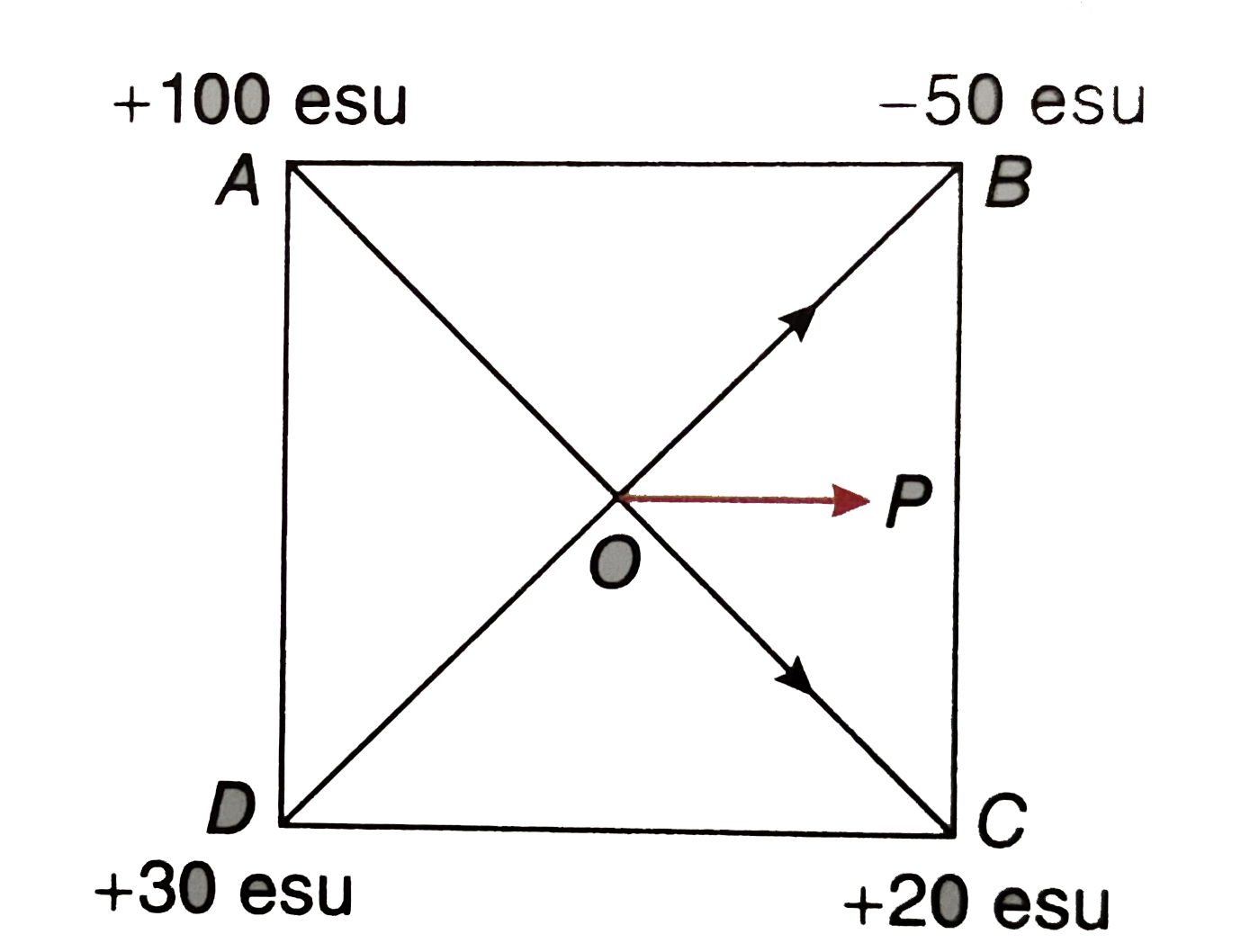
Length of the diagonal of the square
`= sqrt(10^(2) + 10^(2)) = 10sqrt(2) cm`
The point of intersection of the two diagonals is the point O.

`:. AO = BO = CO = DO = (10sqrt2)/2 = 5sqrt(2)cm`
Intensity acts along `vec(OC)` due to the charge at A and it acts along `vec(OA)` due to the charge at C.
So resultant intensity at O due to the charges at A and C is given by
`E_(1) = 100/((5sqrt2)^(2)) - 20/((5sqrt2)^(2))`
`=(2-2/5) = 8/5 dyn cdot statC^(-1) , "along" vec(OC)`
Similarly intensity at O due to the charges at B and D acts along `vec(OB)`.
So, resultant intensity at O due to the charges at B and D is given by,
`E_(2) = 30/((5sqrt2)^(2))+50/((5sqrt2)^(2))`
`= (3/5+1) = 8/5 dyn cdot statC^(-1) , "along" vec(OB)`
Here `E_(1)` and `E_(2)` act perpendicular to each other and `E_(1) = E_(2)`.
`:.` Resultant intensity at O,
`E = sqrt(E_(1)^(2)+E_(2)^(2)) = sqrt((8/5)^(2)+(8/5)^(2)) = 8/5sqrt(2)`
`=2.263 dyn cdot stat C^(-1)`
The direction of E is along the bisector `vec(OP)` of the angle COB, i.e., parallel to the side AB or DC.
Again, potential at `O = 100/(5sqrt2) - 50/(5sqrt2) + 20/(5sqrt2) + 30/(5sqrt2)`
`=100/(5sqrt2) = 10sqrt(2) = 14.14 statV`.
Promotional Banner

Topper's Solved these Questions

  • ELECTRIC POTENTIAL

    CHHAYA PUBLICATION|Exercise Section related questions|25 Videos
  • ELECTRIC POTENTIAL

    CHHAYA PUBLICATION|Exercise Higher order thinking skill (HOTS) questions|23 Videos
  • ELECTRIC FIELD

    CHHAYA PUBLICATION|Exercise CBSE SCANNER|31 Videos
  • ELECTROMAGNETIC INDUCTION & ALTERNATING CURRENT

    CHHAYA PUBLICATION|Exercise CBSE SCANNER|28 Videos

Similar Questions

Explore conceptually related problems

At each of the four vertices of a square of side 10 cm, four positive charges each of 20 esu are placed. Find the potential at the point of intersection of the two diagonals.

At each of the four vertices of a square of side 10 cm there is a +20 esu of charge. Find the Intensity of electric fleld at the point of Intersection of the two dlagonals.

In vacuum, four charges each equal to q are placed at each of the four vertices of a square. Find the intensity and potential of the electric field at the point of intersection of two diagonals.

Four particles of mass 2 kg , 4 kg , 5 kg , and 3 kg are placed at the four vertices A, B, C and D of a square of side 1 m. Find the position of centre of mass of the particle.

Three point charges q, 2q and 3q are placed at the vertices of an equilateral triangle of side ‘a’. Find the electric potential and intensities at the geometric centre of the triangle.

Three positive charge 3 esu, 4 esu and 5 esu are placed at the vertices of an equilateral triangle of side 10 cm. What is the force acting the largest charge?

Charge of magnitude +100 esu and -100 esu are placed at two vertices of an equilateral triangle of side 5 cm. What is the value of resultant intensity in esu at the third vertex?

Four point charges +q,+q,+q and -q are placed at the four comers of a square, length of each side of which is a. Find the magnitude of the intensity of the electric field at the centre of the square.

Four charges of + 2 xx10^-9c, +,1 xx 10^-9c,-2xx10^-9c and + 3 xx10^-9c are kept at the four vertices of a square of sides sqrt2 m . What is the potential at its centre?

