Home
Class 12
PHYSICS
A particle charged with 1.6 xx 10^(-19)C...

A particle charged with `1.6 xx 10^(-19)C` is in motion. It enters the space between two parallel metal plates, parallely along the midway between them. The plates are 10 cm long and the separation between them is 2 cm. A potential difference of 300V exists between the plates. Find out the maximum velocity of the charged particle at the point of entry, for which it would be unable to emerge from the space between the plates. Given, mass of the particle = `12 xx 10^(-24) kg`.

Text Solution

Verified by Experts
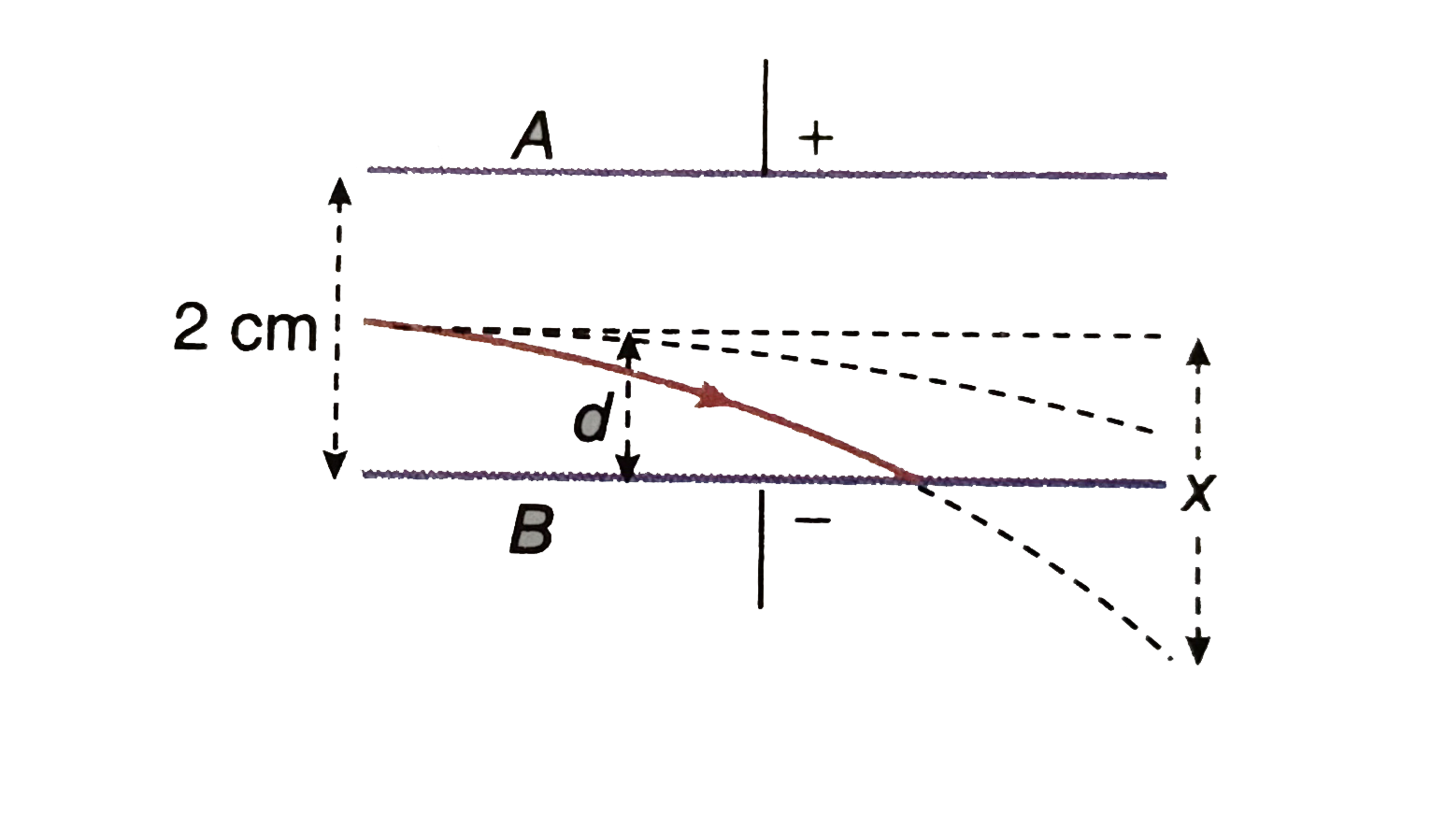
Length of the plates A and B is
`l = 10 cm = 0.1m`
Half of the distance between the plates,
`d = 1/2 xx 2 cm = 1 cm = 0.01 cm`

Uniform electric field in the intermediate space,
`E = (300V)/(0.02 m) = 15 xx 10^(3) V cdot m^(-1)`
Let the charge `q = 1.6 xx 10^(-19)` be positive.
So, a downward force acts on it due to the electric field E, given by
`F = qE`
`:.` Downward acceleration, `a = (qE)/(m)`
At the point of entry, let v be the velocity of the charged particle.
In the axial direction, it experiences no force, so the time taken to travel the distance l is `t = 1/v`
Again, at the point of entry, the downward component of velocity = 0, Thus the downward displacement in time t is
`x = 1/2 at^(2) = 1/2 (qE)/(m)(l/v)^(2)`
The condition, that the particle will not emerge from the space between the plates, is
`x ge d`
or `1/2 (qE)/(m)(l/v)^(2) ge d or, 1/2 (qEl^(2))/(md) ge v^(2) or, v le 1sqrt((qE)/(2md))`
Therefore, the maximum permitted velocity is
`v_(max) lsqrt((qE)/(2md)) = 0.1 xx sqrt(((1.6xx10^(-19))xx(15xx10^3))/(2xx(12xx1^(-24))xx0.01))`
`= 10^(4) m cdot s^(-1)`.
Promotional Banner

Topper's Solved these Questions

  • ELECTRIC POTENTIAL

    CHHAYA PUBLICATION|Exercise Section related questions|25 Videos
  • ELECTRIC POTENTIAL

    CHHAYA PUBLICATION|Exercise Higher order thinking skill (HOTS) questions|23 Videos
  • ELECTRIC FIELD

    CHHAYA PUBLICATION|Exercise CBSE SCANNER|31 Videos
  • ELECTROMAGNETIC INDUCTION & ALTERNATING CURRENT

    CHHAYA PUBLICATION|Exercise CBSE SCANNER|28 Videos

Similar Questions

Explore conceptually related problems

A parallel plate air capacitor has capacity 'C' distance of separation between plates is ‘d’ and potential difference 'V' is applied between the plates. Force of attraction between the plates of the parallel plate air capacitor is

The distance between the two plates of an isolated charged parallel plate air capacitor is increased. The potential difference between the plates will……………………..

The electric field intensity between two parallel conducting plates separated by a distance 2 cm is 1.5 statV cdot cm^(-1) . Determine the potential difference between the plates in volt.

Five identical plates each of area A are joined as shown in the figure. The distance between the plates is d. The plates are connected to a potential difference of V volts. The charge on plates 1 and 4 will be

Each of the plates of a parallel plate capacitor is a circular disc of radius 5 cm. Find out its capacitance if the separation between the plates is 1 mm.

What is an equipotential between the plates of a parallel plate capacitor.

Two equal point charges ar placed in air 10 cm aprat and the force of interaction between them is 50 mg - wt . Determine the magnitude of the charges.

How the force acting between two charges will change if the air medium betweeen them is replaced by metalic plate?

X and Y are two parallel plate capacitors having the same area of plates and same separation between the plates. X has air between the plates and Y contains a dielectric medium of k =5 Calculate the potential difference between the plates of X and Y

