Text Solution
Verified by Experts



Topper's Solved these Questions
ELECTRIC POTENTIAL
CHHAYA PUBLICATION|Exercise Section related questions|25 VideosELECTRIC POTENTIAL
CHHAYA PUBLICATION|Exercise Higher order thinking skill (HOTS) questions|23 VideosELECTRIC FIELD
CHHAYA PUBLICATION|Exercise CBSE SCANNER|31 VideosELECTROMAGNETIC INDUCTION & ALTERNATING CURRENT
CHHAYA PUBLICATION|Exercise CBSE SCANNER|28 Videos
Similar Questions
Explore conceptually related problems
CHHAYA PUBLICATION-ELECTRIC POTENTIAL -CBSE Scanner
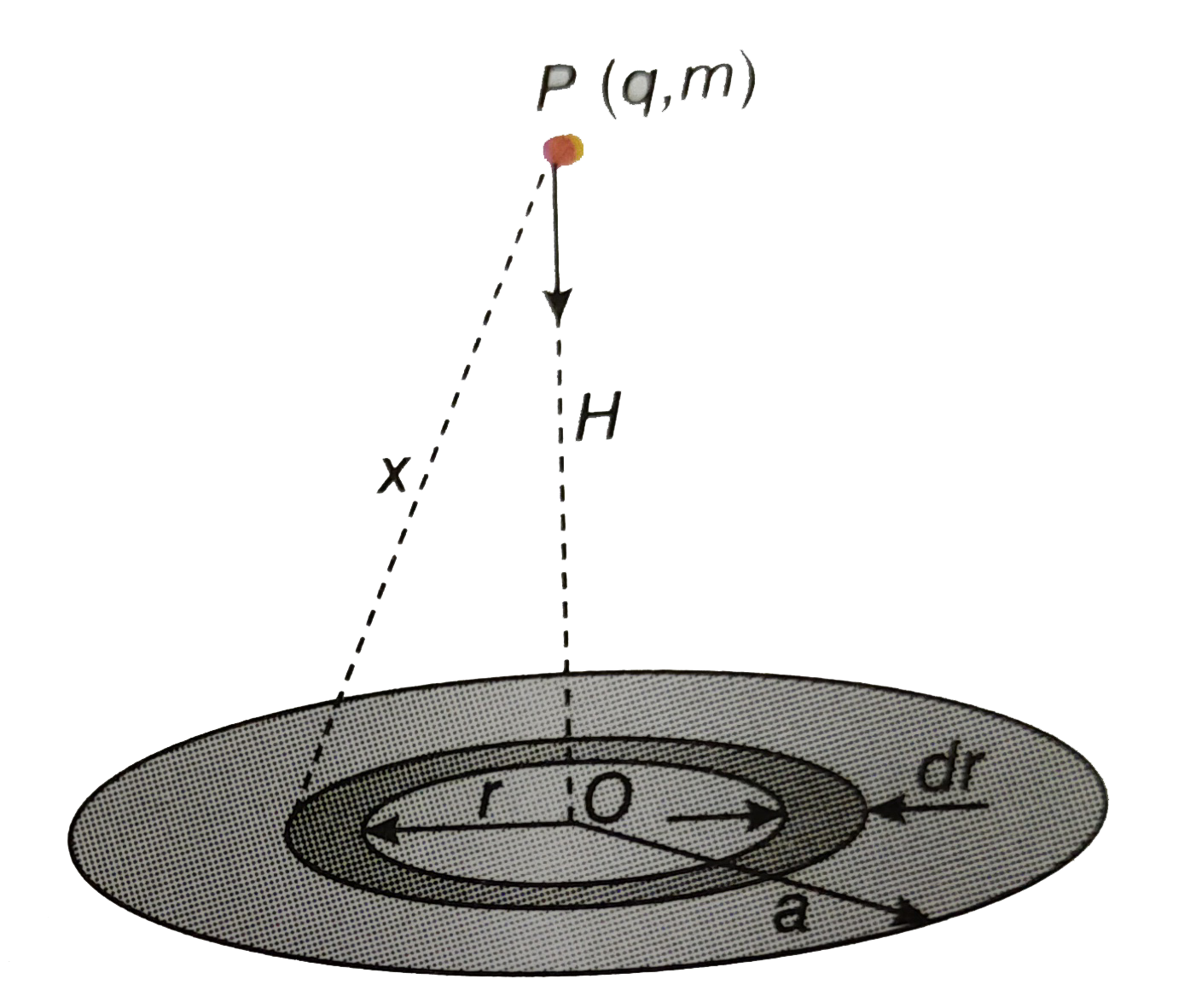
- A non-conducting disc of radius a with uniform positive surface charge...
Text Solution
|
- A test charge q is moved without acceleration along the path from A to...
Text Solution
|
- A test charge q is moved without acceleration along the path from A to...
Text Solution
|
- Draw the equipotential surfaces due to an electric dipole. Locate the ...
Text Solution
|
- Derive the expression for the potential energy of an electric dipole o...
Text Solution
|
- Explain why, for any charge configuration the equipotential surface th...
Text Solution
|
- Obtain an expression for the work done to dissociate the system of thr...
Text Solution
|
- Derive the expression for the electric potential due to an electric di...
Text Solution
|
- Depict the equipotential surfaces due to an electric dipoel.
Text Solution
|
- An infinitely large thin plane sheet has a uniform surface charge dens...
Text Solution
|
- Four point charges Q , q, Q and q are placed at the corners of a squar...
Text Solution
|
- Four point charges Q , q, Q and q are placed at the corners of a squar...
Text Solution
|
- Three point charges q, -4q and 2q are placed at the vertices of an equ...
Text Solution
|
- Find out the amount of the work done to separated the charges at infin...
Text Solution
|