Home
Class 12
PHYSICS
Explain the variations of potential and ...

Explain the variations of potential and field intensity with distance due to a hollow charged spherical conductor (radius a and charge q), both inside and outside the sphere, with a graph.

Text Solution

Verified by Experts
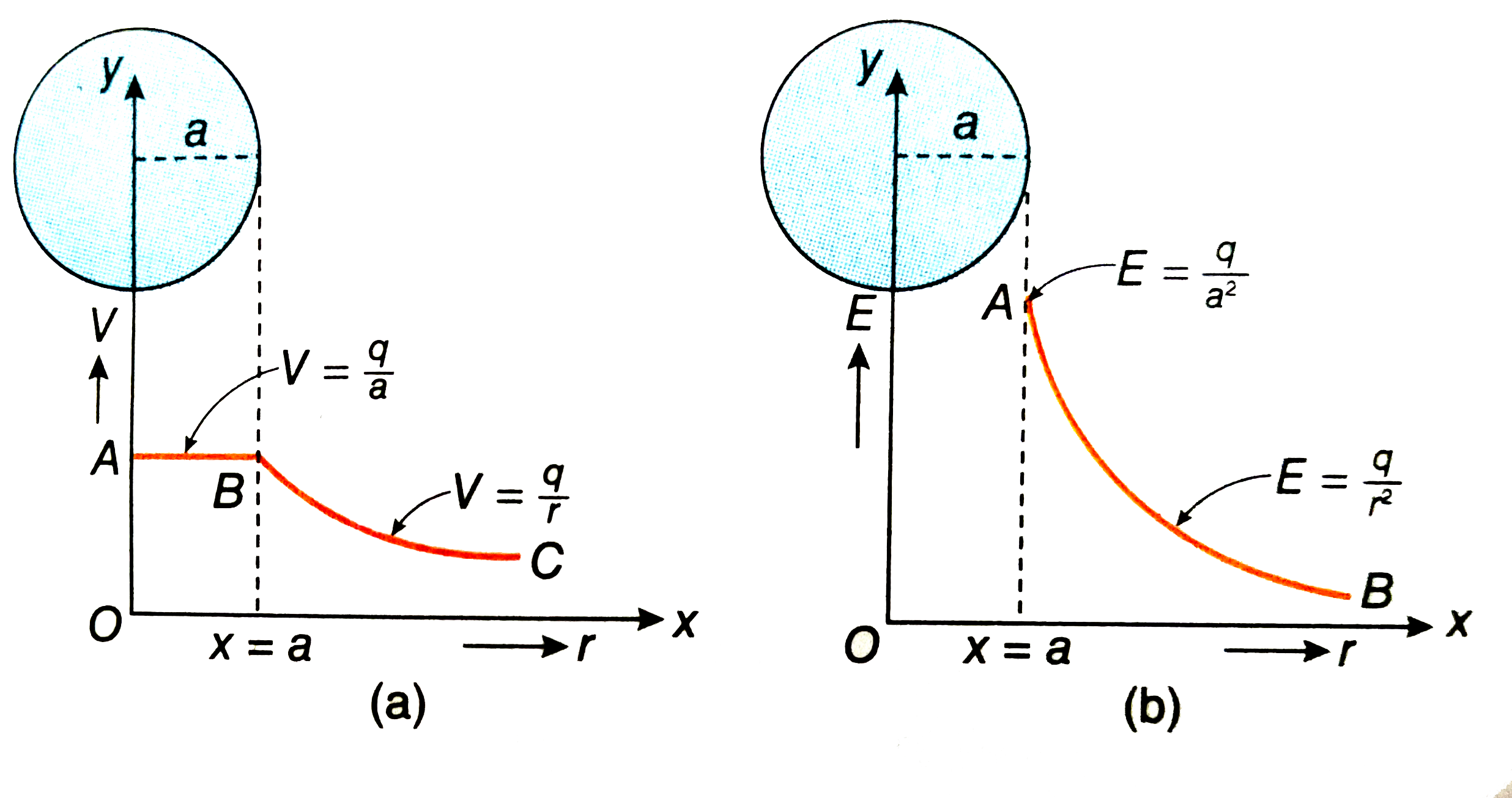
Electric potential : Potential at all points inside a hollow charged spherical conductor and on its surface are equal. Here this potential is , `V = q/a`. So, from the centre to the surface of the conductor, potential is constant and it has been shown be the line AB, parallel to x-axis.
If the distance of an external point from the centre of the conductor be r, then electric potential at that point is given by, `V = q/r`. So as r increases, V decreases. This decrease has been shown by the curved line BC. The inverse variation is illustrated by the moderate slope of the curve.
Electric intensity: As the potential at all points inside a hollow charged spherical conductor is a constant, intensity at those points, i.e., inside the hollow spherical conductor is zero. As the radius of the conductor is a, intensity at a point on its surface, `E = q/(a^2)`. If r be the distance of an external point from the centre of the sphere, intensity at that point will be `E = q/(r^2)`.

So, intensity on the surface of the conductor is maximum and it decreases as we move away from the conductor. This variation has shown by the curved line AB. The inverse square variation has been shown by the steeper slope, as compared to the V-r curve.
Promotional Banner

Topper's Solved these Questions

  • ELECTRIC POTENTIAL

    CHHAYA PUBLICATION|Exercise NCERT textbook questions with answer hint|14 Videos
  • ELECTRIC POTENTIAL

    CHHAYA PUBLICATION|Exercise NCERT examplar questions with answer hint (MCQ -1 single option correct)|3 Videos
  • ELECTRIC POTENTIAL

    CHHAYA PUBLICATION|Exercise Section related questions|25 Videos
  • ELECTRIC FIELD

    CHHAYA PUBLICATION|Exercise CBSE SCANNER|31 Videos
  • ELECTROMAGNETIC INDUCTION & ALTERNATING CURRENT

    CHHAYA PUBLICATION|Exercise CBSE SCANNER|28 Videos

Similar Questions

Explore conceptually related problems

Explain with a graph, the variation of potential and field intensity of a hollow charged spherical conductor, both inside and outside the sphere, with distance.

What is the electric field intensity at a distance r from a charge q placed in vacuum ?

If E be the intensity of the electric field at a distance r(r gt R) due to a uniformly charged spherical shell, then

A hollow charged sphere of radius 2 m does not produce any field intensity

Find the electric field intensity due to a uniformly charged spherical shell at a point (i) out side the shell

Derive the expression for electric field intensity due to a uniformly charged thin spherical shell at a point outside the shell

Derive the expression for electric field intensity due to a uniformly charged thin spherical shell at a point inside the shell.

Discuss the variation of electric potential due to positive and negative point charges with distance from a charge.

Using Gauss' law deduce the expression for the electric field due to a uniformly charge spherical conducting shell of radius R at a point (i) outside the shell.

Using Gauss' law deduce the expression for the electric field due to a uniformly charge spherical conducting shell of radius R at a point (ii) inside the shell.

CHHAYA PUBLICATION-ELECTRIC POTENTIAL -Higher order thinking skill (HOTS) questions
  1. If the intensity at a point in an electric field is zero, will the ele...

    Text Solution

    |

  2. Two hollow conductors are charged positively. The potential of the sma...

    Text Solution

    |

  3. Explain the variations of potential and field intensity with distance ...

    Text Solution

    |

  4. Potential difference between two conductors is very large. What will h...

    Text Solution

    |

  5. Potential difference between two conductors is very large. What will h...

    Text Solution

    |

  6. Potential difference between two conductors is very large. What will h...

    Text Solution

    |

  7. Give an example of a line in the electric field of an electric dipole ...

    Text Solution

    |

  8. Can two different equipotential surfaces intersect each other?

    Text Solution

    |

  9. In fig., two pairs of planes A,B and A', B' are kept in two uniform el...

    Text Solution

    |

  10. A positively charged and a negatively charged body are connected to th...

    Text Solution

    |

  11. When a body is connected with earth, electrons are found to move from ...

    Text Solution

    |

  12. In vacuum, equal charges of the same nature are placed at the vertices...

    Text Solution

    |

  13. Draw three equipotential surfaces corresponding to a field that unifor...

    Text Solution

    |

  14. A unit positive charge is moving along PQR in an electric field of int...

    Text Solution

    |

  15. Fig. shows the variation of electric potential V with 1/r for two char...

    Text Solution

    |

  16. Fig. shows the variation of electric potential V with 1/r for two char...

    Text Solution

    |

  17. Two electric charges q and -2q are placed 6m apart on a horizontal pla...

    Text Solution

    |

  18. A charge Q is uniformly distributed over a long rod AB of length L as ...

    Text Solution

    |

  19. A conducting bubble of radius a, thickness t ( lt lt a) has a potentia...

    Text Solution

    |

  20. Some equipotential surfaces are shown in fig. What can you say about t...

    Text Solution

    |

