

Home
Class 11
PHYSICS
A smooth block loosely fits in a circula...

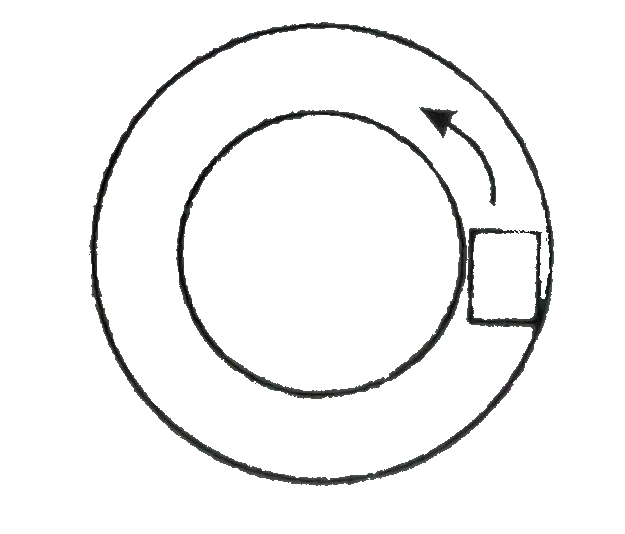
A smooth block loosely fits in a circular tube placed on a horizontal surface . The block moves along the tube (fig ) Which wall (inner or outer) will exert a non zero normal contact force on the block?

Promotional Banner

Similar Questions

Explore conceptually related problems

A smooth block loosely fits in a circular tube placed on a horizontal surface. The block moves in as uniform circular motion along the tube figure. Which wall (inner or outer) will exert a nonzero normal contact force on the block? .

A smooth block loosely fits in a circular tube placed on a horizontal surface. The block moves in as uniform circular motion along the tube figure. Which wall (inner or outer) will exert a nonzero normal contact force on the block? .

A smooth block loosely fits in a circular tube placed on a horizontal surface. The block moves in as uniform circular motion along the tube figure. Which wall (inner or outer) will exert a nonzero normal contact force on the block? .

Consider a block moving in a horizontal circular path on the inner surface of a cone. The normal force on the block is :

Consider a block moving in a horizontal circular path on the inner surface of a cone. The normal force on the block is :

Two blocks of masses M_1 and M_2 are placed in contact with each other on a frictionless horizontal surface. If a force F is applied on the block of mass M, what is the contact force between the two blocks?

Two blocks of masses 1 kg and 2 kg are placed in contact on a smooth horizontal surface as shown in fig. A horizontal force of 6N is applied d(a) on a 1-kg block. Find the force of interaction of the blocks. .

Two blocks of masses 1 kg and 2 kg are placed in contact on a smooth horizontal surface as shown in fig. A horizontal force of 6N is applied d(a) on a 1-kg block. Find the force of interaction of the blocks. .

A block of mass m is moving on a rough horizontal surface. mu is the coefficient of kinetic friction between the block and the surface. What is the net force exerted by the surface on the block?