

Home
Class 11
PHYSICS
A partition divides a container having i...

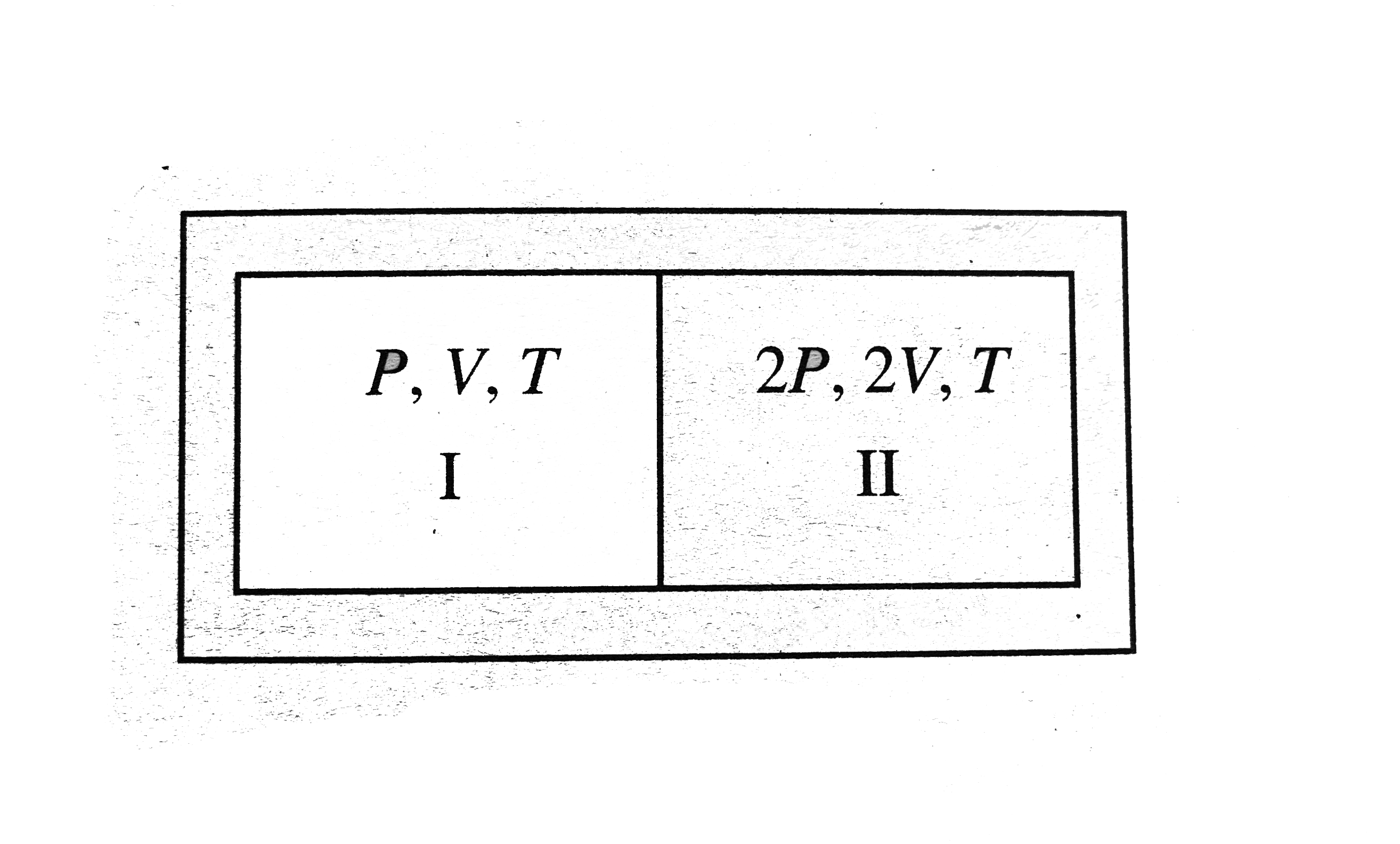
A partition divides a container having insulated walls into two compartments whose initial paraments are given. The partition is a conducting wall which can move freely without friction. Which of the following statements is/are correct, with refrence to the final equilibrium position ?

Promotional Banner

Similar Questions

Explore conceptually related problems

In the following reaction, the final product can be prepared by two paths (I) and (II). Which of the following statements is correct?

In a cylindrical container two pistons enclose gas in two compartments as shown in the figure. The pistons have negligible thickness and can move without friction. The sys- tem is originally in equilibrium. The outer piston is slowly moved out by 10 cm and the inner piston is found to move by 4 cm. Find the distance of the inner piston in equilibrium from the closed end of the cylinder if the outer piston is slowly moved out of the cylinder. Assume temperature of the gas to remain constant.

A thermally insulated piston divides a nonconducting container in two compartements, right compartement of 2V, T and 2P , while in the left compartement the respective values are V, T and P . Total moles in total system of both comartments is 5 moles. if piston can slide freely, and in the final equilibrium position, volume of right compartement is (xV)/(5) then find the value of x .

A thermally insulated piston divides a nonconducting container in two compartements, right compartement of 2V, T and 2P , while in the left compartement the respective values are V, T and P . Total moles in total system of both comartments is 5 moles. if piston can slide freely, and in the final equilibrium position, volume of right compartement is (xV)/(5) then find the value of x .

An ideal gas is enclosed in a thermally insulated container. Container is covered by an insulating piston which is connected with spring. Small displacement is given to piston as shown in figure. Which of the following statements is correct? Neglect friction everywhere.

An ideal gas is enclosed in a thermally insulated container. Container is covered by an insulating piston which is connected with spring. Small displacement is given to piston as shown in figure. Which of the following statements is correct? Neglect friction everywhere.

A ring - shaped tube contains two ideal gases with equal masses and relative molar masses M_(1)=32 and M_(2)=28 . The gases are separated by one fixed partition and another movable stoper S which can move freely without friciton inside the ring . What is the value of the angel alpha (in degree) at equilibrium ?

In the figure, a container is shown to have a movable (without friction) piston on top. The container and the piston are all made of perfectly insulated material allowing no heat transfer between outside and inside the container. The container is divided into two compartments by a rigid partition made of a thermally conducting material that allows slow transfer of heat. The lower compartment of the container is filled with 2 moles of an ideal monatomic gas at 700K and the upper compartment is filled with 2 moles of an ideal diatmoic gas at 400K. The heat capacities per mole of an ideal monatomic gas are C_V=3/2R, C_P=5/2R, and those for an ideal diatomic gas are C_V=5/2R, C_P=7/2R, Consider the partition to be rigidly fixed so that it does not move. When equilibrium is achieved, the final temperature of the gasses will be

In the figure, a container is shown to have a movable (without friction) piston on top. The container and the piston are all made of perfectly insulated material allowing no heat transfer between outside and inside the container. The container is divided into two compartments by a rigid partition made of a thermally conducting material that allows slow transfer of heat. The lower compartment of the container is filled with 2 moles of an ideal monoatomic gas at 700K and the upper compartment is filled with 2 moles of an ideal diatomic gas at 400K. The heat capacities per mole of an ideal monoatomic gas are C_V=3/2R, C_P=5/2R, and those for an ideal diatomic gas are C_V=5/2R, C_P=7/2R, Consider the partition to be rigidly fixed so that it does not move. When equilibrium is achieved, the final temperature of the gasses will be