Home
Class 11
PHYSICS
Which of the four arrangements in the fi...

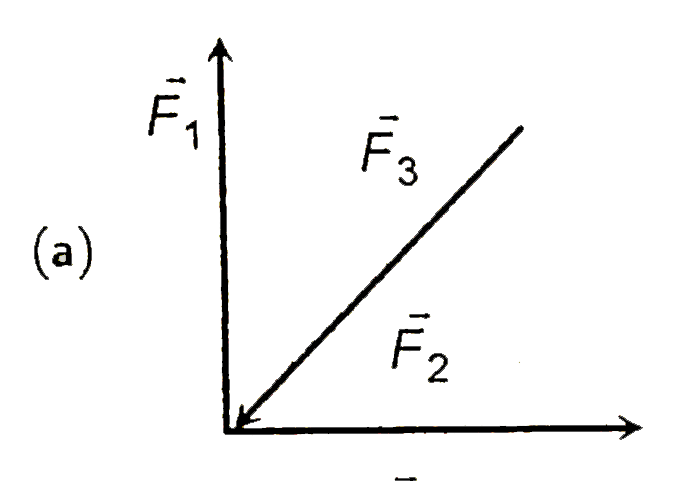
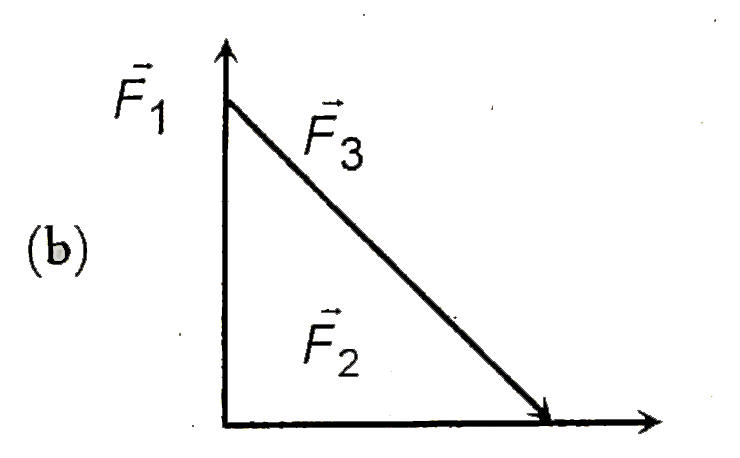
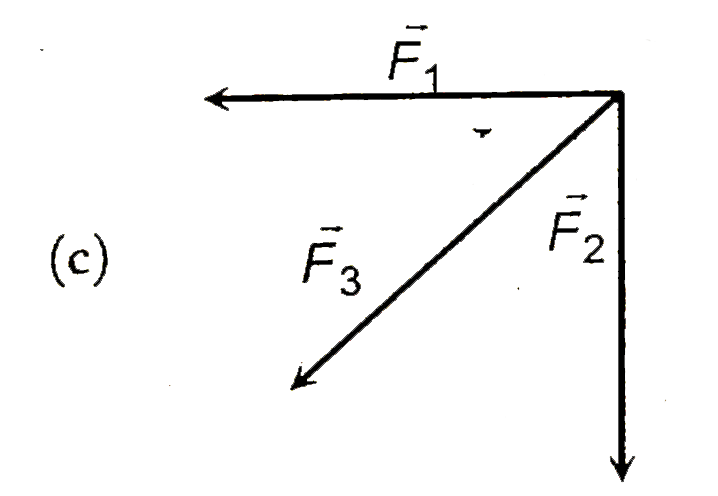
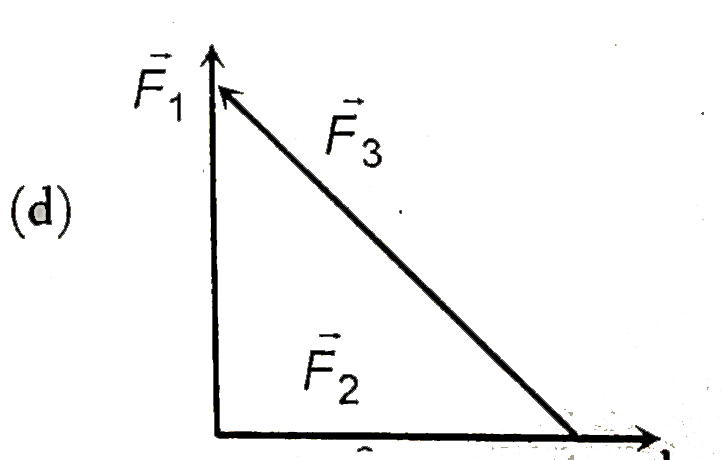
Which of the four arrangements in the figure correctly shows the vector addition of two forces `vecF_(1)` and `vecF_(2)` to yield the third force `vecF_(3)`

A

B

C

D

Text Solution

AI Generated Solution

The correct Answer is:

To determine which of the four arrangements correctly shows the vector addition of two forces \( \vec{F}_1 \) and \( \vec{F}_2 \) to yield the third force \( \vec{F}_3 \), we can follow these steps: ### Step 1: Understand Vector Addition Vector addition involves placing the tail of one vector at the head of another vector. The resultant vector is drawn from the tail of the first vector to the head of the second vector. ### Step 2: Analyze Each Arrangement We need to analyze each of the four arrangements provided in the figure to see which one follows the rules of vector addition. 1. **Arrangement A**: Check if \( \vec{F}_1 \) is placed at the tail of \( \vec{F}_2 \) and the resultant \( \vec{F}_3 \) is drawn from the tail of \( \vec{F}_1 \) to the head of \( \vec{F}_2 \). 2. **Arrangement B**: Check if \( \vec{F}_2 \) is placed at the tail of \( \vec{F}_1 \) and the resultant \( \vec{F}_3 \) is drawn from the tail of \( \vec{F}_2 \) to the head of \( \vec{F}_1 \). 3. **Arrangement C**: Check if \( \vec{F}_1 \) and \( \vec{F}_2 \) are drawn in such a way that \( \vec{F}_3 \) does not represent the resultant. 4. **Arrangement D**: Check if \( \vec{F}_3 \) is drawn incorrectly or does not follow the vector addition rule. ### Step 3: Identify the Correct Arrangement After analyzing each arrangement, identify which one correctly represents the vector addition of \( \vec{F}_1 \) and \( \vec{F}_2 \) to yield \( \vec{F}_3 \). ### Conclusion The correct arrangement will show that \( \vec{F}_1 + \vec{F}_2 = \vec{F}_3 \), meaning the head of \( \vec{F}_1 \) or \( \vec{F}_2 \) should meet the tail of \( \vec{F}_3 \).
Promotional Banner

Topper's Solved these Questions

  • NEWTONS LAWS OF MOTION

    ERRORLESS |Exercise Motion of Connected Bodies|23 Videos
  • NEWTONS LAWS OF MOTION

    ERRORLESS |Exercise Critical Thinking|19 Videos
  • NEWTONS LAWS OF MOTION

    ERRORLESS |Exercise Conservation of Linear Momentum and Impulse|27 Videos
  • MOTION IN TWO DIMENSION

    ERRORLESS |Exercise Exercise|319 Videos
  • ROTATIONAL MOTION

    ERRORLESS |Exercise Practice Problems (Problems based on motion of connected mass)|10 Videos

Similar Questions

Explore conceptually related problems

Which of the figure's six arrangements correctly show the vector addition of forces vec(F)_(1) and vec(F)_(2) to yield the third vector, which is meant to represent their net force vec(F)_("net") ?

The resultant of the forces vecF_(1)=4hati-3hatj and vecF_(2)=6hati+8hatj is

A body is at rest under the action of three forces, two of which are vecF_(1)=4hati, vecF_(2)=6hatj , the third force is

The figure shows an overhead view of a meter stick that can pivot about the point indicated, which is to the left of the stick's midpoint. Two horizontal forces, vecF_(1)andvecF_(2) , are applied to the stick. Only vecF_(1) is shown. Force vecF_(2) is perpendicular to the stick and is applied at the right end. If the stick is not to turn, (a) what should be the direction of vecF_(2) , and (b) should F_(2) be greater than, less than, or equal to F_(1) ?

Two forces vecF_(1)=(3N)hati-(4N)hatj and vecF_(2)=-(1N)hati-(2N)hatj act on a point object. In the given figure which of the six vectors represents vecF(1) and vecF_(2) and what is the magnitude of the net forces

If the four forces as shown are in equilibrium Express vecF_(1)& vecF_(2) in unit vector form.

Two forces vecF_(1) and vecF_(2) are acting at right angles to each other, find their resultant ?

In the given figure L=1 metre if total gravitational force on 4 kg mass is verF_(1) and on 2 kg mass is vecF_(2) then find out the ratio of |(vecF_(2))/(vecF_(2))|

ERRORLESS -NEWTONS LAWS OF MOTION-Equilibrium of Force
  1. The weight of an aeroplane flying in the air is balanced by

    Text Solution

    |

  2. When a body is stationary:

    Text Solution

    |

  3. Two forces, each of magnitude F have a resultant of the same magnitude...

    Text Solution

    |

  4. Two forces with equal magnitudes F act on a body and the magnitude of ...

    Text Solution

    |

  5. An object is subjected to a force in the north-east direction. To bala...

    Text Solution

    |

  6. The resultant force of 5 N and 10 N can not be

    Text Solution

    |

  7. The resultant of two forces 3P and 2P is R. If the first force is doub...

    Text Solution

    |

  8. The resultant of two forces , one double the other in magnitude is pe...

    Text Solution

    |

  9. Two forces are such that the sum of their magnitudes is 18N and their ...

    Text Solution

    |

  10. Which of the four arrangements in the figure correctly shows the vecto...

    Text Solution

    |

  11. Which of the following sets of concurrent force may be in equilibrium?

    Text Solution

    |

  12. Three forces start acting simultaneously on a particle moving with vel...

    Text Solution

    |

  13. Which of the following groups of forces could be in equibrium

    Text Solution

    |

  14. Two block are connected by a string as shown in the diagram. The upper...

    Text Solution

    |

  15. Consider the following statements about the blocks shown in the diagra...

    Text Solution

    |

  16. If two forces of 5 N each are acting along X and Y axes, then the magn...

    Text Solution

    |

  17. which of the following is correct order fo forces?

    Text Solution

    |

  18. A block is kept on a frictionless inclined surface with angle of incli...

    Text Solution

    |
