Home
Class 11
PHYSICS
Which of the following graph depicts spr...

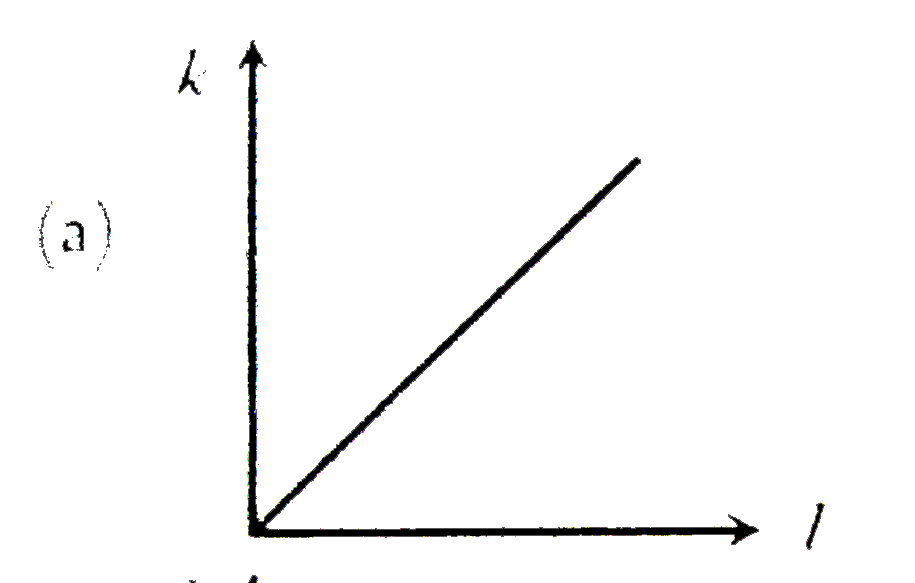
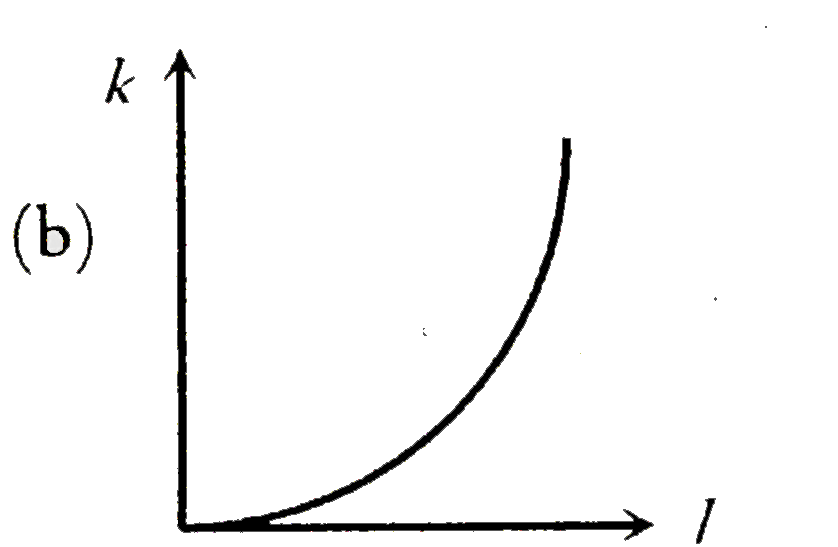
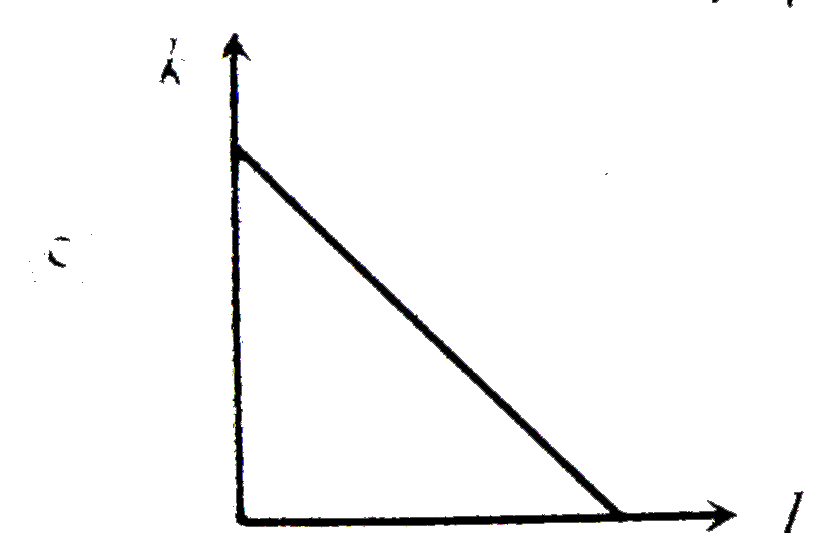
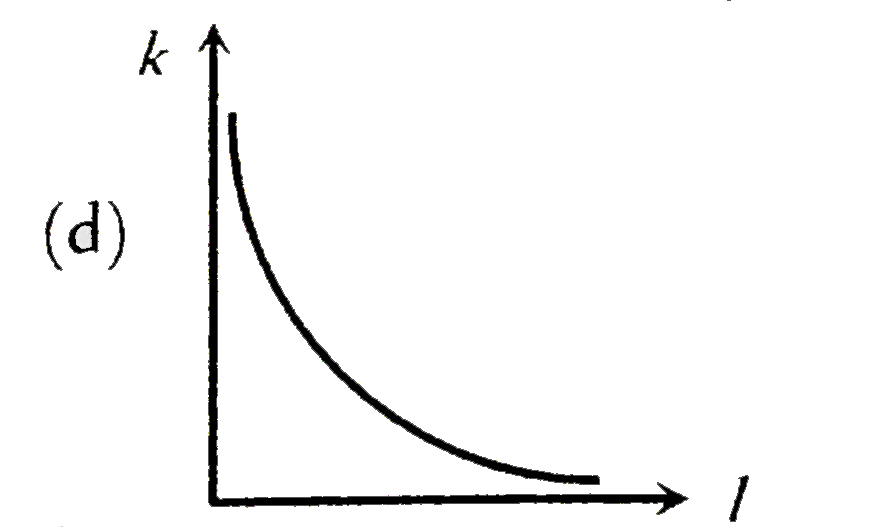
Which of the following graph depicts spring constant `k` versus length `l` of the spring correctly

A

B

C

D

Text Solution

AI Generated Solution

The correct Answer is:

To solve the problem of determining which graph depicts the relationship between the spring constant \( k \) and the length \( l \) of the spring, we can follow these steps: ### Step 1: Understand the relationship between force, spring constant, and displacement The spring force can be described by Hooke's Law, which states: \[ F = -kx \] where \( F \) is the force applied, \( k \) is the spring constant, and \( x \) is the displacement from the equilibrium position. ### Step 2: Rearranging the equation When we consider the magnitude of the force, we can write: \[ F = kx \] From this, we can express the spring constant \( k \) in terms of the force \( F \) and the displacement \( x \): \[ k = \frac{F}{x} \] ### Step 3: Analyzing the effect of length on the spring constant If we keep the force \( F \) constant and increase the displacement \( x \) (which corresponds to the length \( l \) of the spring), the spring constant \( k \) will change. Specifically, since \( k \) is inversely proportional to \( x \): \[ k \propto \frac{1}{x} \] This means that as the length \( l \) (or displacement \( x \)) increases, the value of \( k \) decreases. ### Step 4: Graphical representation The relationship \( k \propto \frac{1}{l} \) indicates that if we were to plot \( k \) against \( l \), we would expect a hyperbolic curve that decreases as \( l \) increases. Therefore, the graph depicting \( k \) versus \( l \) should show a downward trend, indicating that as the length of the spring increases, the spring constant decreases. ### Conclusion Based on the analysis, the correct graph that depicts the relationship between the spring constant \( k \) and the length \( l \) of the spring is a graph that shows \( k \) decreasing non-linearly as \( l \) increases.
Promotional Banner

Topper's Solved these Questions

  • NEWTONS LAWS OF MOTION

    ERRORLESS |Exercise Assertion & Reason|25 Videos
  • NEWTONS LAWS OF MOTION

    ERRORLESS |Exercise Self Evaluation Test|16 Videos
  • NEWTONS LAWS OF MOTION

    ERRORLESS |Exercise Critical Thinking|19 Videos
  • MOTION IN TWO DIMENSION

    ERRORLESS |Exercise Exercise|319 Videos
  • ROTATIONAL MOTION

    ERRORLESS |Exercise Practice Problems (Problems based on motion of connected mass)|10 Videos

Similar Questions

Explore conceptually related problems

The electrical analog of a spring constant k is

What will be the spring constant k of a. spring if length of the spring is made n times?

The time period (T) of a spring mass system depends upon mass (m) & spring constant (k) & length of the spring (l)[k=("Force")/("length")] . Find the relation among T, m , l & k using dimensional method.

A block of mass 'm' is attached to a spring in natural length of spring constant 'k' . The other end A of the spring is moved with a constat velocity v away from the block . Find the maximum extension in the spring.

Block of mass 2 m is given v_(0) towards the right. If L is the natural length of spring constant k , find the maximum elongation of the spring.

A ring of mass m is attached to a horizontal spring of spring constant k and natural length l_0 . The other end of the spring is fixed and the ring can slide on a horizontal rod as shown. Now the ring is shifted to position B and released Find the speed of the ring when the spring attains its natural length.

The spring constant of spring A is twice the spring constant of spring B . Each of the spring is cut into two pieces. First piece of spring A is (4//5) of the total length. Second piece of spring B is (5//6) of its total length. Both springs are of equal lengh initially :

A spring of certain length and having spring constant k is cut into two pieces of length in a ratio 1:2 . The spring constants of the two pieces are in a ratio :
