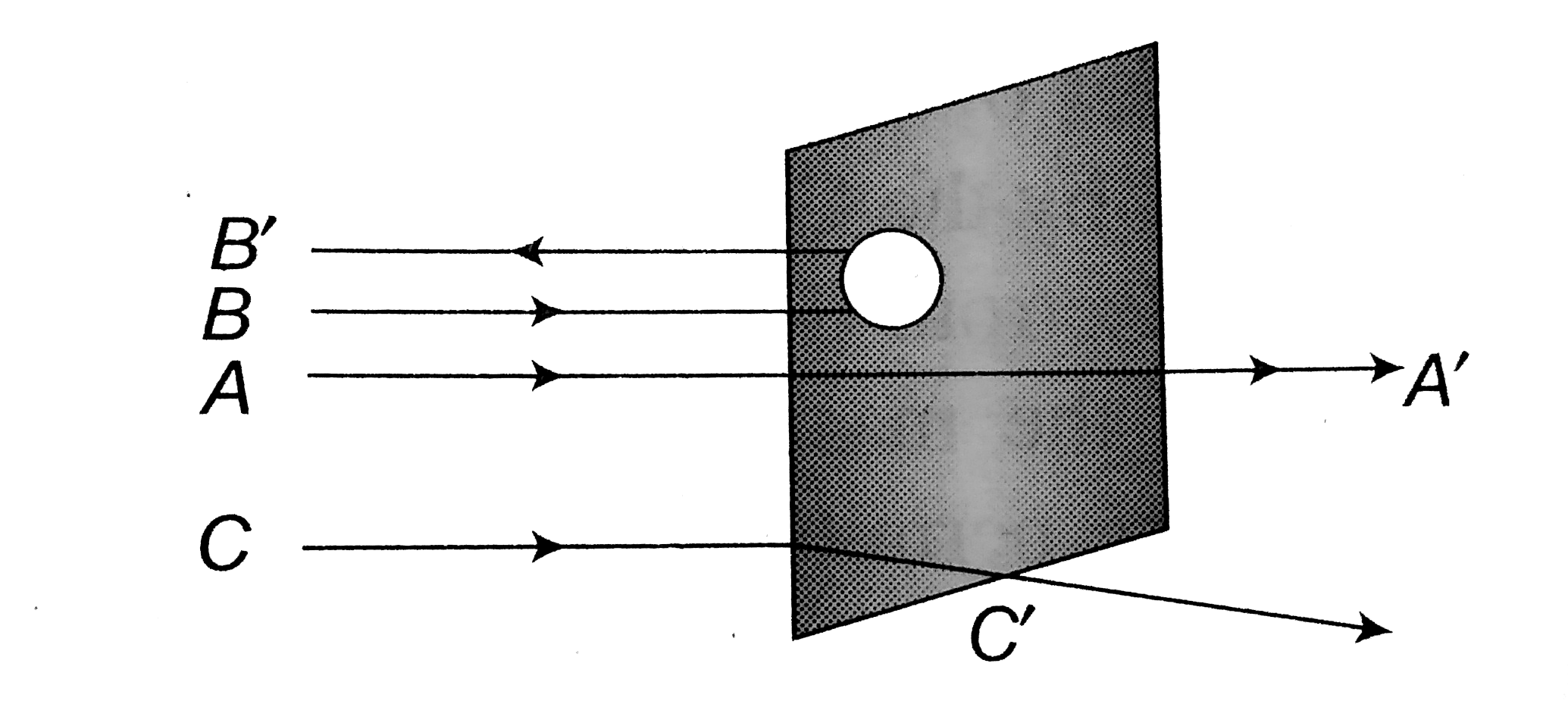
A beam of fast moving alpha particles were directed towards a thin film of gold. The parts `A', B'` and `C'` of the transmitted and refected beams correcponding ro the incident parts `A, B` and `C` of the beam, are shown in the adjoining diagram. The number of alpha particles in
A beam of alpha - particle is incident on a gold foil . Corresponding to the incident beams A , B and C , the emergent beams A' , B' and C' . The transmission and deflection of alpha - particles through the foil take place such that
Answer the following questions, which help you understand the difference between Thomson’s model and Rutherford’s model better. (a) Is the average angle of deflection of -particles by a thin gold foil predicted by Thomson’s model much less, about the same, or much greater than that predicted by Rutherford’s model? (b) Is the probability of backward scattering (i.e., scattering of alpha -particles at angles greater than 90° ) predicted by Thomson’s model much less, about the same, or much greater than that predicted by Rutherford’s model? (c) Keeping other factors fixed, it is found experimentally that for small thickness t, the number of alpha -particles scattered at moderate angles is proportional to t. What clue does this linear dependence on t provide? (d) In which model is it completely wrong to ignore multiple scattering for the calculation of average angle of scattering of alpha -particles by a thin foil?
A parallel beam, of light of wavelength 100 nm passed through a sample of atomic hydrogen gas in ground state. (a) Assume that when a phton supplies some of its energy to a hydrogen atom, the rest of the energy appears an another photon moving in the same direction as the incident photon. Neglecting the light emitted by the excited hydrogen atoms in the direction of the incident beam, what wavelengths may be observed in the transmitted beam? (b) A radition detector is placed near the gas to detect radiation coming perpendicular to the incident beam. Find the wavelength of radiation that may be detected by the detector.
A beam of mixture of alpha particle and protons are accelerted through same potential difference before entering into the magnetic field of strength B. if r_1=5 cm then r_2 is
A beam of equally charged particles after being accelerated through a voltage V enters into a magnetic field B as shown in Fig. 1.31. It is found that all the particles hit the plate between C and D. Find the ratio between the masses of the heaviest and lightest particles of the beam.
A narrow beam of alpha particles with kinetic energy 1.0 MeV falls normally on a platinum foil 1.0 mu thick. The scattered particles are observed at an angle of 60^(@) to the incident beam direction by means of a counter with a circular inlet area 1.0 cm^(2) located at the distacne 10 cm from the scattering section of the foil. What fraction of scattered alpha particles reaches the counter inlet?
A narrow beam of alpha particles with kinetic energy T== 0.50 MeV falls normally on a golden foil whose t=mass of thickness is rho d= 1.5 mg//cm^(2) The beam intensity is I_(0)= 5.0.10^(5) particles per second. Find the number of alpha particles scattered by the foil during the time interval tau=30 m in into the angular interval: (a) 59-61^(@) , (b) over theta_(0)=60^(@) .