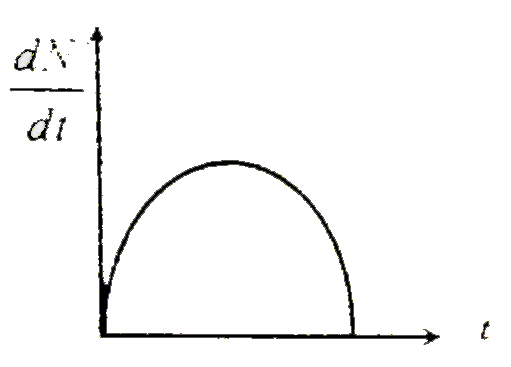
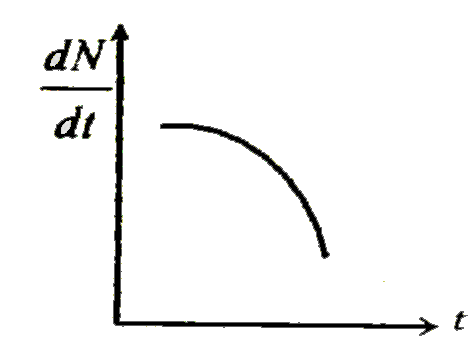
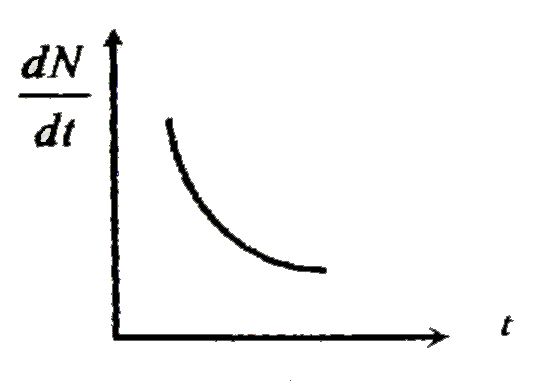
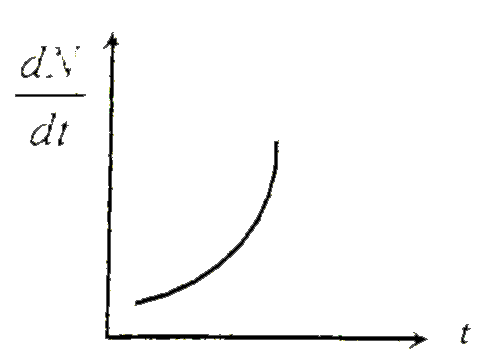
The radioactive nucleus of an element X decays to a stable nucleus of element Y.A graph of the rate of romation of Y against time would look like:
Nuclei of a radioactive element X are being produced at a constant rate K and this element decays to a stable nucleus Y with a decay constant lambda and half-life T_(1//3) . At the time t=0 , there are N_(0) nuclei of the element X . The number N_(X) of nuclei of X at time t=T_(1//2) is .
Nuclei of a radioactive element X are being produced at a constant rate K and this element decays to a stable nucleus Y with a decay constant lambda and half-life T_(1//3) . At the time t=0 , there are N_(0) nuclei of the element X. The number N_(Y) of nuclei of Y at time t is .
Nuclei of a radioactive element X are being produced at a constant rate K and this element decays to a stable nucleus Y with a decay constant lambda and half-life T_(1//3) . At the time t=0 , there are N_(0) nuclei of the element X . The number N_(Y) of nuclei of Y at t=T_(1//2) is.
20% radioactive sample decay in time t. How much sample decay in time 2t ?
A radioactive element A decays with a decay constant lambda . The fraction of nuclei that decayed at any time t , if the initial nucle are N_(0) is given by:
A radioactive element X with half life 2 h decays giving a stable element Y. After a time t, ratio of X and Y atoms is 1:16 .Time t is