

Home
Class 11
PHYSICS
Two blocks of masses m(1) and m(2) are k...

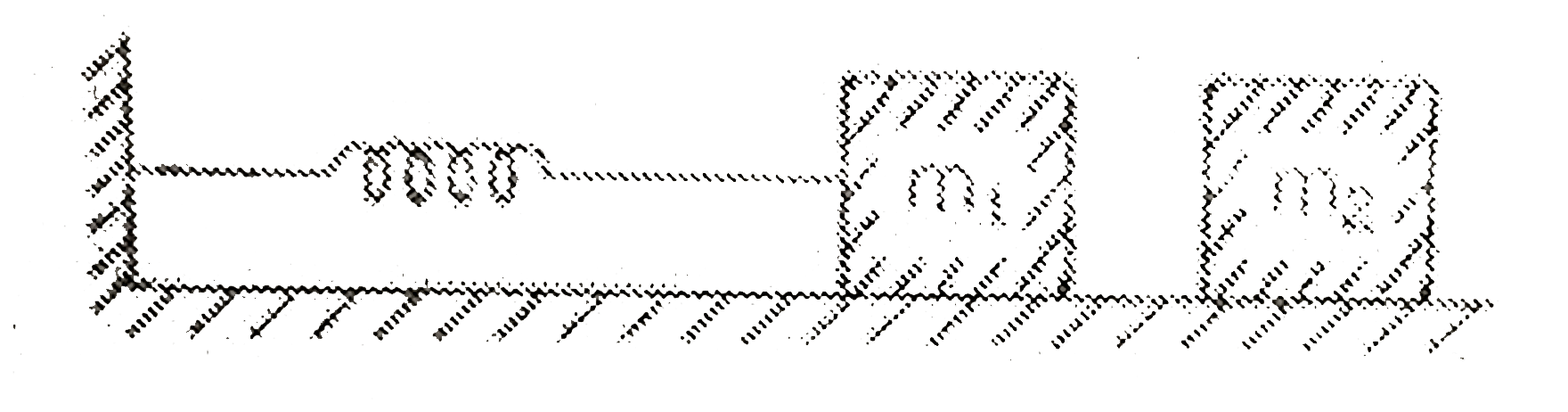
Two blocks of masses `m_(1)` and `m_(2)` are kept on a smooth horizontal table as shown in figure. Block of mass `m_(1)` (but not `m_(2)` is fastened to the spring. If now both the blocks are pushed to the left so that the spring is compressed a distance d. The amplitude of oscillatin of block of mass `m_(1)` after the system is released is

Promotional Banner

Similar Questions

Explore conceptually related problems

The masses in figure slide on a frictionless table. m_(1) but not m_(2) , is fastened to the spring. If now m_(1) and m_(2) are pushed to the left , so that the spring is compressed a distance d , what will be the amplitude of the oscillation of m_(1) after the spring system is released ?

The masses in figure slide on a frictionless table. m_(1) but not m_(2) , is fastened to the spring. If now m_(1) and m_(2) are pushed to the left , so that the spring is compressed a distance d , what will be the amplitude of the oscillation of m_(1) after the spring system is released ?

Two block of masses m_(1) and m_(2) are connected as shown in the figure. The acceleration of the block m_(2) is:

Two block of masses m_(1) and m_(2) are connected as shown in the figure. The acceleration of the block m_(2) is:

Two blocks of masses m_1 and m_2 are connected as shown in the figure. The acceleration of the block m_2 is :

Two blocks of masses m_1 and m_2 are connected as shown in the figure. The acceleration of the block m_2 is :

Two blocks of mass m_(1) and m_(2) lie on smooth horizontal table in contact with each other as shown in figure If a force F is applied to the mass m_(1) then the contact force between the block will be

Two blocks of mass m_(1) and m_(2) lie on smooth horizontal table in contact with each other as shown in figure If a force F is applied to the mass m_(1) then the contact force between the block will be

The block of mass m_1 shown in figure is fastened to the spring and the block of mass m_2 is placed as against it. Find the compression of the spring in the equilibrium position.