A
B
C
D
Text Solution
Verified by Experts
The correct Answer is:
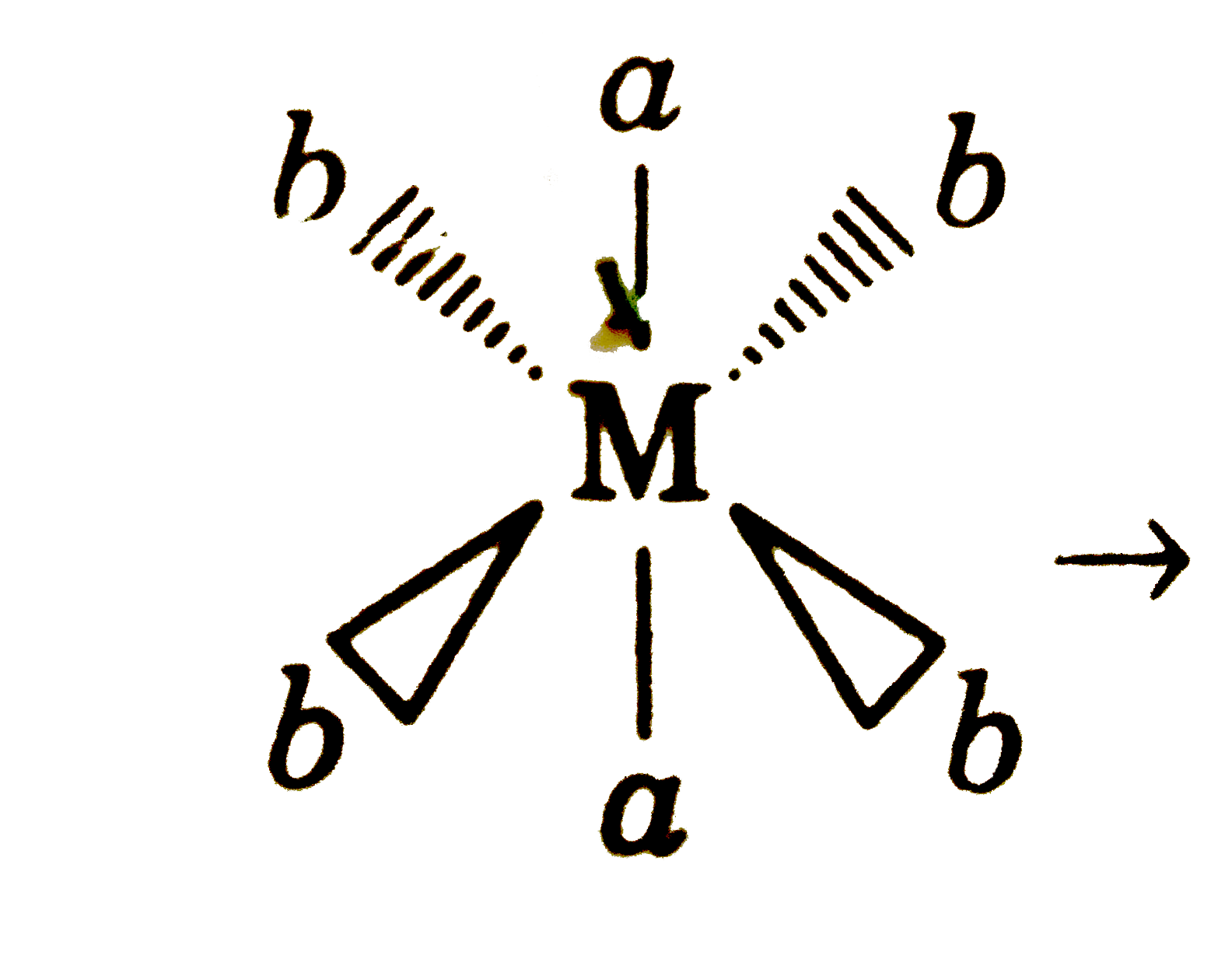 to only one possible because all 'b' position are identical.


Topper's Solved these Questions
COORDINATION COMPOUNDS
GRB PUBLICATION|Exercise G. Organometallic Compounds, Synergic Bonding|52 VideosCOORDINATION COMPOUNDS
GRB PUBLICATION|Exercise REASONING TYPE|59 VideosCOORDINATION COMPOUNDS
GRB PUBLICATION|Exercise E. Stability, Colour and Magnetic Properties of Complexes|60 VideosCHEMICAL KINETICS
GRB PUBLICATION|Exercise Subjective Type|63 VideosD-BLOCK ELEMENTS
GRB PUBLICATION|Exercise Subjective Type|18 Videos
Similar Questions
Explore conceptually related problems
GRB PUBLICATION-COORDINATION COMPOUNDS-F.Isomerism in Coordination Compounds
- Geometrical isomerism is found in coordination compounds having coordi...
Text Solution
|
- Cis-trans isomerism is found in square planar complexes of molecular f...
Text Solution
|
- In the reaction [CoCI(2)(NH(3))(4)]^(o+)rarr^(cl)[CoCI(3)(NH(3))(3)]...
Text Solution
|
- Geometrical isomerism in coordination compounds is exhibited by :
Text Solution
|
- Which of the following is not optically active?
Text Solution
|
- Geometrical isomerism can be shown by :
Text Solution
|
- For the square planar complex [Pt(NH(3))(NH(2)OH)(py)(No(2))]^(o+) how...
Text Solution
|
- Which of the following would exhibit geometrical as well as optical is...
Text Solution
|
- The number of geometrical isomers and optical isomers of [Pt(NH(3))(Br...
Text Solution
|
- The complex entity which shows geometrical as well as optical isomeris...
Text Solution
|
- Which of the following complex compound exhibits geometrical isomerism...
Text Solution
|
- Which of the following will exhibit more than ten isomers ?
Text Solution
|
- How many total possible isomers are present for [Pt(CN)(2)(NO(2))(2)]^...
Text Solution
|
- Coordination number, oxidation state and number of isomers in K(3)[Cr(...
Text Solution
|
- The total number of optically active isomers of [Pt(en)(2)Cl(2)]^(2+) ...
Text Solution
|
- Select the correct statement regarding the complex given below :
Text Solution
|
- Which of the following complex does not show geometrical isomerism ?
Text Solution
|
- Which of the following is correct IUPAC name of any compound.
Text Solution
|
- Which of the following ions are optically active ?
Text Solution
|
- In which case racemic mixture is obtained on mixing its mirror images ...
Text Solution
|