Home
Class 12
PHYSICS
A particle moves along x-axis in positiv...

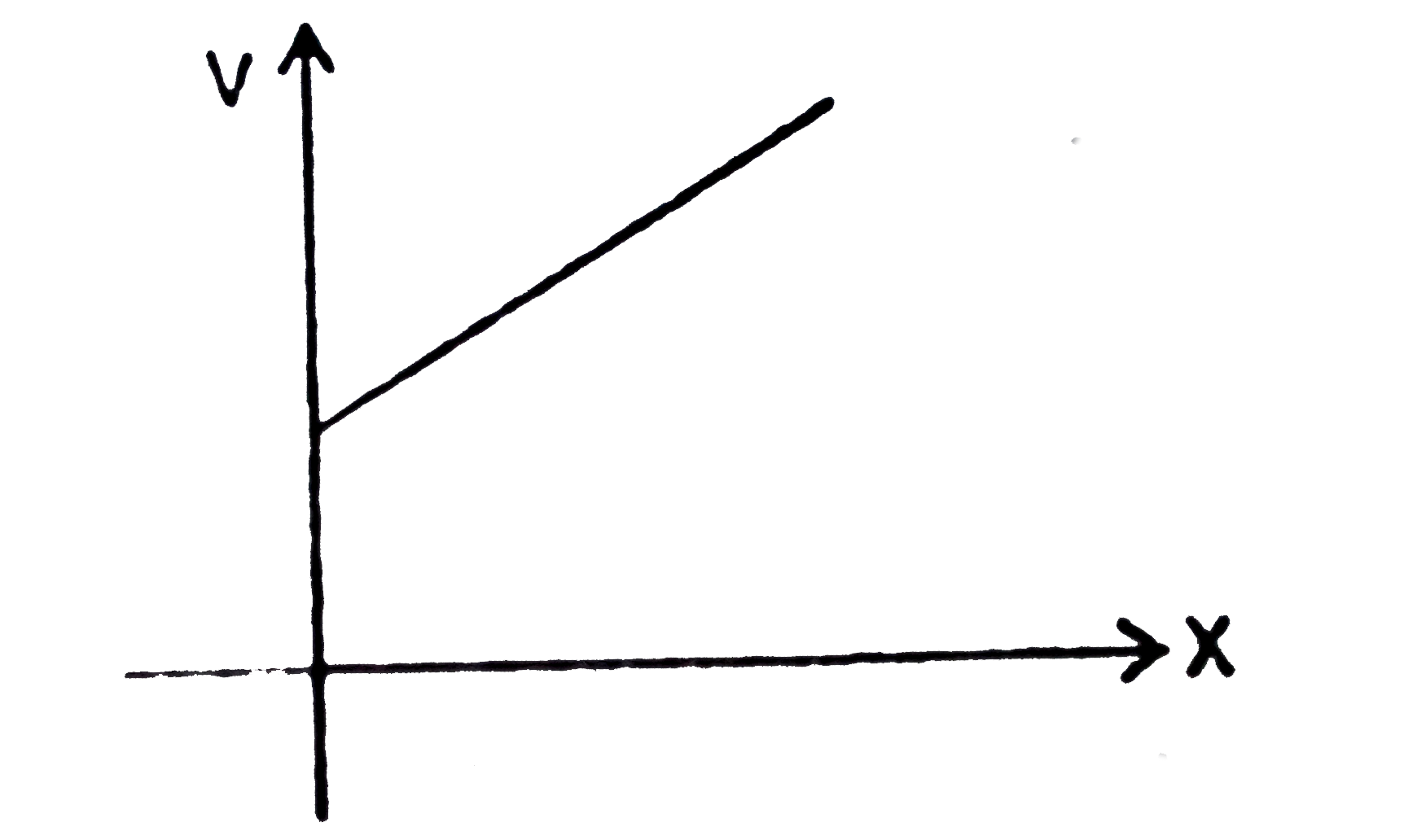
A particle moves along `x`-axis in positive direction. Its acceleration `'a'` is given as `a=cx+d`, where `x` denotes the `x`- coordinate of particle, `c` and `d` are positive constants. For velocity position graph of particle to be of type as shown in figure, the value of speed of particle at `x=0` should be

A

`sqrt((2d^(2))/c)`

B

`sqrt((8d^(2)/c)`

C

`sqrt((4d^(2))/c)`

D

`sqrt((d^(2))/c)`

Text Solution

Verified by Experts

The correct Answer is:

D

`a=V(dv)/(dx)=cx+d`
Let at `x=0 v=u`
`:.int_(u)^(v) vdv=int_(0)^(x)(cx+d) dx`
or `v^(2)=cx^(2)+2dx+u^(2)`
`v` shall be linear function of `x` if `cx^(2)+2dx+u^(2)` is perfect square
Promotional Banner

Similar Questions

Explore conceptually related problems

Velocity (v) versus position (x) graph of a particle is shown.The acceleration of the particle at x=1m is ?

The velocity –position graph of a particle moving along a straight line is shown. Then acceleration of the particle at s = 15 m is :

The velocity-position graph of a particle moving in a straight line along x -axis is given below.Acceleration of particle at x=2m is

The velocity-position graph of a particle moving in a straight line along x -axis is givenbelow.Acceleration of particle,at x=2m is

The velocity-position graph of a particle moving in a straight line along x-axis is given below. Acceleration of particle at x = 2 m is

Position-time graph for a particle moving along x- direction is as shown in the figure. Average speed of the particle from t = 0 to t = 4 is :

The position-time graph for two particles P and Q moving on x-axis is shown in the figure. Then

A particle moves in the xy plane with a constant acceleration omega directed along the negative y-axis. The equation of motion of particle has the form y = cx -dx^(2) , where c and d are positive constants. Find the velocity of the particle at the origin of coordinates.

For a particle moving along x-axis, velocity-time graph is as shown in figure. Find the displacement of the particle?

The x-t graph of a particle moving along a straight line is shown in figure The speed-time graph of the particle is correctly shown by
