Home
Class 12
PHYSICS
A pulley is attached to one arm of a bal...

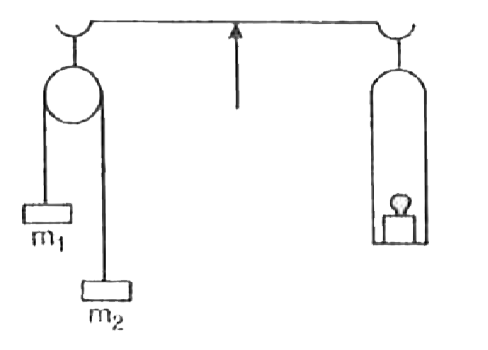
A pulley is attached to one arm of a balance and a string passed around it carries two masses `m_(1)` and `m_(2)` . The pulley is provided with a clamp due to which `m_(1)` and `m_(2)` do not move . On removing the clamp `m_(1)` and `m_(2)` start moving . How much counterweight is to be reduced or increased to restore balance ?

A

`(m_(1)^(2)g)/(m_(1)+m_(2))`

B

`((m_(1)+m_(2))^(2)g)/(m_(1)+m_(2))`

C

`(m_(2)^(2)g)/((m_(1)+m_(2))^(2))`

D

zero

Text Solution

Verified by Experts

The correct Answer is:

B

When theh clamp is removed, the pull on the left arm is `(4m_(1)m_(2)g)/(m_(1)+m_(2))`
When `m_(1)` and `m_(2)` do not move, the pull is `(m_(1)+m_(2))g`
`DeltaW=((m_(1)-m_(2))^(2))/(m_(1)-m_(2))`
Promotional Banner

Similar Questions

Explore conceptually related problems

A pulley is attached to one arm of a balance and a string passed around it carries two masses m_(1) and m_(2) . The pulley is provided with a clamp due to which m_(1) and m_(2) do not move. On removing the clamp, m_(1) and m_(2) start moving. How much change in counter mass has to be made to restore balance ?

In the system shown in fig the pulley is frictionless and the string massless if m_(1)=m_(2) thrust on the pulley will be:

When we ignore friction and mass of pulley what would be the accelerations of the two blocks m_(1) and m_(2) .

Two masses m_(1) and m_(2) are attached to a spring balance S as shown in figure. m_(1) gt m_(2) then the reading of spring balance will be . .

Two masses m_(1) and m_(2) are connected by a light string passing over a smooth pulley. When set free m_(1) moves downward by 2 m in 2 s. The ratio m_(1)//m_(2) is

In the given arrangement, all strings and pulleys are light. When the system was released it was observed that M and m_(0) do not move. Find the masses M and m_(0) in terms of m_(1) "and" m_(2) . Find the acceleration of all the masses if string is cut just above m_(2) .

A pulley fixed to the ceiling of an elevator car carries a thread whose ends are attached to the masses m_(1) and m_(2) . The car starts going up with an acceleration a_(0) . Assuming the masses of the pulley and the thread as well as the friction to be negligible, find: (a) the acceleration of the load m_(1) relative to the elevator shaft and relative to the car (b) the force exerted by the pulley on the ceiling of the car. Given m_(1) gt m_(2) .

Two masses m_(1) kg and m_(2) kg passes over an atwoods machine. Find the ratio of masses m_(1) and m_(2) so that string passing over the pulley will just start slipping over its surface. The friction coefficient between the string and pulley surface is 0.2.
