Home
Class 12
PHYSICS
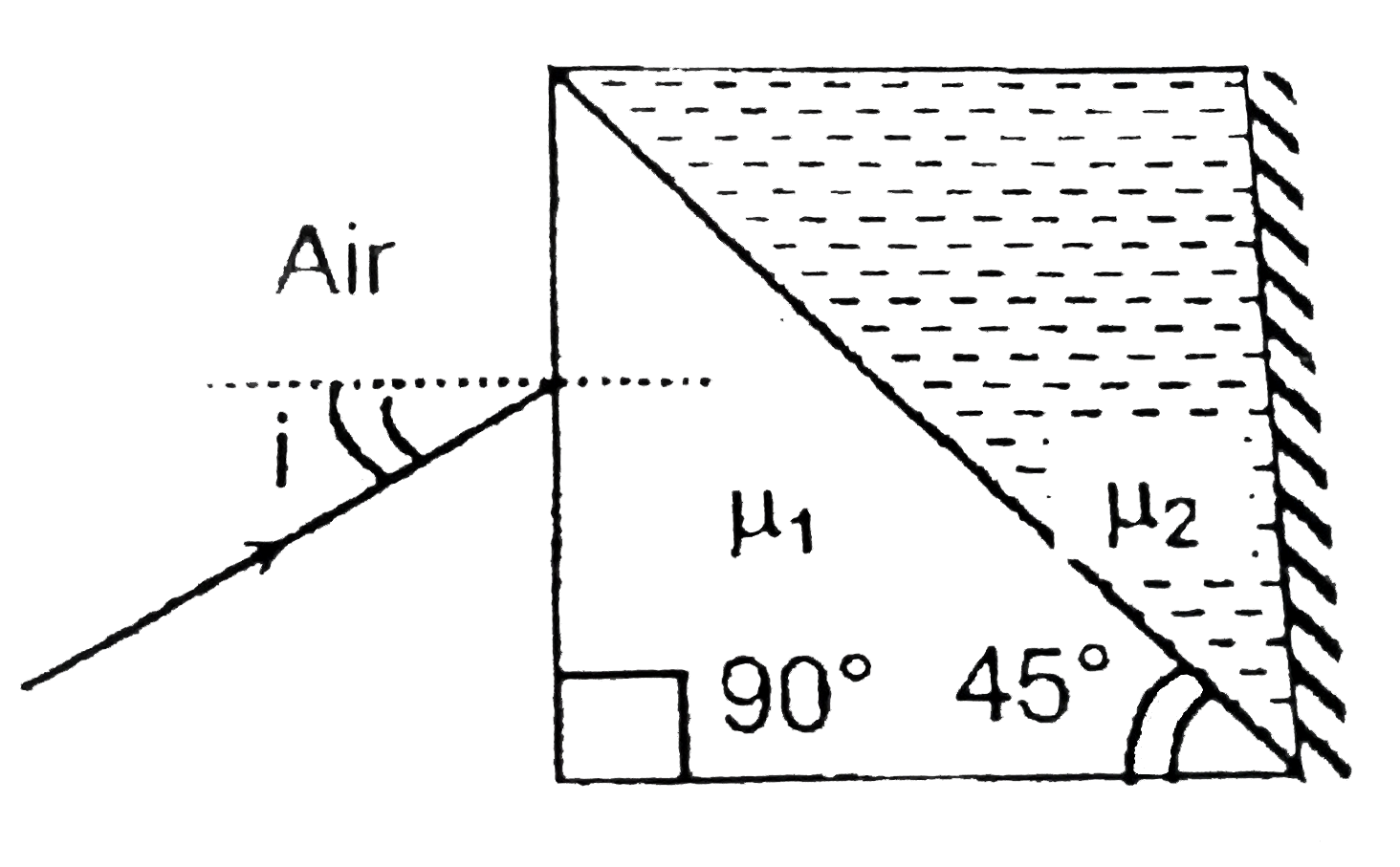
In the given situation, for what value o...


In the given situation, for what value of `i`, the incidence ray will retrace its initial path.

A

`cos^(-1)[mu_(1)sin((pi)/4-sin^(-1)(mu_(2))/(sqrt(2)mu_(1)))]`

B

`sin^(-1)[mu_(1)sin((pi)/4-sin^(-1)(mu_(2))/(sqrt(2)mu_(1)))]`

C

`sin^(-1)[mu_(2)sin((pi)/4-sin^(-1)(mu_(2))/(sqrt(2)mu_(2)))]`

D

`cos^(-1)[mu_(2)sin((pi)/4-sin^(-1)(mu_(2))/(sqrt(2)mu_(2)))]`

Text Solution

Verified by Experts

The correct Answer is:
B

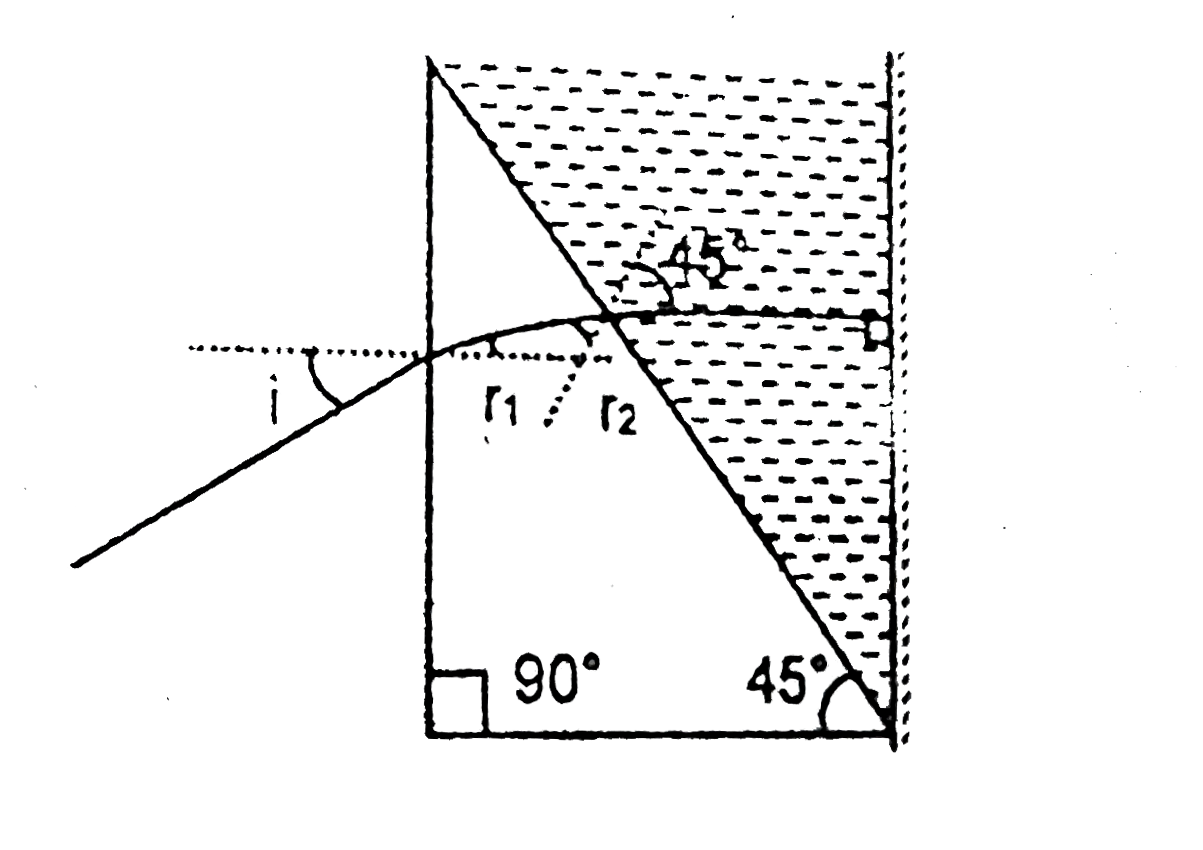
Since incident ray retraces its path it must strike the plane mirro perpendiculary.
From Snell's law `sini=mu_(1)sinr_(1)`
and `mu_(1)sinr_(2)=mu_(2)sin45^(@)impliesmu_(1)sinr_(2)=(mu_(2))/(sqrt(2))`
`impliesr_(2)=sin^(-1)((mu_(2))/(sqrt(2)mu_(1)))`
Also `r_(1)+r_(2)=(pi)/4`
`:.r_(1)=(pi)/4-sin^(-1)((mu_(2))/(sqrt(2)mu_(1)))`
`:. i=sin^(-1)[mu_(1)sin((pi)/4-sin^(-1)(mu_(2))/(sqrt(2)mu_(1)))]`
Promotional Banner

Similar Questions

Explore conceptually related problems

If one face of a prism angle 30^(@) and mu=sqrt( 2) is silvered, the incident ray retraces its initial path. What is the angle of incidence ?

If one face of a prism angle 30^(@) "and" mu= sqrt2 is silvered , the incident ray retraces its initial path. What is the angle of incidence?

For the situations shown in figure, determine the angle by which the mirror should be rotated, so that the light ray will retrace its path after refraction through the prism and reflection from the mirror?

The sides of an isosceles right prism are coated with a reflecting coating. A ray of light falls on the hypotenuse at an arbitrary angle i. For what value of i the ray leaving the prism is parallel to the incident ray ?

A prism has refracting angle 30^(@) and mu = 2 . One of the mat surface of the prism is polished to make it reflecting. Find the incidence angle of a light ray on other mat surface of prism so that after reflection the ray will retrace the path of incident ray.

In terms of theta find the value of i, show that ray of light retraces its path after third reflection

When two plane mirrors subtend an angle theta between them, then a ray of light incident parallel to one of them retraces its path afer n reflections such that ntheta=c (where c is constant) If the angle between mirrors is 60^(@) . Then light ray retraces its path after n reflections where n is

When two plane mirrors subtend an angle theta between them, then a ray of light incident parallel to one of them retraces its path afer n reflections such that ntheta=c (where c is constant) What is the angle of c?

When two plane mirrors subtend an angle theta between them, then a ray of light incident parallel to one of them retraces its path afer n reflections such that ntheta=c (where c is constant) The graph between theta and n will

