Home
Class 12
PHYSICS
A cylinder of mass M and radius R is res...


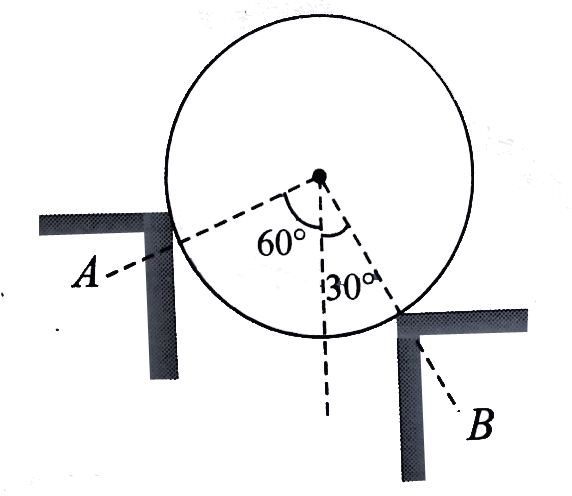
A cylinder of mass M and radius R is resting on two corner edges A and B as shown in figure. The normal reaction at the edges A and B are: (Neglect friction)

A

`N_(A)=sqrt(2)N_(B)`

B

`N_(B)=sqrt(3)N_(A)`

C

`N_(A)=(Mg)/2`

D

`N_(B)=(2sqrt(3)Mg)/5`

Text Solution

Verified by Experts

NA
Promotional Banner

Similar Questions

Explore conceptually related problems

A cylinder of mass 1/sqrt(3)kg is placed on the corner of two inclined planes as shown in the figure.Find the normal reaction in newtons at contact point of cylinder with the slope of inclination 30^(@) g=10m/s^(2)

A block of mass m is at rest on wedge as shown in figure. Let N be the normal reaction between two and f the force of friction, then choose the wrong option.

Two blocks A and B of equal masses are released on two sides of a fixed wedge C as shown in figure. Find the acceleration of centre of mass of blocks A and B. Neglect friction.

A solid cylinder of mass M and radius 2R is rolled up on an incline with the help of a plank of mass 2M as shown in the figure. A constant force F is acting on the plank parallel to the incline. There is no slipping at any of the contact. The friction force between the plank and cylinder is given by:

A cylinder of mass m and radius r rests on two supports of the same height (Fig. ). One support is stationary, while the other slides from under the cylinder at a velocity v. Determine the force of normal pressure N exerted by the cylinder on the stationary support at the moment when the distance between points A and B of the supports is Ab = r sqrt(2) , assuming that the supports wery very close to each other at the initial instant. The friction between the cylinder and the supports should be neglected.

Two blocks A and B of mass 10 kg and 40 kg are connected by an ideal string as shown in the figure. Neglect the masses of the pulleys and effect of friction. (g = 10 m/s2) А B 45° Fixed 45°

Two blocks A and B of mass 10 kg and 40 kg are connected by an ideal string as shown in the figure. Neglect the masses of the pulleys and effect of friction. (g = 10 m/s2) A B 45° Fixed 45°

A uniform cylinder of mass M and radius R is placed on a rough horizontal board, which in turn is placed on a smooth surface. The coefficient of friction between the board and the cylinder is mu . If the board starts accelerating with constant acceleration a, as shown in the figure, then

A uniform cylinder of mass M and radius R is released from rest on a rough inclined surface of inclination theta with the horizontal as shown in figure. As the cylinder rolls down the inclined surface, the maximum elongation it the spring stiffness k is

