Home
Class 12
PHYSICS
One mole of helium gas follows the cycle...

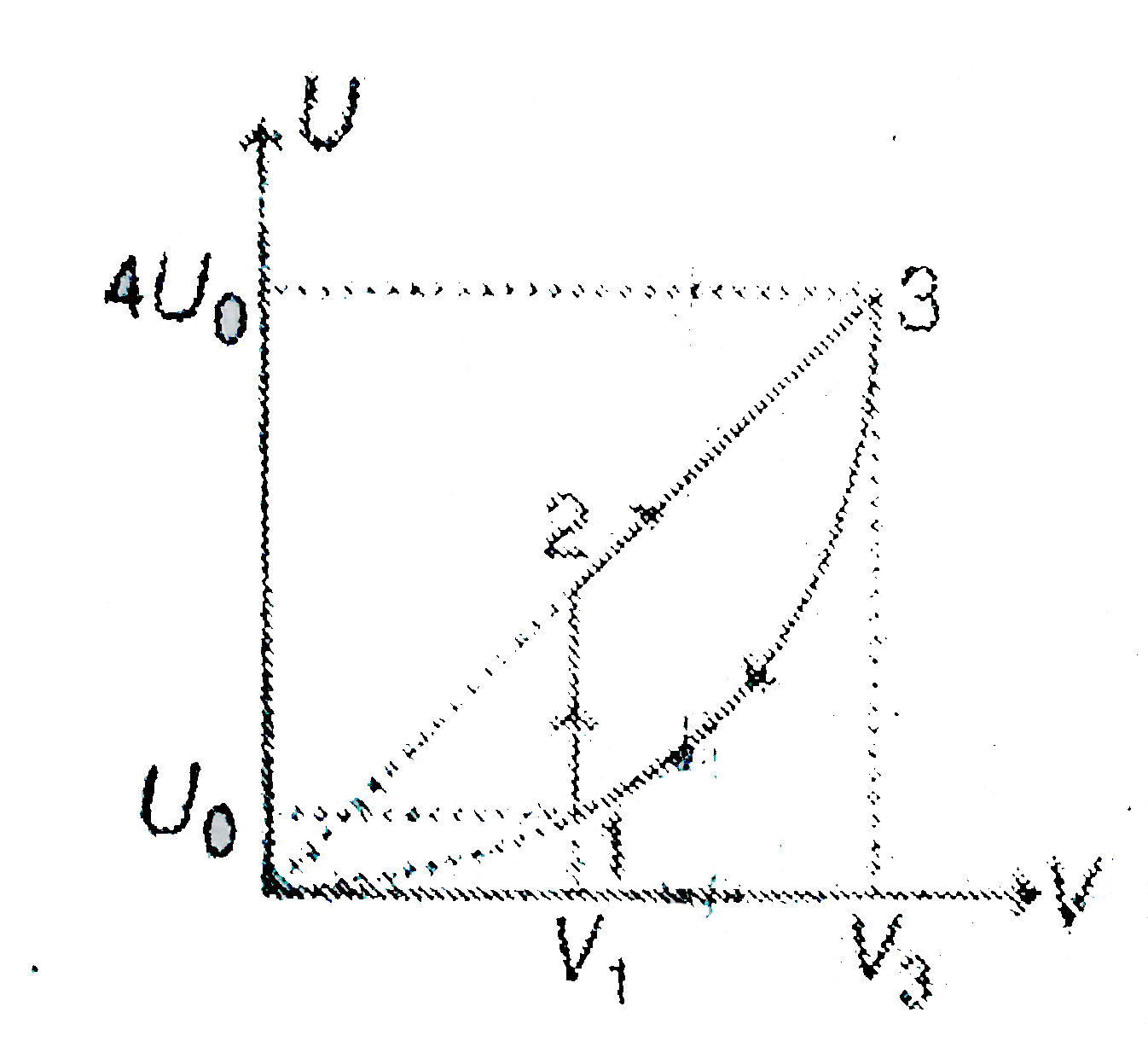
One mole of helium gas follows the cycle 1-2-3-1 shown in the diagram. During process 3-1, the internal energy (U) of the gas depends on its volume (V) as `U=bV^(2)`, where b is a positive constant. If gas releases the amount of heat `Q_(1)` during process 3-1 and gas absorbs th amount of heat `Q_(2)` during process `1rarr2rarr3` them:

The value of `O_(1)//Q_(2)` is

A

`8/9`

B

`9/8`

C

`12/13`

D

none of these

Text Solution

Verified by Experts

The correct Answer is:
C

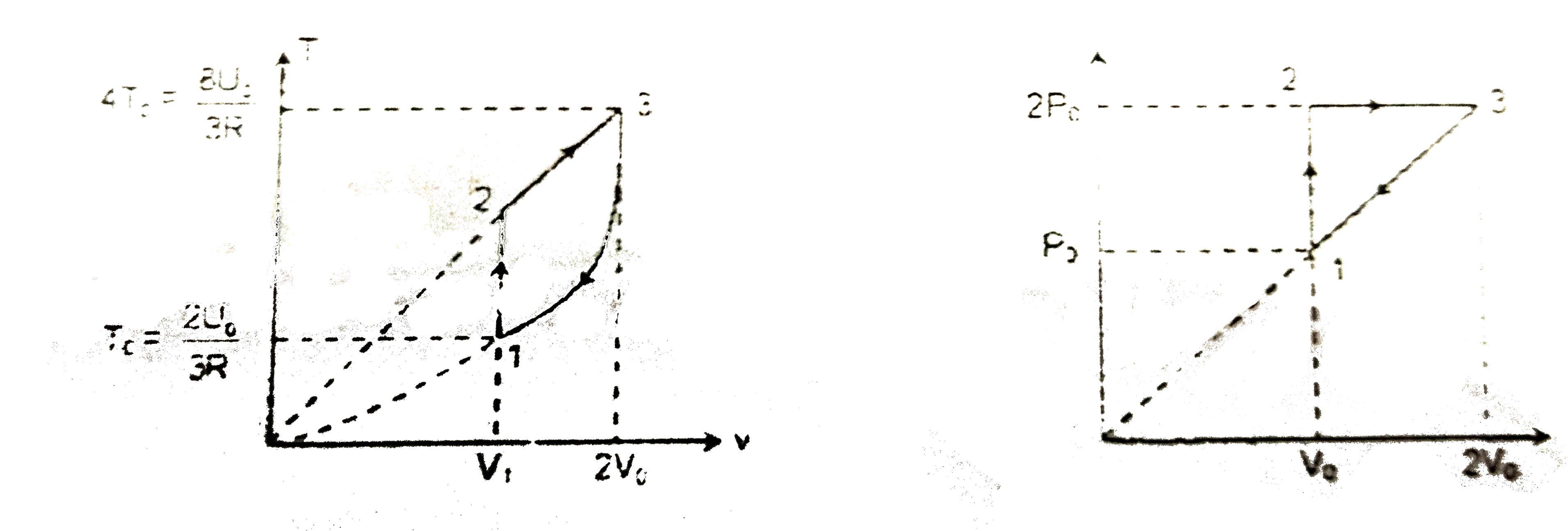
`U_(1)=nCvT=(3R)/2TimpliesT_(1)=(2U_(0))/(3R)`
Process `3-1impliesU=bV^(2)`
`implies(2bV_(1)^(2))/(3R)implies(PV_(1))/R=(2bV_(2))/(3R)impliesp_(1)=(2bV)/3`
When temperature becomes four times the volume becomes double
`DeltaU_(31)=U_(0)=4U_(0)=-3U_(0)`
`[1/2xx3P_(0)xxV_(0)]=(-3)/2P_(0)V_(0)=(-3)/2 RT_(0)=(-3R)/2xx(2U_(0))/(3R)=-U_(0)`
`Q_(31)=-4U_(0)=-Q_(1)`
process `1-2implies` isochoric process
`W_(12)=DeltaU_(12)nCv(T_(2)-T_(1))=1xx(3R)/2((2P_(0)V_(0))/R-(P_(0)V_(0))/R)`
`=(3R)/2xx(P_(0)V_(0))/2=(3RT_(0))/2=U_(0)`
`Q_(12)=U_(0)`
Process `2-3implies` isobaric process
`W_(23)=2P_(0)v_(0)=2xxRT_(0)=2Rxx(2U_(0))/(3R)=(4U_(0))/3`
`U_(23)=nCV(T_(3)-T_(2))=1xx(3R)/2`
`[(4P_(0)V_(0))/R-(2P_(0)V_(0))/R]=3P_(0)V_(0)=3RT_(0)=2U_(0)`
`Q_(23)=(10U_(0))/3`
`Q_(2)=Q_(12)+Q_(23)=(13U_(0))/3`
Promotional Banner

Similar Questions

Explore conceptually related problems

One mole of helium gas follows the cycle 1-2-3-1 shown in the diagram. During process 3-1, the internal energy (U) of the gas depends on its volume (V) as U=bV^(2) , where b is a positive constant. If gas releases the amount of heat Q_(1) during process 3-1 and gas absorbs th amount of heat Q_(2) during process 1rarr2rarr3 them: (V_(3))/(V_(1)) is

One mole of helium gas follow cycle 1-2-3-1 shown in the diagram. During process 3-1 , the internal energy (U) of the gas depends on its volume (V) as U=bV^(2) , where b is a positive constant. If gas releases the amount of heat Q during process 3-1 and gas absorbs the amount of heat Q_(2) during process 1rarr2rarr3 . The value of ratio of volume of gas in state -3(V_(3)) to that of gas in state -1(V_(1)) is:

The temperature (T) of one mole of an ideal gas varies with its volume (V) as T= - alpha V^(3) + beta V^(2) , where alpha and beta are positive constants. The maximum pressure of gas during this process is

Two moles of an ideal monoatomic gas is taken through a cycle ABCA as shown in the p - T diagram. During the process AB, the pressure and temperature of the gas vary such that pT = constant. If T_(1)= 300 K and the amount of heat released by the gas during the process AB is Q = -x R , then the value of x is

Two moles of an ideal gas are undergone a cyclic process 1-2-3-1. If net heat exchange in the process is 300J, the work done by the gas in the process 2-3 is

During the adiabatic expansion of 2 moles of a gas, the internal energy of the gas is found to decrease by 2 joules , the work done during the process on the gas will be equal to

One mole of an ideal gas at initial temperature T, undergoes a quasi-static process during which the volume V is doubled. During the process the internal energy U obeys the equation U=aV(3) where a is a constant. The work done during this process is-

The internal energy of a gas is given by U = 3 pV. It expands from V_(0) to 2V_(0) against a constant pressure p_(0) . The heat absorbed by the gas in the process is

The P - V diagram of 2 gm of helium gas for a certain process A rarr B is shown in the figure. What is the heat given to the gas during the process A rarr B ?

A heat engine carries one mole of an ideal mono-atomic gas around the cycle as shown in the figure below. Process 1 rarr 2 takes place at constant volume, process 2 rarr 3 is adiabatic and process 3 rarr 1 takes place at constant pressure. Then the amount of heat added in the process 1 rarr2 is

