Home
Class 12
PHYSICS
There is an infinite line of uniform lin...


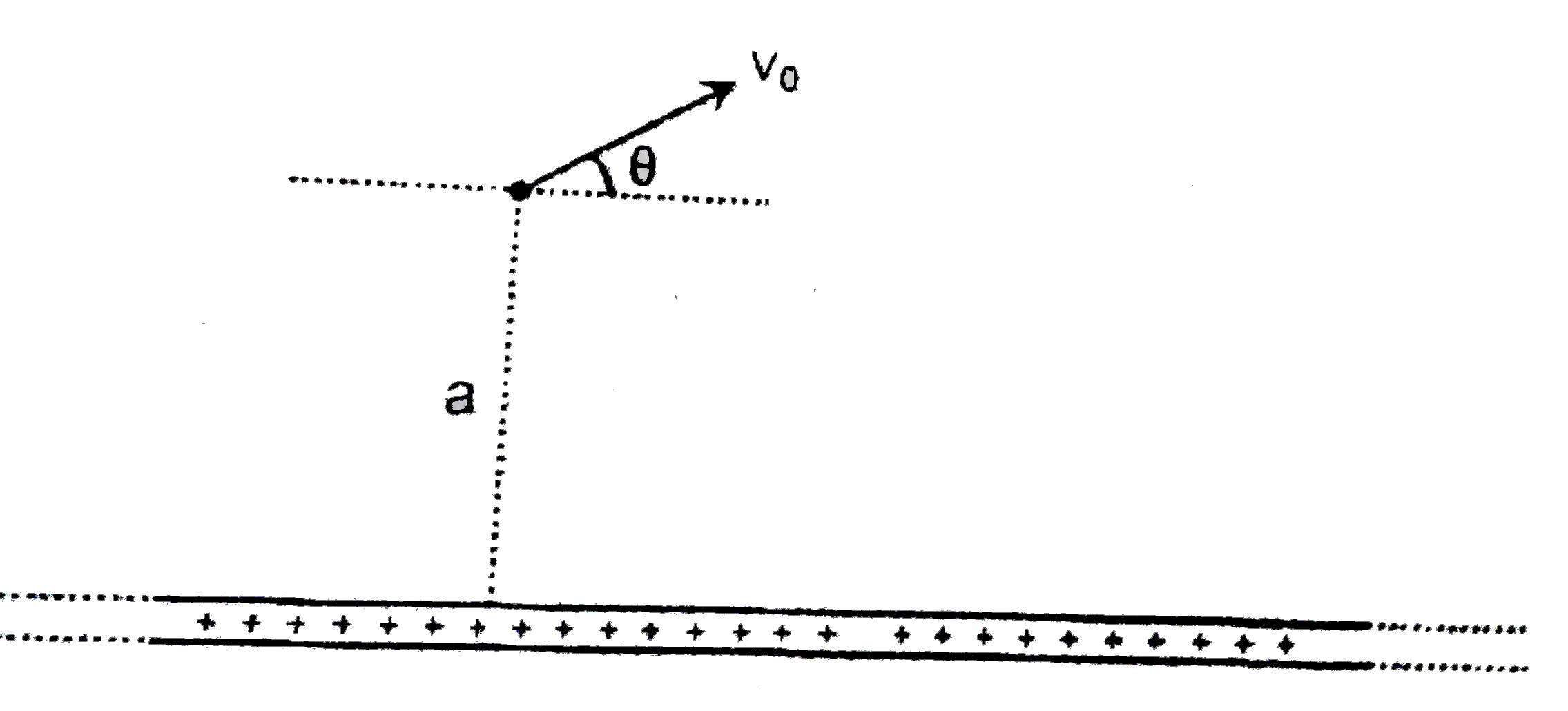
There is an infinite line of uniform linear density of charge `+lamda`. A particle of charge `-q` & mass `m` is projected with initial velocity `v_(0)` at an angle `theta` with the line of charge from a distance `a` from it. The point charge moves in plane containing line charge and point of projection The speed of the particle of found to be minimum when it's distance from the line of charge is `ae^((npimepsilon_(0)^(2)//qlamda))`. The value of n is (ingnore gravity)

Text Solution

Verified by Experts

The correct Answer is:

1

`a_(y)=(qlamda)/(2piepsilon_(0)my)impliesV_(y)(dv_(y))/(dy)=(-qlamda)/(2piepsilon_(0)my)`
`implies int_(v_(0)sintheta)^(0)v_(y)dv_(y)=(-qlamda)/(2piepsilon_(0)m_(0))int_(a)^(y) (dy)/y`
`=y_(max)=ae^((pimepsilon_(0)v_(0)^(2)sin^(2)theta//q_(lamda))`
Promotional Banner

Similar Questions

Explore conceptually related problems

There is an infinite line of uniform linear density of charge +lamda . A particle of charge -q & mass m is projected with initial velocity v_(0) at an angle theta with the line of charge from a distance a from it. The point charge moves in plane containing line charge and point of projection The speed of the particle of found to be minimum when it's distance from the line of charge is ae^((npimepsi_(0)^(2)0//qlamda)) . The value of n is (ingnore gravity)

A particle of charge q is projected from point P with velocity v as shown. Choose the correct statement from the following.

A positive point charge is released from rest at a distance r _ 0 from a positive line charge with uniform density. The speed (v) of the point charge, as a function of instantaneous distance r from line charge, is proportional to:

A particle is projected from the ground with an initial speed of v at an angle theta with horizontal. The average velocity of the particle between its point of projection and highest point of trajectroy is :

An infinite line cahrge is perpendicular to the plane of the figure having linear charge density lamda , A partcle having charge Q and mass m is projected in the field of the line cahrge fromo point P. the point P is at a distance R from the line cahrge and velocity given tot he particle is perpendicular tot he radial line at P (see figure) (i). Find the speed of the particle when its distance from the line cahrge grows the etaR(eta gt 1) (ii). Find the velocity component of the particle along the radial line (joining the line charge to the particle) at the instant its distance becomes etaR .

Consider an infinite line charge having uniform linear charge density and passing through the axis of a cylinder is removed.

A charged particle having charge 2q and mass m is projected from origin in X-Y plane with a velocity v inclined at an angle of 45^@ with positive X-axis in a region where a uniform magnetic field B unit exists along +z axis. The coordinates of the centre of the circular path of the particle are

In the figure shown there is a large sheet of charge of uniform surface charge density 'sigma' .A charge particle of charge '-q' and mass 'm' is projected from a point A on the sheet with a speed 'u' with the angle of projection such that it lands at maximum distance from A on the sheet. Neglecting gravity, find the time flight
