Home
Class 12
PHYSICS
Which of the following option correctly ...

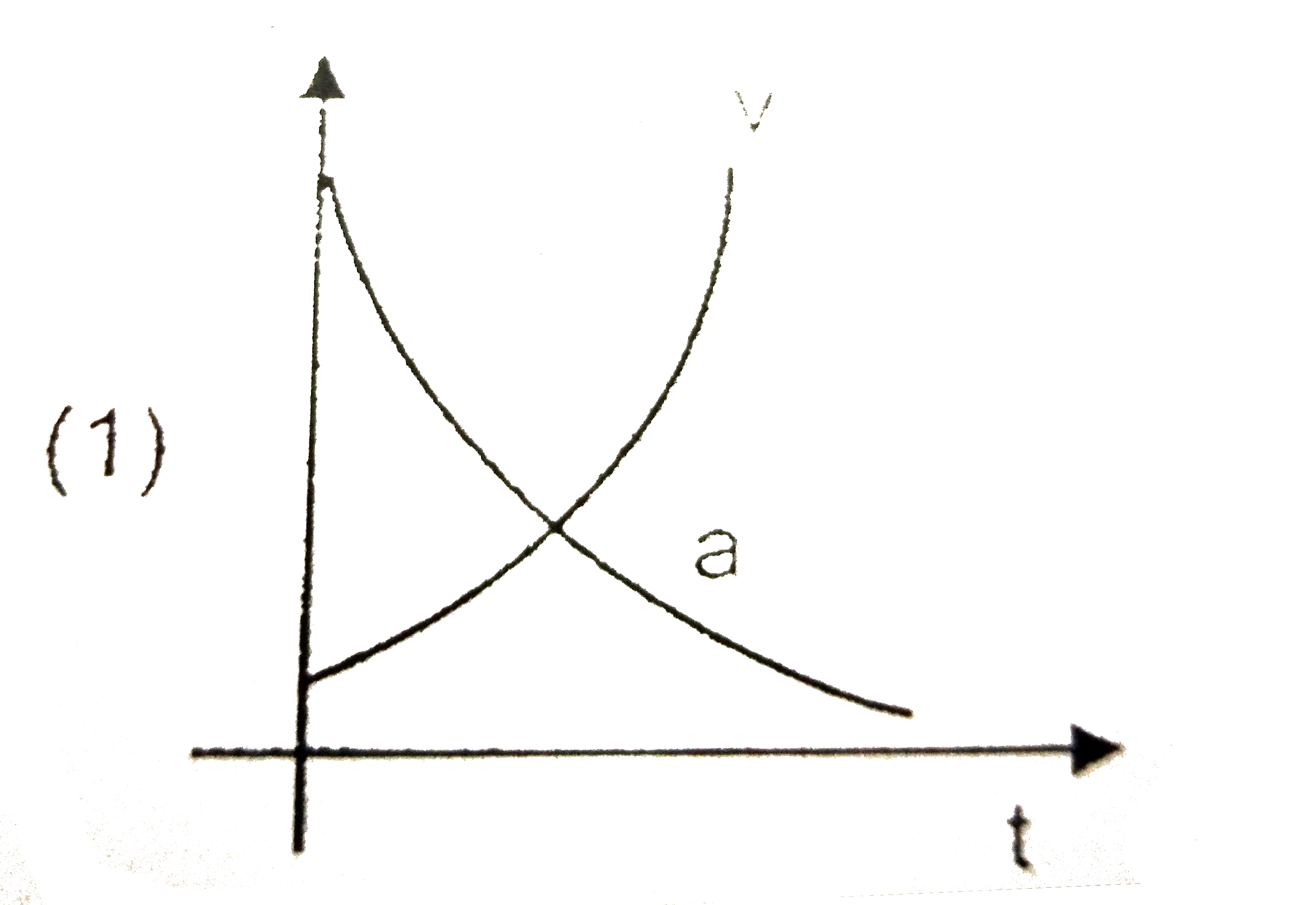
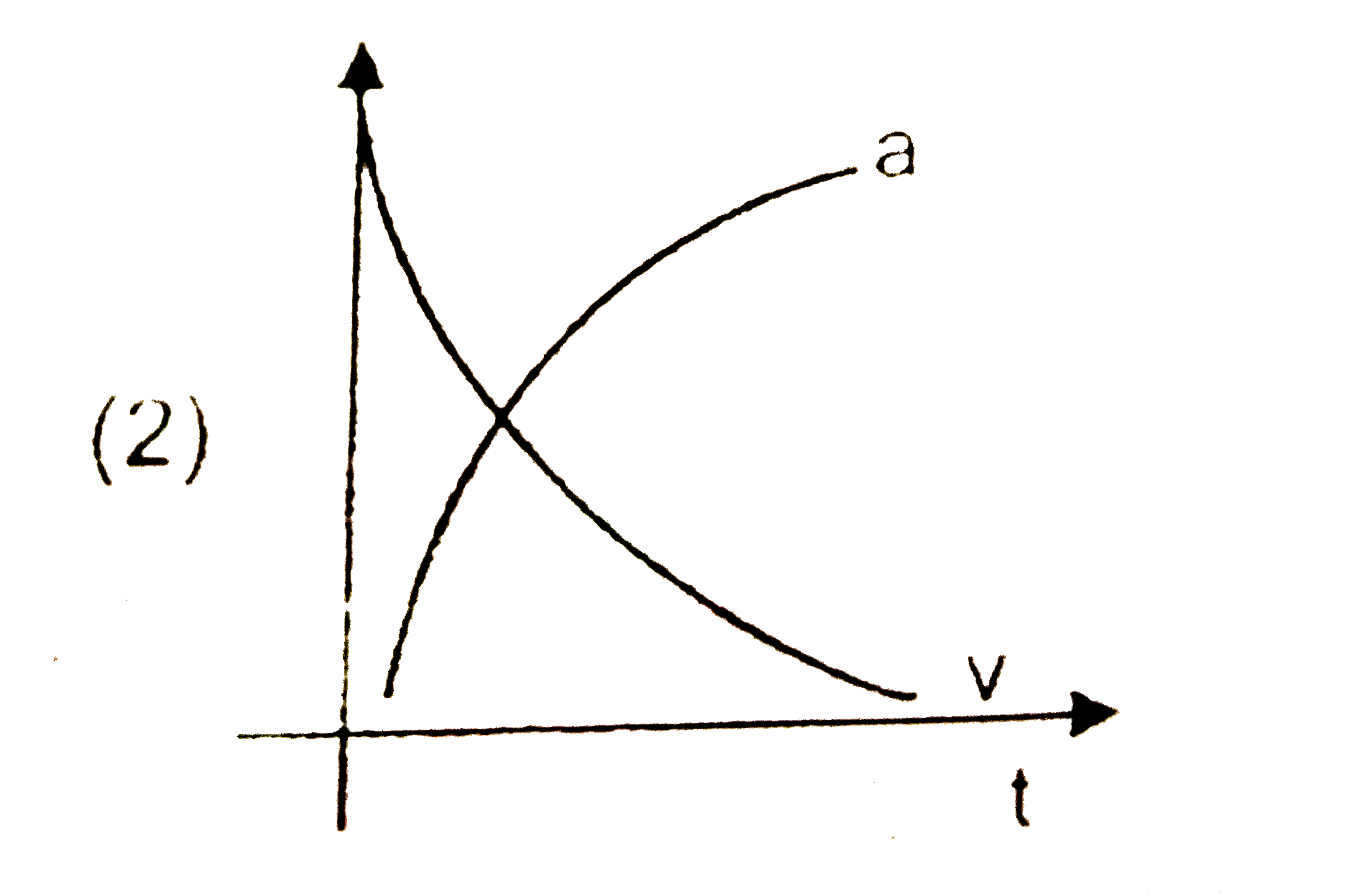
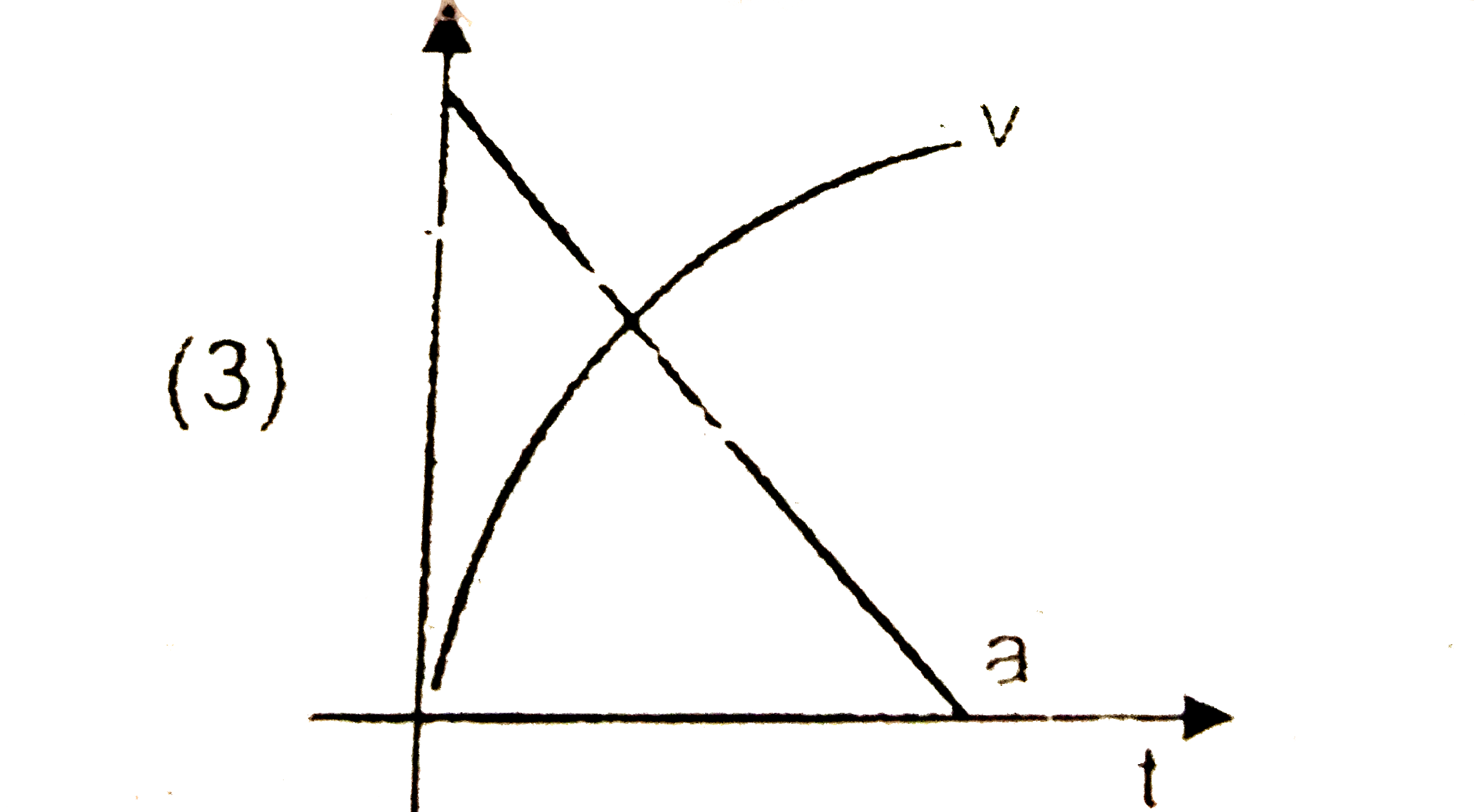
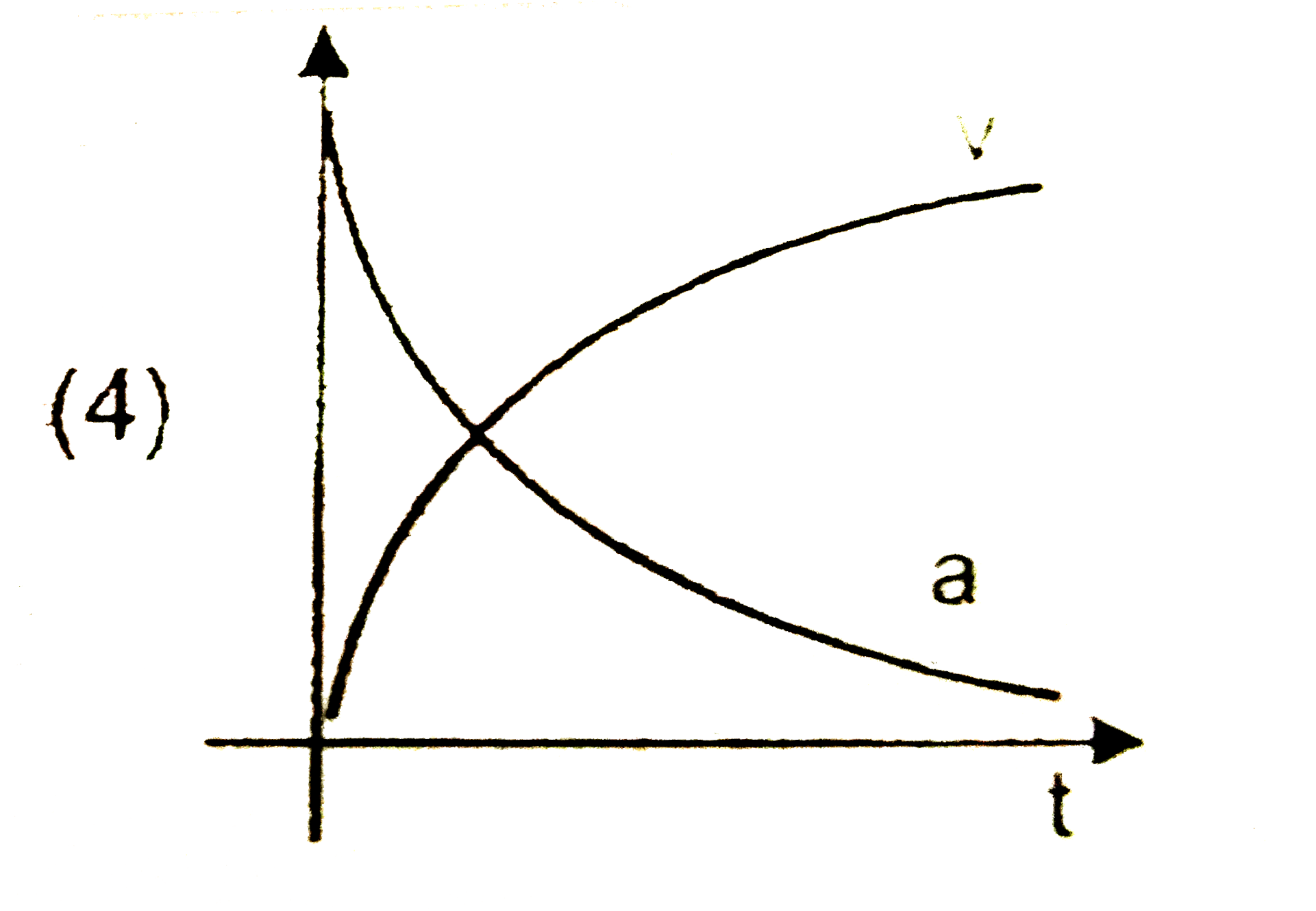
Which of the following option correctly describes the variation of the speed ` ` and acceleration `'a'` of a point mass falling vertically in a viscous medium that applies a force `F=-kv`, where `'k'` is constant, on the body?
(Graphs are schematic and drawn to scale)

A

B

C

D

Text Solution

AI Generated Solution

The correct Answer is:

To solve the problem of determining the variation of speed \( v \) and acceleration \( a \) of a point mass falling vertically in a viscous medium, we can follow these steps: ### Step 1: Understand the Forces Acting on the Mass The forces acting on the mass are: - The gravitational force \( F_g = mg \) acting downwards. - The viscous drag force \( F_d = -kv \) acting upwards. ### Step 2: Write the Equation of Motion Using Newton's second law, we can set up the equation of motion: \[ ma = mg - kv \] Rearranging gives: \[ ma = mg - kv \implies a = g - \frac{k}{m}v \] ### Step 3: Identify Terminal Velocity At terminal velocity \( v_t \), the acceleration \( a \) becomes zero: \[ 0 = g - \frac{k}{m}v_t \implies v_t = \frac{mg}{k} \] ### Step 4: Express Acceleration in Terms of Velocity From the equation \( a = g - \frac{k}{m}v \), we can see that as \( v \) approaches \( v_t \), the acceleration \( a \) approaches zero. ### Step 5: Analyze the Behavior of Velocity Over Time To find how velocity changes with time, we can rearrange the equation: \[ \frac{dv}{dt} = g - \frac{k}{m}v \] This is a first-order linear differential equation. Solving this will show that velocity increases towards \( v_t \) exponentially. ### Step 6: Solve the Differential Equation Separating variables and integrating: \[ \int \frac{1}{g - \frac{k}{m}v} dv = \int dt \] This leads to: \[ t = -\frac{m}{k} \ln\left( \frac{g - \frac{k}{m}v}{g} \right) \] From this, we can derive that: \[ v(t) = v_t \left(1 - e^{-\frac{k}{m}t}\right) \] This shows that velocity increases exponentially and approaches \( v_t \). ### Step 7: Determine the Behavior of Acceleration Since \( a = g - \frac{k}{m}v \) and \( v \) increases over time, \( a \) decreases over time and approaches zero as \( v \) approaches \( v_t \). ### Final Conclusion - The velocity \( v \) increases exponentially and approaches \( v_t \). - The acceleration \( a \) decreases exponentially and approaches zero.

To solve the problem of determining the variation of speed \( v \) and acceleration \( a \) of a point mass falling vertically in a viscous medium, we can follow these steps: ### Step 1: Understand the Forces Acting on the Mass The forces acting on the mass are: - The gravitational force \( F_g = mg \) acting downwards. - The viscous drag force \( F_d = -kv \) acting upwards. ### Step 2: Write the Equation of Motion ...
Promotional Banner

Similar Questions

Explore conceptually related problems

Which of the following optiona correctly describes the variation of the speed upsilon and acceleration a of a point mass falling vertically in a viscous medium that applies a force F=-KC where K is a constant on the body ? (graphs are schematic and not drawn to scale)

Which one of the following given graphs represents the variation of rate constant (k) with temperature (f) for an endothermic reaction ?

Which of the following graphs correctly shows variation between the restoring force I F I and distance from the mean position (x) of a particle performing linear S.H.M.?

From amongst the following curves, which one shows the variation of the velocity v with time t for a small sized spherical body falling vertically in a long column of a viscous liquid

In a uniform electric field, a point charge of mass m and charge q is released from rest. If there are no other forces acting on the particle, then which of the following graphs, correctly show the dependence of the particles speed v on the distance x travelled by the particles speed v on the distance x travelled by it? [Graphs are schematic and not drawn to scale]

An oil drop of mass m and falls through a medium that offers a viscous drag force. F. if the velocity of the drop is constant it means that

A particle of mass and charge is released from rest in a uniform electric field. If there is no other force on the particle, the dependence of its kinetic energy on the distance travelled by it is correctly given by (graphs are schematic and not drawn to scale)

For a simple pendulum, a graph is plotted between itskinetic energy (KE) and potential energy (PE) against its displacement d . Which one of the following represents these correctly? (graph are schematic and not drawn to scale)
